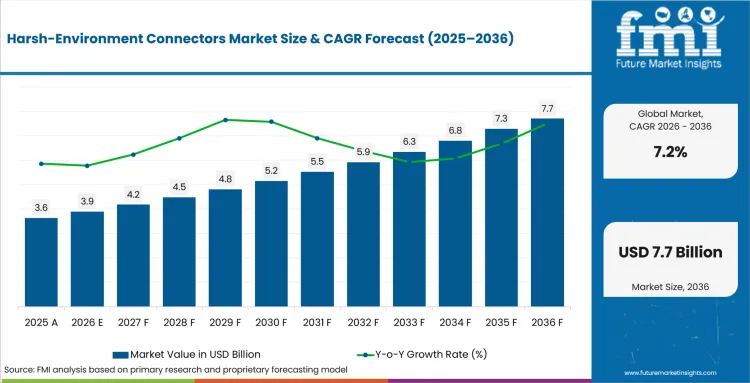
- Market Size (2026)
- USD 3.9 Bn
- Forecast (2036)
- USD 7.7 Bn
- CAGR (2026 to 2036)
- 7.2%
How big is Harsh-Environment Connectors Market in 2026?
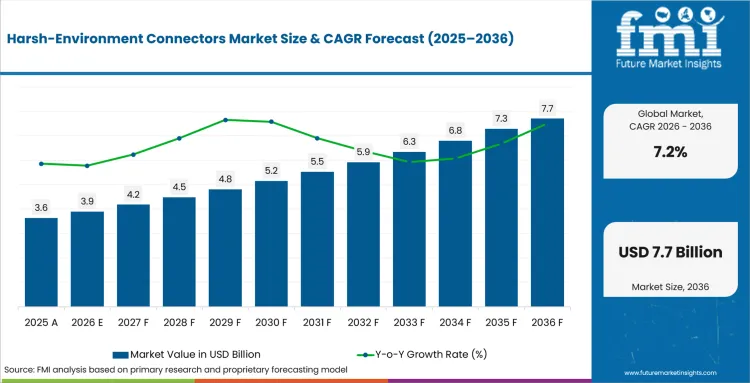
USD 3.9 billion in 2026 and USD 7.7 billion by 2036 at a 7.2% CAGR.
Demand for harsh-environment connectors is projected to expand at 7.2% CAGR between 2026 and 2036, increasing valuation from USD 3.9 billion in 2026 to USD 7.7 billion by 2036. New aircraft deliveries enlarge the installed platform base that requires qualified connector systems across production and later fleet support. GAMA reported in February 2026 that 2025 general aviation aircraft deliveries were valued at USD 35.7 billion worldwide. Each delivered aircraft adds installed aircraft cables that require support through scheduled maintenance and recurring equipment upgrades.
Long aircraft and defense programs favor approved aviation connectors as contact-system changes can reopen environmental testing and maintenance documentation. Rail and energy operators apply similar discipline to interfaces exposed to vibration and moisture throughout extended service intervals.
Key Takeaways
- Aerospace and defense programs generate recurring orders as qualified connector families remain embedded throughout long equipment service lives.
- Circular connectors are projected to represent 28.0% share in 2026 owing to familiar coupling choices and configurable contacts.
- IP67 / IP68 connectors are estimated to hold 24.0% by environment in 2026 through clearly documented sealing criteria.
- Aluminum shells are forecast to capture 42.0% share in 2026 due to established aerospace specifications and lower weight.
- Platform-specific revalidation slows substitution as connector changes can reopen tooling reviews and environmental testing across approved equipment programs.
- Amphenol and TE Connectivity compete with players such as Molex and ITT Cannon through qualified product breadth and regional application support.
Analyst Perspective
“Connector manufacturers protect recurring revenue by keeping qualified contact systems stable across aircraft upgrades and depot repairs. Commercial advantage favors companies that document sealing performance and replace damaged assemblies through local repair channels without reopening platform approval.”
– , Principal Consultant, Future Market Insights
How is the harsh-environment connectors market segmented?
The harsh-environment connectors industry is segmented by connector type, environment rating, material, end use, sales channel and region.
The market uses connector type, environment rating, material, end use, sales channel and region to separate design and purchasing requirements. Connector type covers circular, rectangular, D-sub or Micro-D, fiber optic, RF or coaxial and hybrid power-signal formats. Environment ratings cover sealing, vibration, temperature, corrosion, EMI and hazardous areas while materials include aluminum, stainless steel, composite and brass or copper-alloy shells. End uses span aerospace and defense, automation, oil and gas, rail, marine and renewable energy through direct OEM, distribution, integration and aftermarket or MRO channels.
Why do circular connectors lead demand within the connector type category?
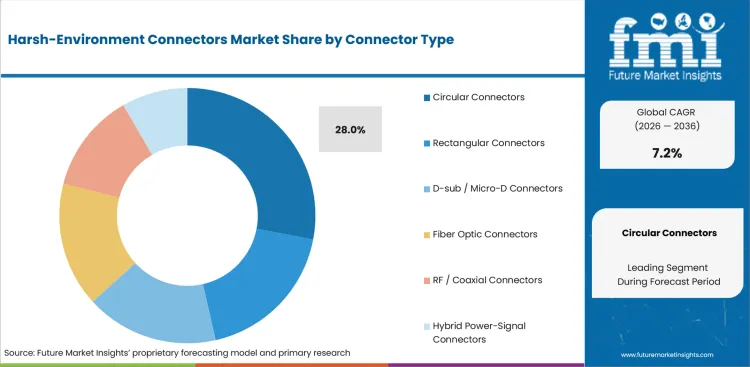
Circular connectors use threaded or bayonet interfaces that resist accidental separation across aircraft engines and rail vehicles exposed to continuous vibration. Standardized shell families also support removable contacts and serviceable backshells throughout lengthy qualification cycles for approved platforms.
- Based on connector type, circular connectors are projected to account for 28.0% in 2026 due to familiar coupling methods and broad contact configurations.
- Systems engineers favor electrical connector inserts that combine signal and power contacts inside serviceable shells for compact equipment layouts. Radiall introduced Fortero in February 2025 as a sealed MPO circular connector derived from a high-speed rail design for demanding defense environments.
How does IP67 / IP68 shape selection within the environment rating category?
IP67 / IP68 connectors protect interfaces from dust ingress and temporary water immersion across washdown equipment and exposed transportation controls. IEC published IEC 61076-8-112 in February 2025 with performance requirements and test methods for IP65 / IP67 power connectors.
- By environment rating, IP67 / IP68 connectors are estimated to hold 24.0% in 2026 owing to measurable ingress thresholds and familiar test documentation.
- Maintenance specialists select sealed housings for harsh-environment fiber optics that must preserve data integrity through repeated handling and outdoor service. Consistent ingress classifications give equipment designers a practical screening point for application-specific vibration and chemical testing.
How are aluminum shells positioned within the material category?
Aluminum shells reduce connector mass while preserving conductive shielding across airborne systems that cannot accept heavier stainless-steel housings during extended service. The material also supports machining routes that accommodate varied shell sizes and durable backshell interfaces.
- In 2026, aluminum shell connectors are expected to lead the material category with 42.0% share because established specifications support favorable strength-to-weight performance. Molex reported in April 2025 that aluminum alloys balance low weight with strong EMI shielding and machinability in aerospace connector housings.
- Platform engineers select aluminum housings around RF connectors to maintain shielding continuity without the mass penalty of stainless steel during maintenance and major equipment upgrades.
What makes aerospace and defense central to the end use category?
Defense program offices require connector records that remain traceable through equipment upgrades and field repairs. ITT Cannon’s January 2025 United States Army qualification for MKJ Warrior connectors documented the approval route for power and data links in soldier-worn communications equipment.
- The end use category is forecast to be led by aerospace and defense at 31.0% share in 2026 due to strict documentation and platform-specific testing.
- Program offices integrate wire harnesses with approved contact systems to simplify replacement planning across depot repairs and scheduled modernization programs. Stable configuration records reduce the risk that replacement connectors force wider system testing during future upgrades.
What are the drivers, restraints and opportunities in the harsh-environment connectors market?
Qualification records sustain repeat orders while platform revalidation slows substitution and regional repair support improves integrated assembly adoption.
- Driver: Current qualification records direct repeat aerospace and defense orders toward connector families with verified environmental performance.
- Restraint: Platform-specific revalidation raises conversion costs across installed equipment with long maintenance and certification cycles.
- Opportunity: Integrated assemblies and regional repair support reduce installation risk across dispersed fleets and remote industrial assets.
Military and aerospace programs screen connector families through current qualification records during major repeat-order reviews. The DLA’s July 2026 MIL-DTL-38999 listing provides an active approval route for environment-resistant circular connectors and cable assemblies.
Platform owners compare mating geometry and crimp tooling during proposed connector-family replacements across installed equipment. Requalification can preserve incumbent positions despite stronger electrical performance from a competing connector design across approved platforms.
Manufacturers package connectors with terminated cables and backshells inside one supported configuration for easier field replacement. Installation teams use aerospace conduit systems and regional repair routes to protect terminations across dispersed fleets and remote industrial assets.
Which country CAGRs are profiled in the harsh-environment connectors market?
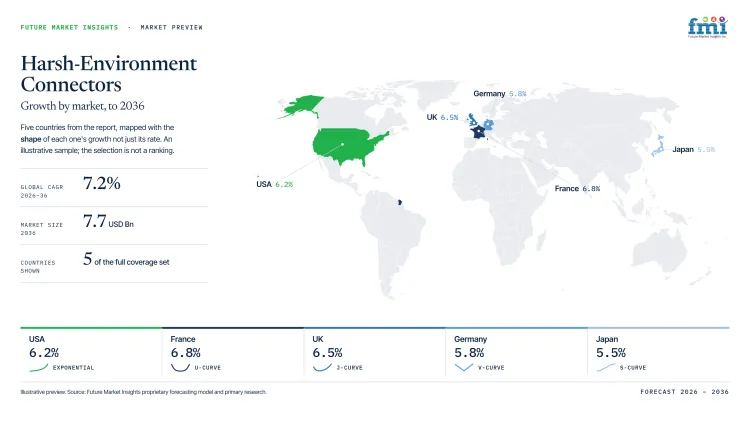
| Country | CAGR |
|---|---|
| United States | 6.2% |
| Germany | 5.8% |
| Japan | 5.5% |
| France | 6.8% |
| United Kingdom | 6.5% |
How do country-level CAGRs compare in the harsh-environment connectors market?
The spread reaches 1.3 percentage points between France at 6.8% CAGR and Japan at 5.5% CAGR. Relative spacing reflects qualification routes and service-network depth rather than differences in current market size alone.
- France’s rate exceeds the United Kingdom by 0.3 percentage point as specialized aerospace engineering supports interconnect qualification.
- The United Kingdom exceeds the United States by 0.3 percentage point through backlogs and established maintenance capability.
- The United States exceeds Germany by 0.4 percentage point as naval investment supports new qualification work.
- Germany exceeds Japan by 0.3 percentage point as labor shortages regionally slow customized assembly deliveries.
- Japan’s rate reflects disciplined validation and slower line-specific approval across domestic manufacturing and maintenance programs.
Comparable CAGRs can produce different market entry conditions. The full report provides country-level CAGR analysis across North America, Latin America, Europe, East Asia, South Asia and Pacific, and the Middle East and Africa.
Country-wise Analysis
- United States naval and aerospace programs rely on domestically qualified interconnect systems and authorized technical support across major shipbuilding programs and long depot-maintenance cycles for controlled military platforms. The Navy linked fleet expansion to a USD 65.8 billion fiscal 2027 shipbuilding request in May 2026. Harsh-environment connector sales in the United States are forecast to expand at 6.2% CAGR by 2036 due to new platform work and accessible military qualification routes. Lengthy approvals remain a material friction as alternate connector families require renewed environmental testing and tooling reviews under existing configuration records for controlled production and depot maintenance across regional depots.
- German aerospace manufacturers use detailed engineering approvals and traceable component records across civil and defense programs supported by specialist distributors and regional repair capability for long-term maintenance contracts. Germany’s harsh-environment connector outlook is anticipated to advance at 5.8% CAGR over the assessment period supported by continuing aerospace production ramp-up for qualified connector assemblies. BDLI’s May 2026 industry data recorded a 19% increase in 2025 aerospace revenue as manufacturers expanded output and employment. Fragile supply chains and skilled-worker shortages remain material frictions that can delay customized assembly qualification and reduce delivery confidence across scheduled production increases at regional production sites during peak periods.
- Japanese aerospace and rail manufacturers emphasize consistent quality records and domestic coordination across component validation and long-term maintenance planning supported by experienced integrators and disciplined production systems. The Society of Japanese Aerospace Companies published May 2026 trade data showing 2025 aerospace exports reached 113.6% of the prior-year level across aircraft and space programs. Harsh-environment connector demand in Japan is forecast to rise at 5.5% CAGR over the forecast period owing to controlled production growth and dependable domestic engineering support. Line-specific validation and service distance remain material frictions that complicate crimping and shielding procedures across dispersed sites and factories during extended equipment lifecycles and scheduled maintenance programs.
- French aerospace clusters combine aircraft production with defense electronics and specialized interconnect engineering supported by dense distributor and maintenance networks across established regional manufacturing sites and extended aircraft support programs. The French harsh-environment connector sector is projected to record 6.8% CAGR during the assessment period driven by sustained civil and defense activity across qualified platform programs. GIFAS stated in May 2026 that 2025 aerospace revenue increased 11.9% as manufacturers continued industrial ramp-up. Technical hiring constraints remain a material friction that can lengthen testing queues and customized cable-assembly deliveries across regional production clusters during planned output increases and maintenance schedules at regional depots.
- United Kingdom aerospace programs combine long aircraft backlogs with established design engineering and experienced MRO providers across civil and defense supply chains supporting extended production and fleet maintenance cycles. ADS Group’s February 2026 delivery review placed the commercial aircraft backlog at 16,371 units and more than thirteen years of work for the United Kingdom aerospace sector. Adoption of harsh-environment connectors in the United Kingdom is estimated to expand at 6.5% CAGR through 2036 attributable to sustained production schedules and established maintenance capability. Supply-chain pressure remains a material friction as approved component availability can tighten during production ramp-ups and unexpected maintenance demand across dispersed fleets.
Who are the notable companies in the harsh-environment connectors market?
Amphenol, TE Connectivity, Molex, ITT Cannon, Smiths Interconnect, a Molex company, Souriau-Sunbank by Eaton, Radiall, Hirose Electric and Glenair serve this market.
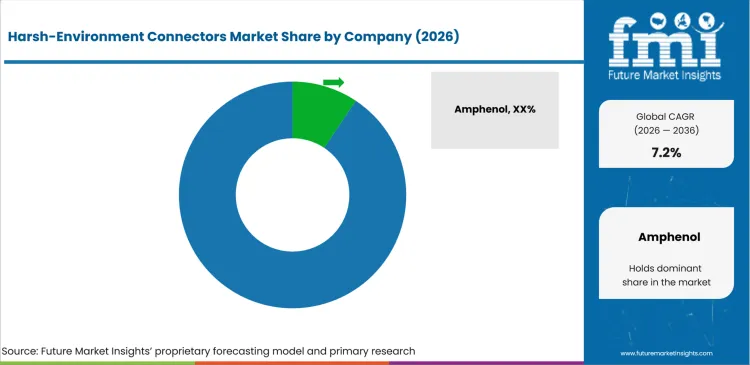
The industry is moderately concentrated around interconnect groups, while specialists retain niches and entry into rugged terminal systems requires qualified specifications plus regional engineering support.
- Amphenol and TE Connectivity compete through military circular portfolios and regional engineering support for demanding platform specifications.
- Molex and ITT Cannon combine rugged connectors with high-speed contacts while Smiths Interconnect adds precision RF capabilities.
- Souriau-Sunbank by Eaton and Radiall address qualified circular applications alongside alternatives from Hirose Electric and Glenair.
Competitive Benchmarking: Harsh-Environment Connectors Market
| Company | Qualification Breadth | Environmental Sealing | Platform Traceability | Geographic Reach |
|---|---|---|---|---|
| Amphenol | High | High | High | Global |
| TE Connectivity | High | High | High | Global |
| Molex | High | High | Medium | Global |
| ITT Cannon | Medium | High | High | Global |
| Smiths Interconnect, a Molex company | Medium | Medium | Medium | Global |
| Souriau-Sunbank by Eaton | High | High | High | Global |
| Radiall | Medium | High | Medium | Global |
| Glenair | High | High | High | North America, Europe and Asia |
Scoring basis: Qualification breadth is High for three rugged families, Medium for two and Low for one verified family. Environmental sealing and platform traceability apply those thresholds to verified sealing classes and documented support routes. Geographic reach lists operating regions while company records support ratings and missing evidence receives no score.
Key Developments in the Harsh-Environment Connectors Market
- In July 2026, ITT completed its acquisition of Aerospace Contacts and strengthened supply for custom high-reliability contacts and shells used in harsh-environment connector programs.
- In June 2026, Molex expanded the AirBorn SInergy platform with high-power modules that combine power and data and RF contacts for harsh aerospace and defense systems.
- In April 2026, Molex completed its acquisition of Smiths Interconnect and expanded rugged connector capabilities across RF and optical technologies within 90 plants in 22 countries.
- In June 2025, TE Connectivity launched the MULTIGIG transceiver platform for modular high-speed fiber transmission across rugged aerospace and defense systems.
Harsh-Environment Connectors Market – Report Scope
| Coverage field | Report scope |
|---|---|
| Market breakdown | By connector type, environment rating, material, end use, sales channel and region. |
| Quantitative Units | USD billion. |
| Market Definition | The market covers revenue from harsh-environment connector products and assemblies supplied for applications requiring documented environmental performance. |
| Regions Covered | North America, Latin America, Europe, East Asia, South Asia and Pacific and Middle East and Africa. |
| Countries Covered | United States, Germany, Japan, France, United Kingdom and 20+ countries included in the full report. |
| Key Companies Profiled | Amphenol, TE Connectivity, Molex, ITT Cannon, Smiths Interconnect, a Molex company, Souriau-Sunbank by Eaton, Radiall, Hirose Electric and Glenair. |
| Forecast Period | 2026 to 2036. |
| Approach | Primary and secondary research with market triangulation. |
Harsh-Environment Connectors Market – Research Methodology
| Method | Approach |
|---|---|
| Primary Research | FMI analysts gathered input from manufacturers, service providers, technology developers, distributors, end users, procurement teams, and subject-matter experts. Interviews examined purchasing decisions, product or service evaluation, adoption barriers, approval requirements, pricing considerations, and expectations for technical or commercial support. Respondents were also asked what evidence is required before a trial, pilot, or initial order develops into regular purchasing. |
| Desk Research | Desk research covered government statistics, regulatory publications, trade data, industry associations, technical literature, standards, company filings, product information, and official corporate announcements. Sources were reviewed for relevance, publication date, geographic coverage, and consistency with the defined market scope. Claims relating to performance, applications, approvals, capacity, investment, and commercial activity were retained only when supported by credible public evidence. |
| Market Sizing and Forecasting | The market model combined the baseline value with historical performance, segment structure, pricing and volume indicators, adoption levels, company participation, and country-level demand conditions. Forecast assumptions considered economic activity, investment trends, regulatory developments, technology adoption, purchasing cycles, supply availability, and barriers to wider market use. Segment and regional estimates were reconciled before the final market total was calculated. |
| Data Validation | Estimates were checked against multiple independent indicators, including public data, company activity, trade patterns, industry developments, and findings from primary interviews. Validation also tested whether products, services, applications, and company revenues fell within the defined market boundaries. Adjacent categories, unsupported claims, overlapping revenues, and activities without direct market relevance were excluded to reduce double counting and maintain consistency across segments and countries. |
Harsh-Environment Connectors Market by Segments
Harsh-Environment Connectors Market segmented by Connector Type:
- Circular Connectors
- Rectangular Connectors
- D-sub / Micro-D Connectors
- Fiber Optic Connectors
- RF / Coaxial Connectors
- Hybrid Power-Signal Connectors
Harsh-Environment Connectors Market segmented by Environment Rating:
- IP67 / IP68
- High Vibration
- High Temperature
- Corrosion Resistant
- EMI Shielded
- Explosion-proof / Hazardous Area
Harsh-Environment Connectors Market segmented by Material:
- Aluminum Shell
- Stainless Steel Shell
- Composite Shell
- Brass / Copper Alloy Shell
Harsh-Environment Connectors Market segmented by End Use:
- Aerospace & Defense
- Industrial Automation
- Oil & Gas
- Rail & Transportation
- Marine
- Renewable Energy
Harsh-Environment Connectors Market segmented by Sales Channel:
- Direct OEM
- Authorized Distributors
- System Integrators
- Aftermarket / MRO
Harsh-Environment Connectors Market by Region:
- North America
- Latin America
- Brazil
- Mexico
- Argentina
- Chile
- Western Europe
- Germany
- France
- United Kingdom
- Italy
- Spain
- Benelux
- Nordics
- Eastern Europe
- Poland
- Czech Republic
- Romania
- Hungary
- East Asia
- South Asia and Pacific
- India
- ASEAN
- Australia and New Zealand
- Middle East and Africa
- GCC Countries
- South Africa
- Türkiye
- Israel
Research Sources and Bibliography
- General Aviation Manufacturers Association. (2026, February 18). GAMA Releases 2025 Aircraft Shipment and Billing Report.
- Defense Logistics Agency Land and Maritime. (2026, July 20). MIL-DTL-38999 qualification information.
- Molex. (2025, April 1). Molex releases new report on strategies for advancing rugged, reliable connectivity in modern aerospace and defense applications.
- Molex. (2026, June 15). Molex expands award-winning AirBorn SInergy modular high-speed hybrid connectors with new high-power modules for all-in-one connectivity.
- ITT Inc. (2025, January 14). ITT Cannon connectors receive USA Army qualification on Nett Warrior program.
- USA Department of the Navy. (2026, May 11). Department of the Navy releases fiscal year 2027 shipbuilding plan.
- German Aerospace Industries Association. (2026, May 27). BDLI Industry Data 2026: Aerospace industry sets new records for revenue and employment.
- Society of Japanese Aerospace Companies. (2026, May 14).[Trade statistics, January-December 2025].
- GIFAS. (2026, May 11). 2025 results: The French aerospace industry remains strongly positioned for the future.
- ADS Group. (2026, February 3). 2025 global aircraft deliveries at highest peak in seven years.
- ITT Inc. (2026, July 6). ITT completes acquisition of Aerospace Contacts LLC.
- Molex. (2026, April 1). Molex completes acquisition of Smiths Interconnect, expanding portfolio of high-reliability connectivity solutions.
- Radiall. (2025, February 18). Introducing a new MPO circular connector for demanding applications.
- International Electrotechnical Commission. (2025, February 6). IEC 61076-8-112:2025: Connectors for electrical and electronic equipment – Product requirements – Part 8-112: Power connectors – Detail specification for 2-pole snap locking rectangular connectors with IP65/IP67 plastic housing for rated current of 50 A.
- TE Connectivity. (2025, June 18). TE Connectivity unveils MULTIGIG Transceiver platform for improved data transmission.
- Eaton Corporation plc. (2026, February 26). 2025 annual report on Form 10-K: Exhibit 21, subsidiaries of Eaton Corporation plc.
- Amphenol. (2025, April 15). Now available: 6-pin AT circular connector built for extreme conditions.
- Glenair. (2025, January). Industrial-strength interconnect solutions.
- Hirose Electric Co., Ltd. (2025, June 17). Releases new waterproof version of IEC-compliant ix Industrial™ connector.
This bibliography is provided for reader reference and is not exhaustive. The full report contains the complete reference list and detailed citations
This Report Answers
- How large is the harsh-environment connectors market in 2026 and 2036?
- Which operating conditions support demand for harsh-environment connectors across critical applications?
- Which connector type is projected to account for the largest 2026 share?
- How do environment ratings influence commercial selection across exposed equipment programs?
- Which end-use category shapes qualification and replacement activity through 2036?
- How do profiled country growth rates differ across major aerospace markets?
- Which companies serve the harsh-environment connectors market through qualified portfolios?
- What currently limits connector substitution across long equipment service programs?
- How should engineers compare connector materials and termination support requirements?
Frequently Asked Questions
What is driving growth in the harsh-environment connectors market?
Qualification rules sustain orders for connector families that resist vibration and moisture throughout long aircraft and defense platform service lives.
Who are the key players in the harsh-environment connectors market?
Amphenol, TE Connectivity, Molex and ITT Cannon provide broad qualified portfolios while specialist brands support narrower sealing and engineering requirements.
What is a notable restraint in the harsh-environment connectors market?
Platform-specific revalidation delays substitution by requiring fresh environmental tests and renewed tooling reviews for alternate connectors across installed equipment programs.
Why should executives track the harsh-environment connectors market?
Connector choices influence recurring maintenance revenue throughout long aircraft and defense programs, so executives should track qualification access and regional repair coverage.
What business problem does the harsh-environment connectors market address?
Harsh-environment connectors maintain power and data continuity through vibration, moisture and temperature stress while supporting controlled replacement across exposed equipment.
What should engineering decision-makers evaluate in the harsh-environment connectors market?
Engineering teams should compare qualification status and sealing performance with contact density, termination methods and regional repair support during final selection.
What limits return on investment in the harsh-environment connectors market?
Long validation cycles delay revenue conversion, while limited local repair capacity raises service costs across dispersed fleets and remote industrial sites.
What supports long-term confidence in the harsh-environment connectors market?
Stable contact availability and documented change control support consistent replacements across platform upgrades, scheduled maintenance programs and depot repair activities.
Preview the report firsthand – request a free sample
Get the brochure for pricing and purchase details.