










[
Ancient Eggshell Engravings Reveal 60,000-Year-Old Roots of Human Pattern Thinking
BOLOGNA, ITALY – August 9, 2026 – What if the fundamental cognitive skills students acquire in modern classrooms – pattern recognition, spatial reasoning, and organized information processing – were already ingrained in human thought tens of thousands of years before the advent of formal education? A groundbreaking new study of ancient ostrich eggshell fragments from southern Africa suggests just that, offering a fascinating glimpse into the deep roots of human cognitive development.
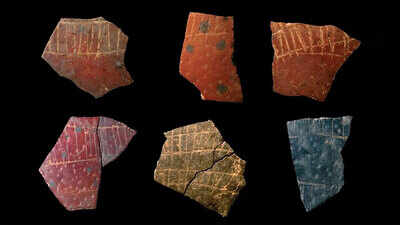
The research, conducted by scientists at the University of Bologna and published in PLOS One, challenges previous assumptions by revealing that engravings on 60,000-year-old ostrich eggshells were not merely random marks or spontaneous artistry. Instead, they demonstrate a sophisticated level of organization, adhering to recurring geometric principles. This insight, as reported by ScienceDaily, proposes that Homo sapiens were employing systematic thinking processes far earlier than commonly understood.
Long before any form of written language or formal schooling, our ancient ancestors were meticulously decorating ostrich eggshells with lines and geometric designs. The study’s findings indicate that these markings were far from arbitrary. Researchers observed a consistent application of principles such as parallel lines, right-angle relationships, and the repetition of specific patterns, suggesting an underlying cognitive framework.
Beyond Random Scratches: A Glimpse into Early Cognitive Abilities
To arrive at these conclusions, researchers from the University of Bologna meticulously examined 112 engraved ostrich eggshell fragments. These invaluable artifacts were recovered from three significant archaeological sites: Diepkloof and Klipdrift in South Africa, and Apollo 11 in Namibia. Utilizing advanced geometric and statistical techniques, the team analyzed the direction, angles, and paths of the engraved lines.
The results were compelling. Over 80% of the analyzed configurations exhibited consistent spatial patterns. This included not only repeated groups of parallel lines but also angles frequently approximating 90 degrees. More intricate designs showcased hatched bands, grids, and diamond-shaped motifs, indicating a diverse yet structured approach to decoration. Furthermore, the study identified evidence of cognitive operations such as rotation, repetition, translation, and what the researchers termed “embedding” – the creation of different layers of signs or patterns on the same surface. This suggests that the ancient artisans were not simply making marks; they were following a set of discernible rules.
Visuo-Spatial Planning: The Foundation of Modern Learning
For educators and students alike, this discovery offers a profound perspective. Pattern recognition is a cornerstone of modern education, integral to understanding mathematics, developing algorithms in computer science, and identifying relationships in scientific disciplines. These ancient engravings, however, push the timeline for this fundamental human ability back by tens of millennia, indicating that the capacity to organize shapes and discern visual relationships predates any formal pedagogical system.
The researchers characterize this capability as visuo-spatial planning – the cognitive ability to arrange forms within space and, crucially, to conceptualize an overall image before its physical creation. This doesn’t imply that ancient humans were engaged in formal geometry lessons akin to today’s curriculum. There is no evidence of textbooks or structured mathematical instruction. Instead, the findings point to something far more elemental: an intrinsic human capacity to identify patterns, apply rules, and transform simple forms into organized, systematic designs. This represents a significant stride in our understanding of emerging abstract thought and human cognitive evolution.
From Ancient Eggshells to Contemporary Classrooms: A Shared Human Trait
While the precise meaning or purpose of these ancient engravings remains a subject of ongoing research – the ostrich eggshells likely served as containers for water – the cognitive ability demonstrated in their creation is undeniably significant. The systematic arrangement of shapes and lines, governed by consistent rules, is posited as a crucial indicator of abstract thought, a pivotal development in human cognition.
These fragmented eggshells are therefore far more than mere archaeological curiosities. They forge an unexpected link between our distant past and our present. Consider a student today, solving a geometry problem by drawing a line, rotating a shape, or searching for a repeating pattern. Sixty thousand years ago, a human in southern Africa was engaged in an astonishingly similar cognitive process, not in a classroom, but on the curved surface of an eggshell. The tools and educational environments have evolved dramatically, but the fundamental human instinct to observe, recognize patterns, and make sense of the intricate world around us appears to be an enduring trait, far older and more deeply embedded than we may have ever imagined.
Disclaimer:This article is based on information and research published by the University of Bologna and reported by ScienceDaily.