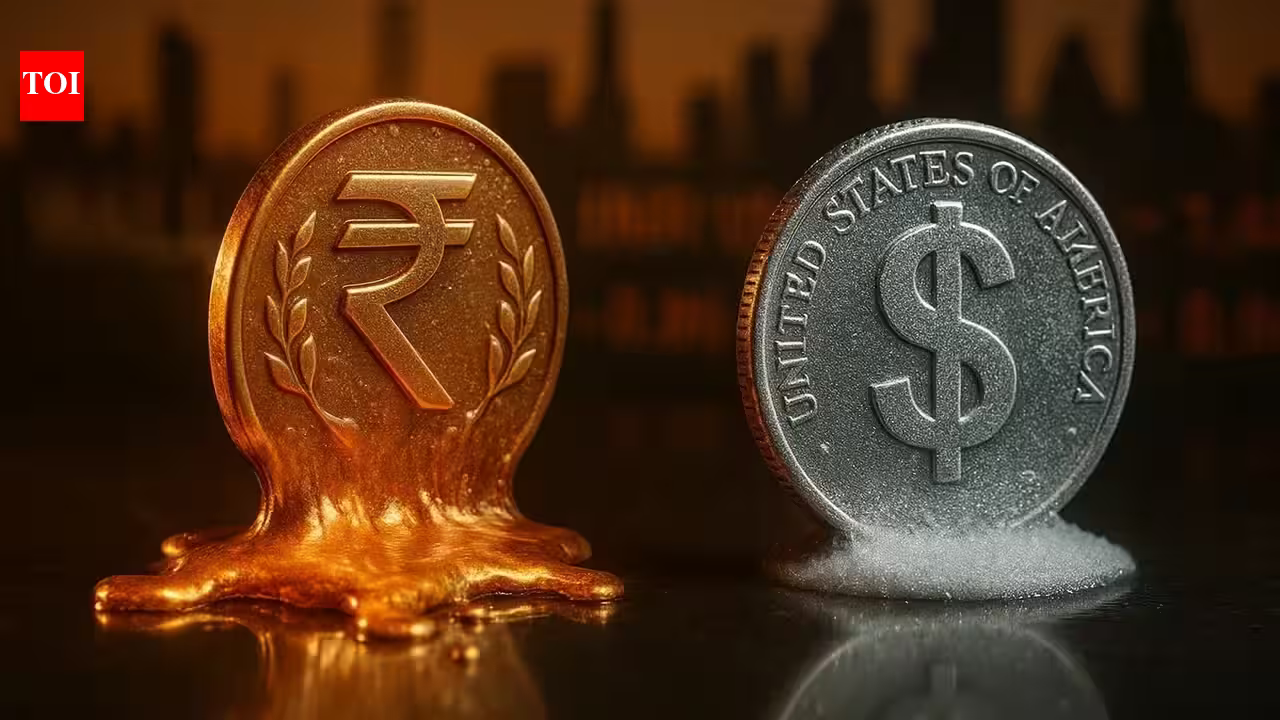










Rupee Opens Lower Amidst Global Pressures, Resilient Due to FII Inflows and Surging Forex Reserves
Mumbai, India – The Indian Rupee commenced the trading week on a subdued note, registering an 8-paise depreciation against the robust US dollar to reach 95.25 in early interbank foreign exchange transactions. The initial downturn is primarily attributed to a strengthening greenback and the persistent upward trajectory of global crude oil prices, further exacerbated by geopolitical tensions in the Middle East.
Despite these external pressures, the rupee’s fall was notably contained by significant foreign institutional investor (FII) inflows into Indian markets and the country’s impressive growth in foreign exchange reserves, as highlighted by forex traders. This underlying strength underscores the resilience of the Indian economy amidst turbulent global financial currents.
On Monday, the domestic currency initiated its session at 95.18 against the US dollar before gradually weakening to 95.25. This compares to its closing position last week, where it had edged 5 paise higher to settle at 95.17 against the American currency, indicating a minor reversal of fortunes at the week’s outset.
Global Factors Weighing on the Rupee
The US dollar index, a key gauge of the greenback’s value against a basket of six major currencies, saw an uptick of 0.17 percent, reaching 99.70. A stronger dollar typically exerts downward pressure on emerging market currencies like the rupee. Concurrently, Brent crude futures, a global benchmark for oil prices, advanced by 0.91 percent, trading at USD 84.31 per barrel. Rising crude oil prices are a significant concern for India, a major oil importer, as they inflate the import bill and can lead to inflationary pressures, further impacting the rupee’s value.
“Overall, USD/INR remained range-bound around 95.20-95.30, with the rupee ending the session (on Friday) marginally stronger. Strong forex reserves also provided confidence and limited dollar-demand pressure,” remarked Anil Kumar Bhansali, Head of Treasury and Executive Director, Finrex Treasury Advisors LLP.
Bhansali further elaborated that market participants will be keenly observing currency movements throughout Monday, with both exporters and importers expected to play a pivotal role in influencing trading levels. He projected that “Exporters may sell upticks up to 95.40 on Monday while importers are likely to buy dips at 95.” Traders are also advised to maintain a vigilant watch on developments emanating from West Asia, given their direct impact on global oil prices, as well as announcements from the Reserve Bank of India (RBI).
Support from Inflows and Reserves
Despite the initial depreciation, the rupee found substantial support from robust foreign institutional investor activity. Exchange data reveals that foreign institutional investors were net buyers of equities worth Rs 480.24 crore on Friday, injecting crucial foreign currency into the market and bolstering the rupee.
Domestically, however, equity markets opened marginally lower on Monday. The Sensex shed 19.38 points to trade at 78,479.79 in early trade, while the Nifty declined 5.10 points to 24,567.45. While a dip in local equity markets can sometimes impact currency sentiment, the positive FII flows provided a counterbalancing force.
A significant factor buttressing the rupee’s stability is the remarkable surge in India’s foreign exchange reserves. According to data released by the Reserve Bank of India (RBI) on Friday, the country’s foreign exchange reserves witnessed a substantial increase of $10.512 billion, reaching an impressive total of $692.866 billion in the week ending July 31.
This follows an increase of USD 6.118 billion in the preceding reporting week, where the overall reserves stood at $682.354 billion. The continuous accumulation of forex reserves provides a strong buffer against external shocks and enhances the RBI’s ability to intervene in the market if deemed necessary to manage currency volatility, thus instilling confidence in the rupee’s long-term outlook.
© [Current Year] [News Outlet Name/Author]. All rights reserved.