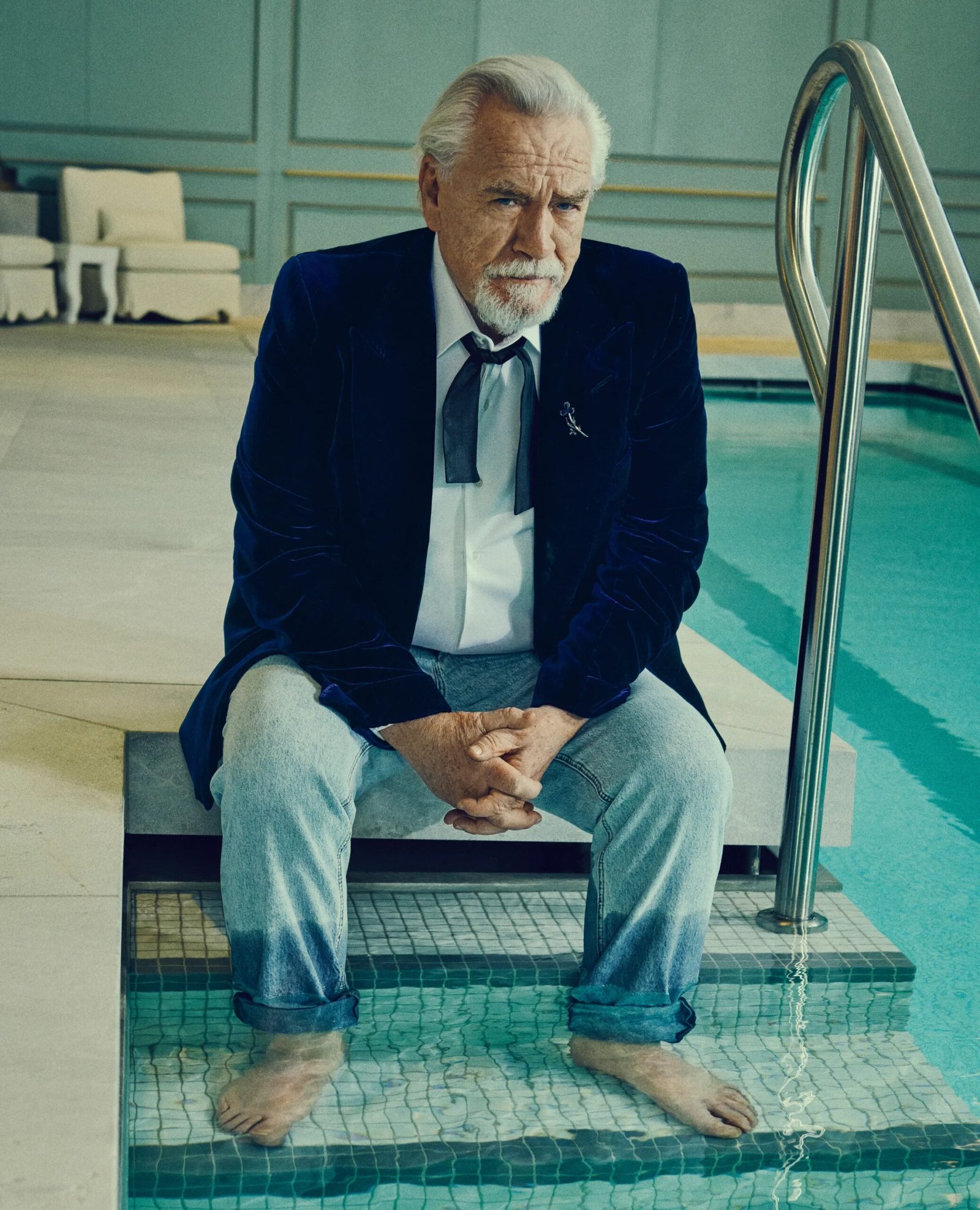
Playing the irascible media patriarch Logan Roy in HBO’s hit Succession is still a challenge for actor Brian Cox. Sure, the show ended three years ago but in some ways Logan Roy is still here.
“I mean, before Succession I never used to swear… Now I swear all the f***ing time!” Cox declares.
There are other echoes. When Cox arrives for our meeting he is stressed in quite a Roy-like way. An assistant has placed a function in Stoke Newington, north London, in his diary.
“I don’t want to go to Stoke Newington so I’ve just said, ‘F*** off. I’m not coming!’” he reports.

And before that he had a run-in with a rep from fast-food giant McDonald’s. Cox is the voice of McDonald’s in America and they recently launched the giveaway of a plush toy called a Squishmallow (you get one with a child’s Happy Meal).
“Listen, I’ve never struggled with ads. It’s a way of earning a living,” he asserts.
Just don’t tell the man who has played King Lear, Hannibal Lecktor (as the killer is named in the film Manhunter) and Logan Roy that his enunciation makes it unclear if he’s saying “mellow” or “mallow”.
“We had a row,” he says solemnly. “I said, ‘For f***’s sake, it’s mallow. I’ve just done a whole day of ads saying Squishmallows!’ ”
The thing is, lots of people like these residual anger-management issues. Once upon a time appreciative fans would simply have asked for an autograph. These days they insist on a video of Cox telling them to f*** off.
“I do mourn when people didn’t know who I was,” he says. “Now the whole f***ing world knows who I am. And it’s a very hard thing to deal with. I’m not mad about it. I really am not…”


We meet in a boardroom at his PR firm in central London. There’s a long table loaded with coffee and snacks. At one end there’s a flip chart as though Cousin Greg is due to make a presentation on cruises and theme parks. Cox doesn’t like the coffee on offer and someone is dispatched to get a latte. I don’t think I’ve ever seen a human being move down a flight of stairs so quickly.
Succession made him a household name in his early seventies but Cox had already enjoyed a pretty extraordinary career. After being brought up in Fifties Dundee by older sisters (his shopkeeper father died when he was eight; his mother had acute mental health issues) he got a job as what he calls a “factotum” at the town’s repertory theatre aged 14 (his first role was playing a man in his forties when he was 15).
It was a scholarship to the London Academy of Music & Dramatic Art (Lamda) that changed Cox’s life. He was still a teenager when Sir Laurence Olivier asked to audition him (Olivier was the director of the National Theatre) and soon learnt how strangely people can behave around great actors when Princess Margaret put her hand inside his shirt to fondle his nipple backstage at London’s Royal Court Theatre in 1969. Cox later appeared opposite Olivier in King Lear and went on to win two Olivier awards for his stage work.
But watch any classic TV from the Sixties onwards and there are abundant “Wait, isn’t that Brian Cox?” moments too: Z-Cars, Inspector Morse, Red Dwarf, Sharpe, Frasier, he was in them all. His film breakthrough was in the seminal Scottish independence text Braveheart in 1995 and since then he’s been in everything from the Jason Bourne series of thrillers to Adaptation and even 2011’s Rise of the Planet of the Apes (Cox played a proto-Logan Roy character, applying brutal management techniques to a monkey sanctuary).
Not “Harry f***ing Potter” though, he sniffs in his 2021 memoir Putting the Rabbit in the Hat (“Before the magician pulls the rabbit out he’s got to get the f***er in,” he explains). All his pals were in it but he never got the call.

But there’s also a danger to doing the big franchises, he has pointed out. The work is well paid but unchallenging, repetitive. Cox turned down the role of the governor in the Pirates of the Caribbean franchise (Jonathan Pryce played him), relieved not to work alongside Johnny Depp who he has previously said is “so overblown, so overrated”.
Latterly, that is what Cox has become known for. When the 79-year-old Scot is discussing the thespian craft, all luvvie protocols are suspended. He states his preferences with King Lear-like vigour.
Edward Norton? “A pain in the arse.” Kevin Spacey? “A stupid, stupid man.” Ian McKellen’s acting? “Not to my taste.”
Quentin Tarantino? ‘Meretricious’
He can be very decided on writers and directors too: Tarantino (“meretricious”); Michael Caton-Jones (“a complete arsehole”); David Hare (a “see you next Tuesday”).
Cox will not hold back if he feels the “work” is being compromised for public taste. In 2017 he played the lead in the biopic Churchill while Gary Oldman portrayed the wartime PM in a film called Darkest Hour released later the same year. Oldman won a best actor Oscar for his performance. Cox called it “cobblers” and “a crowd-pleasing farrago”.

Has being so blunt lost you friends or caused you problems?
“Well, I don’t know yet if it’s caused me problems,” he chuckles. “I mean, my wife keeps saying, ‘Brian, be careful. Brian, be careful.’ I think, ‘F*** it, I don’t want to be careful any more! I’ll be 80 this year. F*** it! I’m gonna say what I want to say.’”
Cox also got into hot water for criticising the “method acting” of his Succession co-star Jeremy Strong (he played Kendall Roy), calling it “f***ing annoying” and “American shit”. Strong was reportedly inspired by Daniel Day-Lewis (Strong was once his personal assistant), who in turn got drawn into the debate at the end of last year. Day-Lewis advised Cox to get off his “soapbox” and to make contact to discuss it.
Did he reach out to Day-Lewis?
‘Children don’t say, “What’s my motivation?”’
“No, I haven’t reached out because it’s got nothing to do with Dan Day-Lewis,” he grumps. “Dan Day-Lewis, he’s discreet. He never upsets it [the filming process]. He’s never, sort of… I don’t want to go on about Jeremy, because I’ve got into a lot of problems and he’s begged me to stop talking about him. He’s a good actor, Jeremy. He’s a wonderful actor. It’s just all the bollocks that goes with it. You watch children — they don’t say, ‘What’s my motivation?’ They just do it!”
Cox gets stroppy with actors who don’t act from “within” and with directors who don’t respect “the text”, even with underperforming audiences. (He once spotted an audience member in a New York theatre reading his programme and snatched it out of his hand. The audience member threatened to sue.)

Today Cox will even go “full Dundee” on a film he hasn’t even seen. I know Laurence Olivier and Merle Oberon’s 1939 film adaptation of Wuthering Heights is a favourite of his and wondered what he made of the new one starring Margot Robbie.
“ ‘Keith Cliff! It’s me, Cathy!’ ” he declaims suddenly in a cod Australian accent (Robbie was once in the Australian soap Neighbours). “‘How ya doing, Keith? Awright?’ ‘Yeah, I’m awright!’ ”
Cox enjoys a hearty chuckle before composing himself.
“Margot Robbie is far too beautiful for that role. I mean, I think there should be something more of the Gypsy about her but it’s wrong of me to judge. It may be a brilliant film.”
Actors who are too beautiful or who bring their “bollocks” to the set are live issues. We are meeting to discuss Cox’s own film directing debut. The film is called Glenrothan and thematically it bears some relation to Succession: two Scottish brothers, Sandy (Cox) and Donal (Alan Cumming), bear the scars of their overbearing father as they battle over the family whisky business.
Given his strong views, was it daunting to direct?

“No, because I realised that I’m more egalitarian than a lot of directors, the kind who call themselves visionaries,” he says.
He gives the example of Quentin Tarantino. “I like to honour the actor’s performance. With a Quentin Tarantino film, what you see is all Quentin Tarantino. That’s not me. I don’t want to do that.”
Glenrothan, he says, is his love letter to Scotland. After leaving for Lamda when he was 17, Cox caught a tide of rising social mobility epitomised by films such as Albert Finney’s Saturday Night and Sunday Morning and John Osborne’s play Look Back in Anger.
‘Scotland doesn’t get what it deserves’
“There were 21 cinemas in Dundee and I went to all of them to see American films which — whether the people were crooked or bent — showed them in a largely egalitarian society,” he says.
This early part of his life, he says, was all about looking outward, lifting himself up through ambition. However, looking back, he feels enraged by the injustices of history.
“The way people treat Scotland, you know, it’s very beautiful and all that, but what we’ve done intellectually — we created television, the telephone, advances in medicine — it’s extraordinary. But we’re so low graded and because of that we don’t get what we deserve.”
Cox has studied his family history closely. He is actually 80 per cent Irish. His forebears arrived in Dundee after the 19th-century potato famine and found work digging canals or spinning jute. The famine was a genocide the effects of which have never been fully acknowledged, he says. The Celts have been “traduced” and often treated little better than “slaves”.

“Ireland was always a problem to them [the English], because we just had a different culture,” he goes on. “That’s why, you know, after what happened in Ireland, the whole rise of the IRA was completely understandable.”
It must be said Glenrothan is not an angry film. There are lovely lochs and forests and folk musicians in cosy pubs. A chocolate-box vision of Scotland then, but Cox’s disaffection with UK politics is very real. In the Nineties he did ads for New Labour but fell out with the party over the 2003 Iraq war. However, he remains friendly with former PM Gordon Brown and still clearly resents how the Tony Blair/Brown partnership played out.
Gordon Brown is ‘the jolliest man I know’
“They were both John Smith’s boys,” he says, recalling the former leader of the Labour party, who died in 1994. “The deal was, Tony would lead from the front and Gordon would do all the donkey work, with Gordon eventually getting his chance — though I felt it should have been the other way around. I left because of Blair’s hubris and what went on with him and Bush and weapons of mass destruction; all those lies that came out and people going along with it.”
Brown eventually became PM in 2007. He sought Cox’s advice when people advised him to smile more. Cox’s counsel? “Be yourself.”
“Because he is the jolliest man I know,” claims Cox. “He’s so jolly!”
Maybe not right now he isn’t. The recent publication of email correspondence between convicted paedophile Jeffrey Epstein and former US ambassador Peter Mandelson mentions Gordon Brown in most unflattering terms. Despite serving as Brown’s business secretary, Mandelson suggested to Epstein that his boss “needs to be confined asap to a sanitorium”.
‘I never trusted Mandelson’
Brown has been helping the UK police with their investigation into Mandelson’s wider dealings with the convicted paedophile.
Has Cox spoken to Brown about this?
“No,” he says. “But I never trusted Mandelson. During the 1997 election he was going on about how we have to ‘get’ John Major. I said, ‘We don’t need to do that, Peter. There’s no need to be horrible to John Major. He’s not a bad man. Actually, he’s an extremely nice man, you know?’ I mean, you can disagree with his politics, but there’s nothing evil about John Major. They were making him the bogey man and I really didn’t like that. I don’t like when they do that. I never trusted Mandelson. I never knew where he was coming from.”
After becoming disillusioned with Labour, Cox backed the Scottish National Party and was close to former SNP leader Alex Salmond (he died in 2024). Salmond’s deputy and longtime ally was Nicola Sturgeon whose estranged husband Peter Murrell (the SNP’s former chief executive) will stand trial next year, accused of embezzlement of £460,000 of party funds.
Cox suspects there is mischief afoot.
“I mean, he [Murrell] may have done it, I don’t know, but they didn’t like Nicola and they were determined to get her,” he says. “I think there’s some dubious legality about the whole thing. I don’t know what it is, but it smells to high heaven and always has done.”
You think the UK government is trying to stitch up Nicola Sturgeon?
“Yeah, because they don’t want us. You know, they don’t. I mean, they’re very active about not wanting an independent [Scotland].”
‘My relationship with Scotland is complicated’
There’s a scene in Glenrothan where Donal’s mother warns him about his homeland. Scotland might be beautiful but it’s a trap, she says. “First chance you get, go and never look back,” she advises.
Is that how Cox felt?
“My relationship with Scotland is complicated,” he sighs. “It’s about being a Celt and feeling displaced.”
I know he has homes in London and New York. Does he have a place in Dundee?
“No, I find Dundee difficult.”
Some people take a dim view of Scottish celebs phoning in their Caledonian patriotism. Rod Stewart and Sean Connery spring to mind. Does he understand that?
“That’s one of the things that is a problem,” he agrees. “I go back to Scotland as much as I can.”
Cox served two terms as rector of Dundee University between 2010-16 and regularly visits his niece in Perthshire.
“It’s a complicated relationship and pretty hard to describe,” he continues. “Actually, the poverty is very hard to take. To see the heroin addiction, to see where it’s got to…”
We can’t seem to get away from questions of nationhood. Outside the meeting room there are pops and booms coming from a wall-mounted TV. Tehran is in flames. Cox’s wife, the actor Nicole Ansari-Cox, is of German/Iranian descent (she’s in Glenrothan too). Is her family OK?
“Yes,” he says, though she gets annoyed with him discussing Iran.
“She thinks I’m very unsympathetic about Iran. I’m not, but I do appear to be at times, because it’s such a complicated issue.”

But with a slurp of coffee Cox soon warms to his theme.
“Trump doesn’t give a shit about the people. He’s only interested in the oil. There’s just sheer f***ing greed motivating him, nothing else. The idea he’s liberating people is a nonsense. And it’s that greed that sort of permeates through society. I find at my age, I just go, ‘Are we going to get any better?’ You’ve seen great times in our country. And then you go, it’s never been worse, with Farage and that shit that he comes out with on a constant level. And there he was, you know, at his school doing Hitler impressions and all that. I find that we’re moving in a direction I can’t understand. Why won’t people want to oppose it?”
He and Ansari-Cox first met after she saw him as King Lear in Hamburg in 1990. She was 23, he was 44, and she was so impressed she saw the play eight times. They chatted at an after-party but only became a couple after a chance meeting in New York eight years later.
“We’re about to have our silver wedding,” he smiles.
‘I was making my own decisions at eight years old’
That’s a real milestone because Cox has twice been married twice before. First to Lilian Monroe-Carr when he was 20 (it lasted two years) and then to actor Caroline Burt for 18 years (she left him in 1986). He admits he wasn’t a good husband. He cheated and, when he and Burt had children (a daughter, Margaret, and the actor Alan Cox), wasn’t a very good dad.
But after Burt he went into therapy and realised he’d never really opened up or been “present”.
“More recently I’ve realised how free I was,” he says now. “At eight years old [when his father died] I was making my own decisions. There was freedom to that.”
Anyway, he is obviously very happy now. With his white hair and dark eyebrows there’s something of the badger about him. And Cox’s weathered face is as foreboding as an Easter Island statue. However, he beams when talking about his wife.
Mind you, 22 years is quite an age gap (before Ansari-Cox, he was in a relationship with a woman 26 years his junior, 20-year-old actress Siri Neal). Does she keep him on his toes?
“She’s considerable, she is considerable. She’s one of the most generous and caring people. The problem with Nicole, and we discuss this, is she’s got too many friends. At my age I’m trying to get rid of them. Well, most of mine are dying off.”
Ansari-Cox does sound like a straight-shooter. She appeared briefly in the penultimate episode of Succession as a mistress at Logan Roy’s funeral. However she has also voiced concerns about why women are attracted to men like Roy. “It worries me that women find the vile toxic bully Logan Roy sexy. It totally puts me off,” she said last year.
Why do women like you telling them to eff off?

‘In America, they don’t like women’
“That’s something that women should take up among themselves,” chuckles Cox. “I think it’s an economic thing. In America they don’t like women. They won’t let a woman be president, not in the foreseeable future. Look what happened to Hillary Clinton. The patriarchy is so invasive and so insidious, it’s hard to throw it off. I think the patriarchy is a f***ing mess, and it’s the patriarchy that got us into the position that we’re in at the moment, and we don’t learn the lessons. I say, give it over to the women.”
He has credited couples therapy with maintaining his marriage (they have two sons, Orson, 24, and Torin, 21), though Ansari-Cox has mentioned they went through four years of “pure hell” and in 2024 she told reporters: “I’ve supported him for 25 years and it’s my time now. Otherwise I’d leave.”
“Nicole gave up a lot for me. It was tricky for her, but she gave up a lot, and I feel that she needs to be honoured,” he says.
They keep separate bedrooms at their two American homes, one in Brooklyn, the other in upstate New York. And in the UK they maintain completely separate homes nine minutes’ walk apart in Primrose Hill, north London.
“By keeping things separate, we are responsible for our own mess,” he explains. “It’s as simple as that. Her space is very important for her and my space is very important for me. I think if we’re thrown together we feel locked together and that’s not a good creative relationship… You should be free.”
‘I’m not exactly poor’
Logan Roy was an avaricious ball-breaking Dundonian often disappointed by his children.
“Yes, ‘I love you but you are not serious people,’ is my favourite line in the whole show,” agrees Cox.
Has he ever been tempted to say that to his own kids, given it’s perhaps hard for them to understand where he came from?
“I think one has to be careful with that,” he says. “It’s all very well living the life I’ve lived. But you can’t throw it in people’s faces. I think my boys are sensitive. They’re very aware that I’ve done quite well. I’m not exactly poor. But they want to feel free, not burdened by inherited wealth. And I completely respect that. I completely admire it.”
For his 80th in June he’ll throw a party. Could it be like the scene in Succession where Logan Roy watches as the youngsters make oinking noises while hunting for sausages on the floor?
“No, but I think that was some of the most incredible writing on TV,” he says, smiling.
Cox doesn’t come across like an 80-year-old. He and Cumming even have a scrap in Glenrothan, rolling around on a lawn after a disagreement. Impressive. How does he stay in shape?
“Gym three times a week,” he says, patting his modest tummy. “You really have to be responsible for your body, because it’s dying. You can’t give in to that.”

His greatest fear is dementia
He doesn’t drink much but for the past 30 years has relaxed with an evening spliff.
“Well earned. Pre-rolled.”
Does he have a dealer in London?
“No, he’s in Scotland.”
Cox says he will never retire, though his greatest fear is dementia.
“Yes, you know, there’s all kinds of protocols I can take,” he says. “I’m very careful about it, because I need to learn my lines to keep working.”
Seven years ago he was cast as Lyndon B Johnson in a Broadway production of The Great Society. He learnt 160 pages of dialogue-heavy script in three weeks.
“Couldn’t do that now,” he laments.
To ward off cognitive decline he uses an inhaler he says was invented by Elon Musk. Taken nasally, some drugs are thought to reduce amyloid plaque build-up in the brain (recognised as a cause of dementia), and to enhance sleep Cox chews gummies called Pillow Talk.
Cox perks up talking about another brand (he can’t remember the name) he uses for enhancing his erections.
‘Wealth is a double-edged sword’
“It does help that incredibly,” says Cox. “Oh yeah, it’s amazing. I don’t live on them all the time, but I do take them on occasion.”
Any other 80-year-old actor would feel free to enjoy their success. But Brian Cox is very aware of where he came from. Last year he told a journalist he was embarrassed by his wealth. Is that still true?
“It would be hypocritical of me to pretend I didn’t enjoy it but it’s a double-edged sword. I think it’s a feeling of not being worthy.”
The spectre of Logan Roy looms again. Not the table-thumping deal-maker who died in the toilet of his private jet (Cox says he will die in Scotland). It’s just that both suffered the vertigo of starting at the bottom and reaching the top.
“There’s a lot of people who start off meaning to honour their backgrounds but they end up getting too successful or with too much money and it just slips away from them,” he says. “Logan became the great man he was, but he wasn’t the man he wanted to be. Who can’t take a lesson from that?”
Glenrothan is in cinemas from April 17