‘It can’t go on like this,” was the headline in the Watford Observer three years ago. The local hospital, Watford General, was crumbling. Rats were seen scurrying under the Portakabins. In 2022, 160 patients waited for more than a day in A&E before they were even offered a trolley on a corridor. Hygiene in the kitchens was rated one out of five. Staff endured thousands of assaults and were regularly accosted on the high street with tales of neglect. Cancer targets were routinely missed. The West Hertfordshire Teaching Hospitals NHS Trust was floundering near the bottom of every league table, another demoralising story of our health service in its death throes.
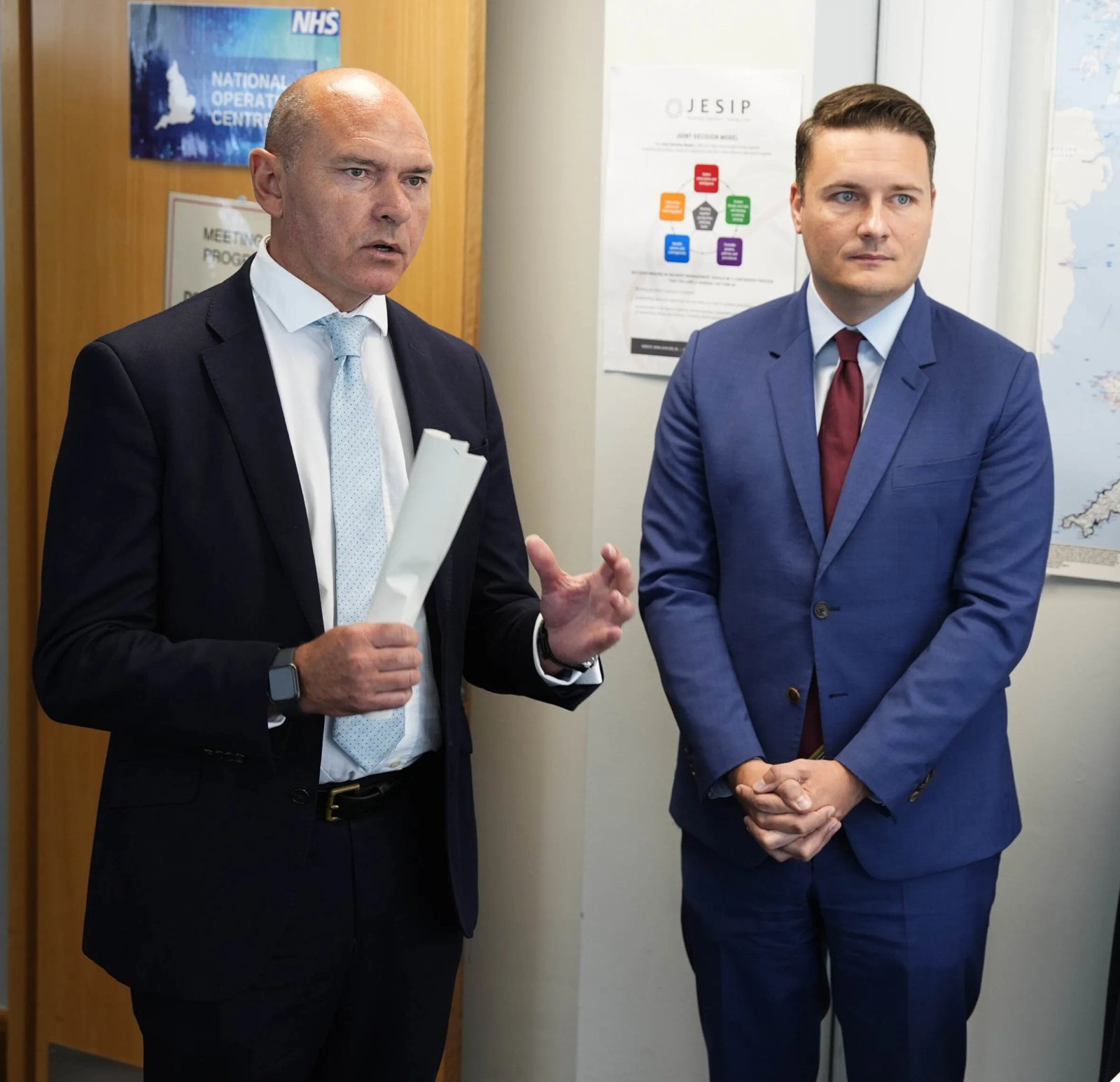
Yet now, as I tour the wards of the still dilapidated estate with Sir Jim Mackey, the new CEO of NHS England, everyone is smiling and joking rather than avoiding eye contact. The corridors are empty; the nurses in A&E are playing with a baby who has earache. The buildings are antiquated, but morale is high and the equipment is beginning to catch up with the 21st century. The hospital’s award-winning surgeon Vanash Patel shows me a new minimally invasive robotic system tackling colorectal and gynaecology surgery times, and I’m introduced to the online hospital team. In an astonishing resurrection, West Hertfordshire Teaching Hospitals NHS Trust has gone from 102nd in the A&E tables in 2022 to 2nd. Staff vacancies have plummeted, as have sickness levels to the fourth lowest in the NHS. The hospital’s chief executive, Matthew Coats, credits Mackey for his life-changing advice.
Mackey is being heralded as the man who could save the NHS. The quiet, unassuming accountant from the northeast, with his reassuring soft Geordie accent and the longest to-do list in Britain, has already turned around the Northumbria and Newcastle NHS trusts. Mackey is convinced he can do the same across the country — crucially, with no extra money. But he certainly has his work cut out. The threat of another resident doctors’ walkout still looms large, and now he warns the war in the Middle East could lead to shortages of medicines (“everything’s at risk”).
Rolling up his sleeves and tucking in his tie, the 59-year-old manager has been on a mission since he watched his father die after shoddy treatment for colorectal cancer a decade ago. “I felt really powerless and I’ll carry that regret with me. We are just one family among so many others,” he says when I tell him I feel the same about my father’s last few weeks in an overstretched hospital ward before he died. “My experience wasn’t what brought me into the NHS — it absolutely drove me to stay and sort it out,” he replies.

Last year, Wes Streeting headhunted Mackey as an interim replacement after the beleaguered Amanda Pritchard stood down. The health secretary is desperate for results. Sir Keir Starmer has promised the “biggest reimagining of our NHS” since it was created, announcing a ten-year plan. Streeting has pledged to clear out underperforming hospital bosses and introduce an intensive recovery programme. This northern knight may be his best chance to prevent the slow, painful death of the service.
In one year, Mackey has improved patient satisfaction levels from an all-time low of 21 per cent in 2024 to 26 per cent in 2025. Yet 53 per cent still say they expect the standard of NHS care to get worse and the young are the least happy.
The challenges of strikes, queues and corridor care
As for the doctors’ strikes, his team have been working round the clock with the union’s negotiating committee to put forward a strong joint offer. “It’s been very disruptive, but I know many of our resident doctors have been left not feeling valued. We need to restore our standards, set the discipline again, and fix the basics to get rid of the ridiculous stuff — like the resident doctors not being able to book leave, being moved around the country — that was causing serious repercussions.”
The week after we meet, new doctors’ strikes are announced.
“It’s extremely disappointing that the BMA’s resident doctor committee has decided to go on strike again, given the strength of the deal on the table,” he tells me. “The NHS managed the strike periods well last year but we know this came at huge cost for other staff, consultants, nurses, therapists, and we can’t keep going like this.”
“We’re in the foothills. There’s a long way to go,” Mackey admits. The service, he states with brutal honesty, has been in a critical condition for years. “We kept pumping in more money and staff but productivity still slumped, waiting times deteriorated, cancer survival rates lagged behind developed countries, buildings are crumbling, technology was outdated.”
We can all recite the service’s woes. Morale was dire, bullying and sexual assault were rife and trolleys were stacked up in corridors under flickering lights.

Mackey doesn’t demur. “We had a sick nation — battered by the Covid pandemic, less fit, heavier, more anxious than previous generations and we weren’t rising to the challenge. We had queueing ambulances, bruising legal fights, the cost of clinical negligence had spiralled out of control and everywhere there were traumatised families.”
But Mackey is convinced he can administer the right medicine and his self-belief is infectious. “No one wants to work in a shitshow. The 1.5 million staff are part of the community. If the NHS is in bad shape, it affects the health of the whole nation. When things go wrong, they get the embarrassment and shame of it. But they also get the glow of respect when it is going well.” Only a few years ago, Mackey remembers being accosted at the airport by a man whose father had been waiting months for heart surgery. “Now people are beginning to say thanks again.”
Mackey is a lifer. He started in the NHS 35 years ago and only expected to stay for two years. “But I got the bug. It takes a while to understand the NHS, and then when my dad became ill it became personal. Standards matter. My first few years were all about closing stuff; cuts and fights with the unions. It was pretty depressing. But it gets under your skin — this thought that you can make a difference.” In 20 years, he turned Northumbria into a top-performing trust.
Every other job, he says, would now feel narrow. “This has complexity. The NHS is the size of a small country like Portugal. It’s enormous. Health represents more than £200 billion of public spending. Just adjusting inflation for us could wipe out whole government departments.”
Covid, he says, is not to blame for the NHS’s malaise. “We were in steady decline before that national trauma. Shocks are driven less by how you manage them and more by your fitness before. The service wasn’t in great shape. We probably kept lockdown for too long and lots of things became embedded as normal. Take corridor care: it’s easy to start walking past lines of trolleys and think it’s acceptable. It’s not. We need to stop walking past things. Then we had industrial action. Financial discipline went. Staff lost the connection with standards and purpose and productivity. I want to return a joy to the service and a sense of pride.”
More cash, he says, is not the answer. “We got into a narrative that the NHS needs more money and more people. That was never sustainable. We can’t keep asking for more; people need something in return. But this time last year we had a £4.5 billion net deficit. We’ll balance the books this year. We won’t have to go through the Treasury for more money. We are on top of it, even with three rounds of industrial action and reforms.”
Gradually, he hopes, patients will see that queues are down and staff are not as frazzled and disillusioned. “These are all soft things that build layers of trust. Then NHS workers can go into the supermarket and people will stop them to say well done, rather than dodging someone who has yet another complaint.”
Reducing waiting lists and modernising care
Under his calm management, NHS waiting lists in the country are at their lowest level for almost three years. “When the meningitis tragedies happened [in Kent], the ability to withstand a shock like that was still poor, but we’re getting there. We need to be better.”
And what about his relationship with Streeting? “He’s provided the political leadership and led the discussions with the Treasury. I have worked with a lot of secretaries of state — seven I think over the years. They have all been motivated, with good intentions, but we need consistency,” he says tactfully.
Mackey tries to work two days in the northeast where he still lives and three in London. The only time he appears riled is talking about the occasion a newspaper caught him napping on a train.
“It’s a national health service and it’s been a big problem that we have been too Londoncentric. Yesterday I was in Durham; today, Watford. I wake at 5am and I work a lot on the train. I was annoyed about the picture of me sleeping, as I had worked 17 hours the day before.”
I don’t think the tabloids will find he does anything more salacious; his work ethic is ferocious. “But we all need to de-stress, so I try to exercise most days and spend time with my family. My wife manages me very well. She knows when I am doing too much, getting grumpy, need to clear my head, when I am becoming combative. Throughout my career and my adult life, really, that’s been a constant. She has kept me sane.”
Prevention, he says, is as important to the service as cure. “It’s not nanny state; it’s common sense. You don’t need money or expensive kit; you just need to move. It’s better for you psychologically and physically. The service can’t fix everything,” he insists. “It’s hard to communicate that now with expectations and the way society is. There is less personal responsibility, but we all must lean in, or the NHS could take up 90 per cent of public spending and the country won’t be able to function.”
Weight-loss drugs sound like a silver bullet, he agrees, but even they must be accompanied by lifestyle changes. Vaccinations have also become a headache. “People started taking them for granted, assuming they didn’t need to bother. Covid made them grateful but wary. We need to get back to a vaccination system that works and is less dispersed and random. We shouldn’t be seeing outbreaks of chickenpox and measles. Vaccines layer the protections for the NHS.”
Many have already given up on the NHS, though. Half of millennials now say they are planning to use private healthcare in the next year. “I think that is patchy, not uniform,” Mackey says. “But we absolutely have to be more responsive for the next generation. That is where the technology kicks in: we create a digital front door, use robotic surgery and online services.”

Why would it matter if the young invested in their own healthcare? Mackey looks horrified. “I believe fundamentally in the NHS; I don’t think anyone should need private healthcare. We should be able to match and beat all other providers. Once you start chipping away at it, you end up in a hybrid, complex system that could be more costly and complicated. We will still have to be there for emergencies and expensive stuff, but private care can pick and choose. But I want the NHS to work like the rest of our lives: be convenient, technology led, accessed by an app.”
Mackey believes the decision to amalgamate patients’ records online for easy access will be transformative. “We are using technology built for the last century,” he says. “I am allergic to dairy, tetanus and penicillin. I always have to warn everyone about my allergies. If you are beginning to get dementia, a bit confused, it’s worse.”
Once, GPs would know all their patients and their families’ medical histories. Now it’s often impossible even to get through to a receptionist. “The GP relationship was very badly dislocated during the pandemic. But it’s much better now than it was two years ago.” Updating the appointments system has been crucial, he says.
But he knows standards could easily slide again. “If we ever think we have nailed it, that’s when everything starts to slip, because everything is constantly shifting and evolving in health.”
Mental health is another challenge, he suggests. “What defines mental health has changed over 20 years dramatically. The labels are now very different. We have probably over-medicalised. We have created an expectation that things can be fixed medically when there isn’t a quick fix.”
Of course, the population is more anxious and stressed, he concedes. “People have more challenges: the cost of living; bringing up families; looking after elderly parents. There have been catastrophic world events. And the service has struggled as we try to pick up the pieces. It is vital we get up to speed. But this is a service model that is not built for every single demand and need and wish.” So not everyone can have a therapist or needs one? “We need a bit of a reset about what the NHS should provide.”
Mackey, however, is an optimist. “Things are beginning to change. Gen Z, like my two children, are generally exercising more, smoking less and eating better. But it probably isn’t even, and that is where the NHS can come in — to help the less privileged with less money to exert control over their lives.”
What about his own staff, who sometimes aren’t in the best shape either? “In Northumbria, we are building a big health and wellbeing centre with a gym in it, with spaces for colleagues to meet and good healthy food. That’s what you can do when you have the financial headroom. Many of the PFI hospitals have fast-food outlets built into their contracts and that’s hard to shift. But we must set an example; provide healthy food for staff and patients. Frazzled staff unsettle patients and damage confidence. People want their health providers to look and feel healthy and in control and relaxed.”

So what is pivotal to success? One suggestion he appears keen on is restructuring the negligence claim scheme after the NHS’s total liabilities for clinical negligence hit £60 billion. “We cause a lot of damage in the complaints and compensation process as everyone gets very loyal and it’s very formal and you can’t be as open. Processes kick in. When someone is grieving because they have lost someone or is struggling to cope because they have lost a function, they shouldn’t have to fight for compensation. We should have a system that allows people to say sorry and learn from it and allows a quick process for families. In the UK it is unnecessarily long and drawn out and expensive for everyone.”
I suspect he would prefer to adopt a system similar to that in New Zealand, where there are set tariffs for claims and lawyers rarely need to become involved, but he doesn’t like comparisons with other countries. “New Zealand is small. It’s the same with Scandinavia. They are different countries with different tax systems and issues. Spain, Portugal and France have a big proportion who are insured. I was on holiday a few years ago and there was an ill toddler with us. The parents went to the local clinic, spent €350 and came back after seven hours. They were over the moon. Yet if that had happened in England and it had cost nothing, they would have complained.”
What about the accusations that too many staff are trained abroad and poached from other continents while British doctors and nurses flee to higher wages and less stressful working conditions in Australia? “We became very fixated about getting more staff as the answer. We’ve had this massive expansion since 2019 with lots of oversees recruitment. The value of British training is still very high internationally, but that squeezed out opportunities for many domestically. Some of our strength has been people bringing their expertise from abroad but it has to be balanced. Staff shouldn’t feel there aren’t enough training positions for them.”
They should also expect to work hard, he says. “It was a lot more brutal 30 years ago; the older staff now talk about that fondly. But again it’s about modernising — people have different expectations.”
Many dream of becoming a doctor; fewer of becoming an NHS CEO, yet they are as crucial in saving lives. “I was fit and healthy as a kid and competed at swimming, then my asthma got worse so I had to stop, although I was nationally ranked. I have always done sport. I haven’t had proper ill health, but we had family who died of cancers before the NHS was formed, who couldn’t afford care, which is why I will always champion the service.”
It’s still hard to pinpoint exactly how Mackey achieves results. He’s the dream manager, according to two former health secretaries, who both told me they’d like to clone him. What are his leadership qualities? Again, he’s not interested in discussing himself, merely saying, “I’m quite driven. I like standards. I am aspirational. I want achievements and to be connected and visible. I am not a tyrant, but everyone feels energised when you get results.” Then he adds, “I want to get back to the northeast and finish my work there before I am too old.” He sounds like Cincinnatus returning to plough his fields, only for Mackey it’s his garden shed. “I won’t go yet.” He laughs.
“The NHS is owned by the population. It’s a fundamental part of our psychology. We need to challenge it, drive it, love it, cherish it together. The sharks are circling the single health service model and, yes, we’ve got a lot to improve, but we have to do everything we can to keep it: care free at the point of need, no matter who you are, where you live or how wealthy you are.”