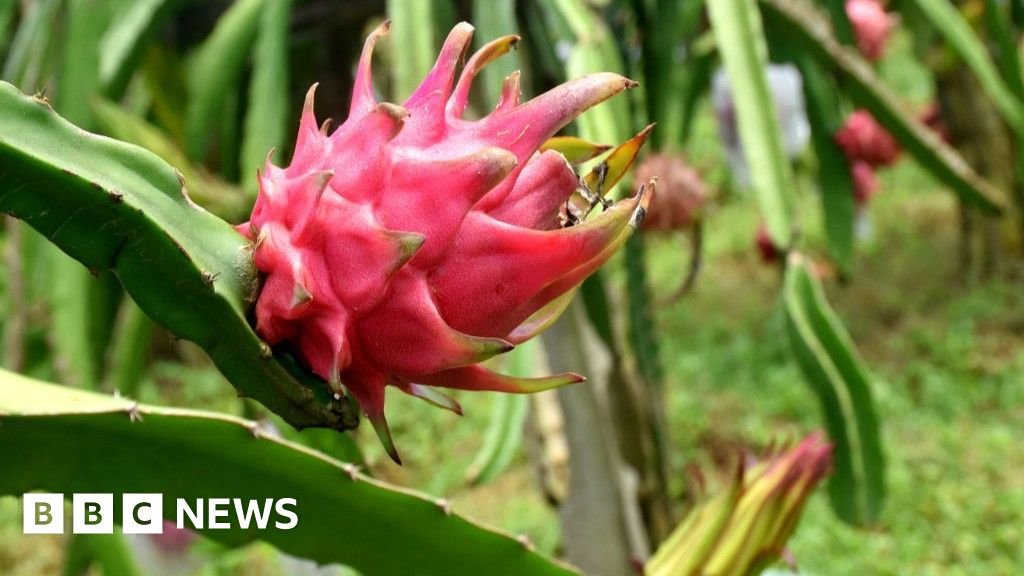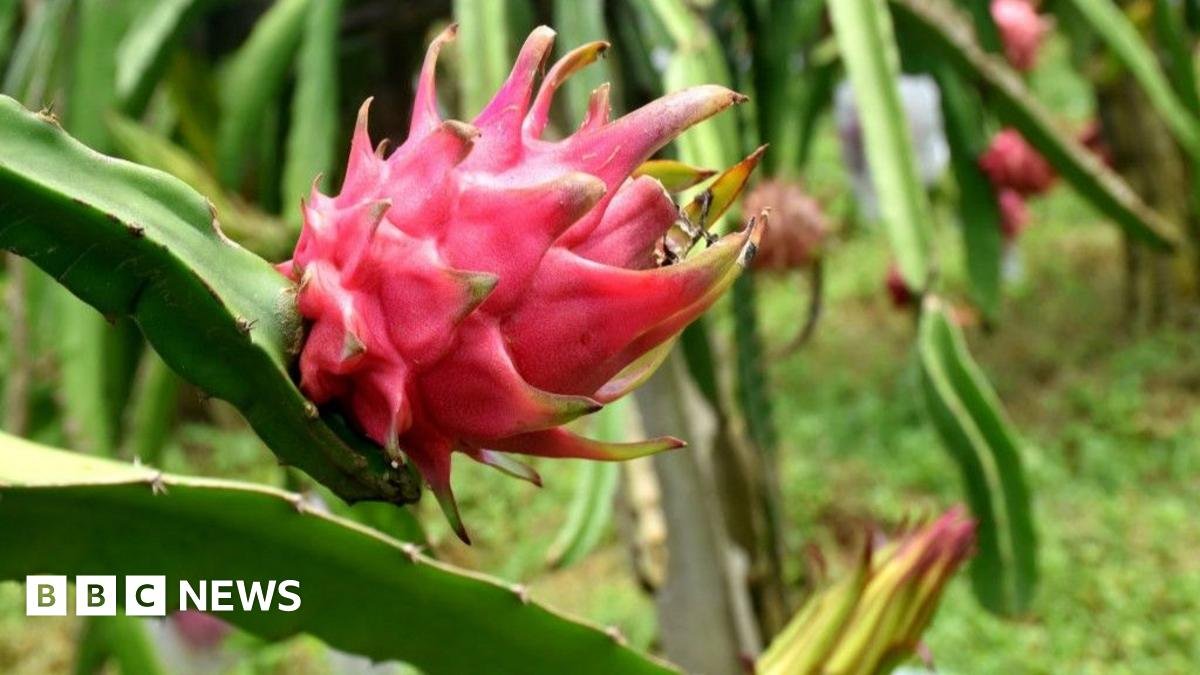
Dragon fruit is a climbing cactus, making it an unusual fruit to cultivate.
Usually it is grown on concrete pillars with a circular ring (sometimes a tyre) at the top for the vines to hang over.
Originally from Central America, Vietnam has become the world’s leading producer, but India has plans to catch up.
Compared to traditional crops dragon fruit promises higher returns and relatively stable prices.
In 2020, the industry was given a boost when Prime Minister Modi congratulated the farmers, external of Kutch in Gujarat for their success in cultivating and exporting the fruit.
“Dragon fruit entered India around 2009. At that time, we knew very little about the crop or how to cultivate it,” says Dr G Karunakaran, the principal scientist and head of the Centre of Excellence for Dragon Fruit at the Indian Institute of Horticultural Research in Bengaluru.
“Serious research on dragon fruit in India started around 2013–14 when we began systematic studies on its cultivation.”
But cultivation really took off after 2021, thanks to media coverage.
“Dragon fruit adoption in India spread like mobile phones, once farmers saw the income potential, everyone wanted to grow it,” says Karunakaran.
Unlike mangoes, which have a short harvest season, dragon fruit can be harvested continuously for six months.
“Farmers harvest small quantities every month, which provides a steady income. A family can manage one acre and produce up to 15 tonnes of fruit annually,” says Karunakaran.