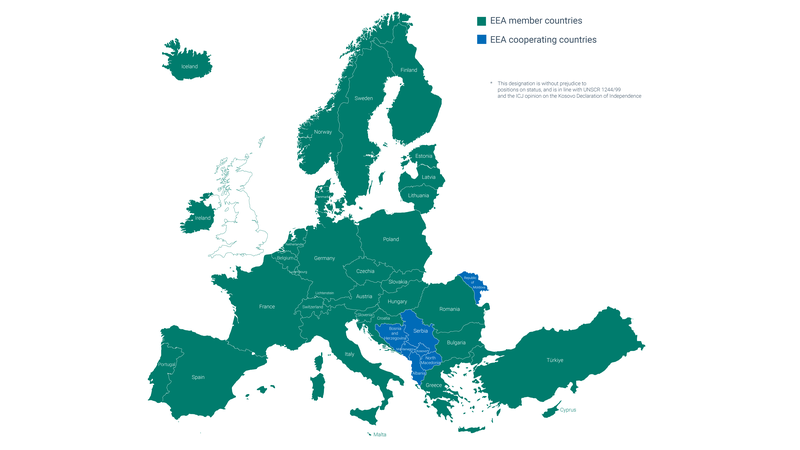
The European Environment Agency (EEA) and its European Environment Information and Observation Network (Eionet) today welcomed the Republic of Moldova as a cooperating country, extending the EEA’s country network to 32 member and 7 cooperating countries across Europe. The EEA is one of the first EU agencies to integrate Moldova into its regular activities and operational structures.
The EEA Management Board formally endorsed Moldova today as a cooperating country of the organisation. With the Management Board’s endorsement today, Moldova becomes the seventh cooperating country of the EEA, joining the Western Balkan partners Albania, Bosnia and Herzegovina, North Macedonia, Montenegro, Serbia and Kosovo¹.
Moldova’s landscapes and ecosystems form part of wider European ecological systems, and its environmental challenges often mirror those faced across the region. An oil spill, caused by Russian attack on a Ukrainian hydropower complex located on the Dniester River close to the border with Moldova, is currently affecting the wider river basin, including the Moldovan territory. Such incidents show that environment and climate challenges do not stop at national borders.
As Moldova has declared a state of environmental alert due to the oil spill, the Moldovan delegation was prevented from participating in the EEA Management Board meeting. Nevertheless, the moment has been marked by the messages sent by Jessika Roswall, EU Commissioner for Environment, Water Resilience and a Competitive Circular Economy, Gheorghe Hajder, Moldovan minister for the Environment, Leena Ylä-Mononen, EEA’s Executive Director and André Weidenhaupt, EEA chair of the Management Board.
Moldova’s cooperation with the European Environment Agency marks an important moment in its European integration journey. It is a concrete step both for Moldova and for the European Union, as we strengthen our cooperation and joint commitment to a healthy and sustainable environment that can strengthen our preparedness, security and resilience.
European Commissioner for Environment, Water Resilience and a Competitive Circular Economy
The Republic of Moldova welcomes this new stage of cooperation with the European Environment Agency and its Eionet network. Joining this community of partners strengthens our capacity to develop evidence-based environmental policies, improve environmental data systems, and align our practices with European standards. At a time when Moldova is advancing important reforms of its environmental institutions, including the strengthening of the Environmental Agency, the experience and expertise of the EEA and the Eionet network will be invaluable. Access to reliable and comparable environmental data will allow us to better understand environmental challenges and design effective public policies. This cooperation will support our efforts to modernise environmental governance, improve data quality and transparency, and accelerate our alignment with the EU environmental acquis as part of Moldova’s European integration path.
Republic of Moldova’s Minister of Environment
We are very happy to announce that the Republic of Moldova is joining the European Environment Agency as a cooperating country and becoming part of our network. Environmental challenges know no borders and cooperation is essential to address them effectively. We have already been working very constructively with Moldovan colleagues under the ongoing Energy Community project, and before that, as part of the ENI SEIS II East project. We look forward to further expanding this cooperation. Incidents such as the oil spill on the river Dniester are a testimony not only to common challenges we face, including those caused by war, but also to the solutions we can develop together.
On behalf of all the other 38 countries, I welcome Moldova as the 39th country in our Eionet family. Eionet connects people and expertise from across Europe, facilitating not only data flows but also knowledge exchange, allowing us to achieve our shared ambitions for a more sustainable Europe.
Chair of EEA Management Board
Roadmap for integration to the EEA
The European Environment Agency’s cooperation framework allows cooperating countries to engage in the Agency’s activities and become part of Eionet. Cooperating countries contribute to and benefit from shared environmental data, assessments and capacity‑building activities, supporting improved environmental governance and evidence‑based policymaking across Europe. Eionet consists of the EEA’s member and cooperating countries. The 32 member countries include the 27 European Union Member States, Iceland, Liechtenstein, Norway, Switzerland and Türkiye.
Cooperation with the EEA forms part of the Republic of Moldova’s broader commitment to European integration. This was reaffirmed at the highest political level in the Joint Declaration following the first EU–Moldova Summit in July 2025, which references Moldova’s participation in selected EU agencies, including the EEA.
Moldova applied for European Union membership in March 2022 and was officially recognised as an EU membership candidate in June 2022 and began accession negotiations in June 2024.
Cooperation between the EEA and Moldova will begin with a dedicated onboarding and diagnostic phase (2026 – 2028). The goals of this phase are to:
- Support Moldova in building the institutional and technical foundations for future gradual Eionet integration.
- Provide a clear roadmap for environmental data reporting to EEA in line with the approximation to the EU environmental acquis.
- Facilitate Moldova’s progressive participation in EEA systems, networks, and knowledge platforms.
The cooperation is supported by the European Union through its external cooperation programmes.
Note 1: This designation is without prejudice to positions on status, and is in line with UNSCR 1244/1999 and the ICJ opinion on the Kosovo declaration of independence.