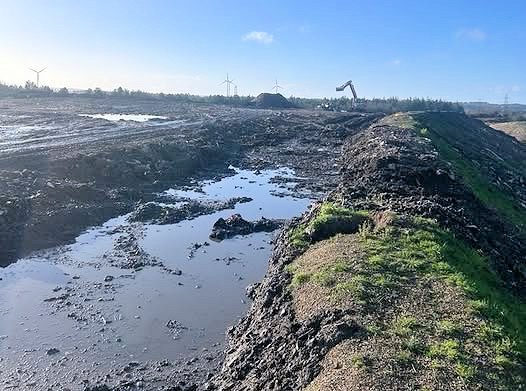
Action has been taken to stop the stink after hundreds of Purbeck residents took to social media to complain about what has been dubbed the Wareham smell.
Concerned residents in Wareham, Sandford, Northport and Holton Heath in Dorset, went online to complain about foul odours they described as like manure or rotting eggs which were making them feel unwell.

The Trigon Hill landfill site near Wareham in Dorset was at the centre of hundreds of complaints about a noxious smell
Symptoms like migraines and nausea
Locals listed symptoms like migraines, headaches, breathlessness, dizziness, and nausea, and say that the problem has been regularly occurring since January 2026.
After Facebook threads were set up to demand action, more than 300 residents complained to the Environment Agency, Dorset Council, and Wareham Town Council, leading to official action.
The Environment Agency made a February site visit to Trigon Hill landfill – on the Bere Regis road near the former Silent Woman pub – as complaints started to accumulate and the company that runs it, Valencia Waste Management, was ordered to take action to stop the smell.
Ten gas collection wells have been installed to collect the gas underground, to be burned off at the onsite turbines to produce power. A further 20 were being sunk on Friday 27th March 2026.
The gas causing the problems is thought to be highly toxic hydrogen sulphide, which can be dangerous to breathe, is flammable and can be explosive.

Trigon Hill is an active landfill site which receives many dozens of daily visits from lorries with waste to tip
“Should not have to tolerate odours”
An Environment Agency spokesperson said:
“The Wareham community should not have to tolerate odours that affect their environment. While landfills and other waste activities will generate some smell, the impact should be minimal, and the recent increase in reports indicates controls are not working effectively.
“Officers from the Environment Agency and Dorset Council visited Trigon Hill Landfill on Wednesday 25th March 2026 to check on the progress of the gas infrastructure improvements that we have required.
“Further gas collection equipment is being connected and will be commissioned on Friday, which is expected to reduce odour.
“Additional measures will be installed next week, beginning Monday 30th March 2026, and we will continue to monitor the effectiveness of these.”

Trigon Hill Landfill site made news in July 2025 after a lorry caught fire on site
“Stressful and disruptive”
The spokesperson added:
“Over the past week, atmospheric and weather conditions have contributed to an increase in odour reports from landfills across the country.
“We have instructed Valencia Waste Management Ltd to make improvements to the gas‑collection infrastructure at Trigon landfill. Further works are being carried out this week, and we are monitoring these upgrades.
“We recognise that living with odours can be stressful and disruptive, and we are continuing to investigate odour complaints in Wareham, Sandford, Holton Heath and the surrounding area, working closely with Dorset Council.
“We do encourage local residents to report any further incidents of odour to our hotline on 0800 80 70 60.”

The entrance to Trigon Hill Landfill near Wareham, where the air quality is now improving
“No risks should be taken”
A Wareham resident who didn’t want to be named, said:
“This smell has been happening for two months now to my knowledge, and there have been so many complaints made already. Sometimes it was worse than others, but it has been making us feel ill for so long.
“There have been many days when we couldn’t open our windows because the smell was so bad and I’ve heard from dog walkers who have been coming back with pounding headaches.
“No risks should be taken where public health is concerned, this should have been investigated immediately complaints began to build up.
“They weren’t isolated complaints, and they weren’t trivial either, there have been many of my friends in Wareham, Northmoor and Sandford who have felt sick and have suffered with headaches, sore throats, coughs and even upset stomachs.
“Someone in authority should have asked long before now whether it could be connected with the smell.”

The Trigon Hill landfill site is operated by national company Valencia
“We apologise for inconvenience”
A Valencia spokesperson said:
“We are committed to operating the Trigon landfill site in accordance with our planning and permitting requirements.
“We apologise for inconvenience caused in recent days, this was due to a power outage in the area.
“We were originally assured that the interruption would not affect power generation at the landfill site.”
And a spokesperson for Dorset Council added:
“We are aware of concerns from local communities about an odour that is believed to be generated from within the Trigon Landfill site.
“The site is operated by Valencia, which is currently carrying out temporary works to capture gases that are generated by the landfill operations.
“Dorset Council as the waste planning authority, is aware of these works and has investigated the complaints about the odour. To date, no breaches of planning control have been identified but we will continue to monitor the situation.”

Portable hydrogen sulphide detectors are used in many industries where the gas can be a health hazard
Distinctive rotten egg smell
Hydrogen sulphide is a colorless gas best known for its distinctive rotten egg smell, which is formed naturally as organic matter breaks down during the decomposition of waste in landfills, and also in swamps, marshes and sewers.
The gas can be dangerous to humans, especially at higher concentrations. While low levels may only cause irritation to the eyes and respiratory system, higher concentrations can overwhelm the sense of smell, making the gas undetectable despite its odor.
Exposure to moderate levels can lead to headaches, dizziness, nausea, and difficulty breathing. For this reason, strict safety guidelines and detection systems are essential wherever hydrogen sulphide may be present.
Even before hydrogen sulphide was discovered by chemists, tin and copper miners in Cornwall knew the gas as ‘stinkdamp’ and recognised it as a dangerous and often fatal underground gas.
Further information