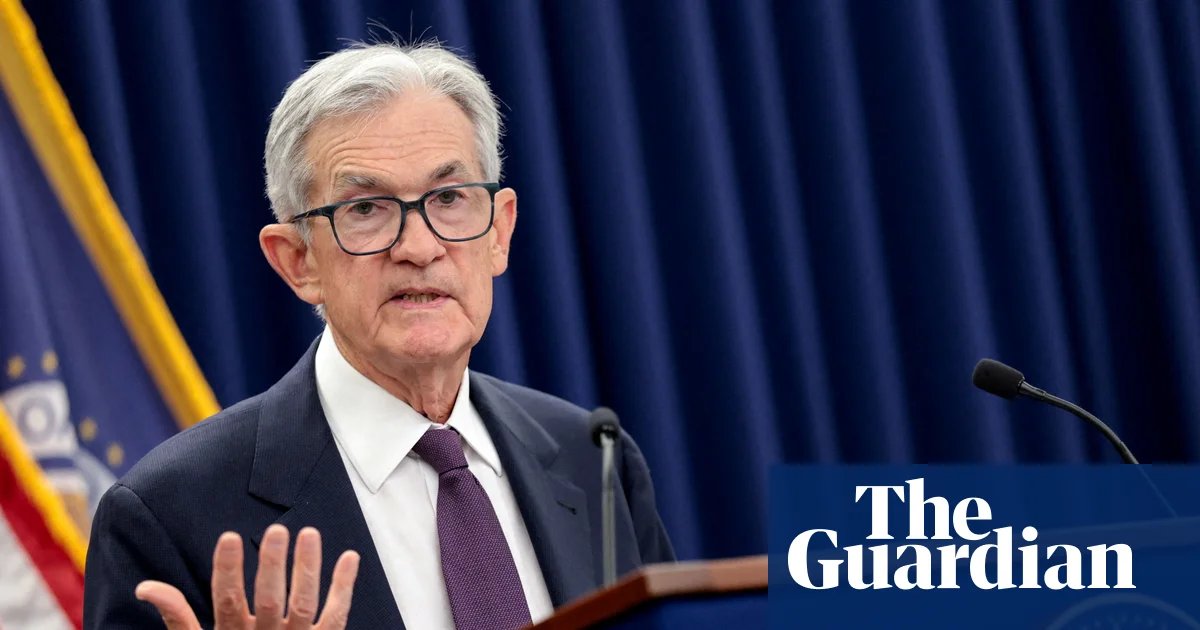
The US Federal Reserve held interest rates steady for the second time this year, a widely expected move amid turmoil in the Middle East and rising energy prices.
Fed officials faced a confluence of issues to consider in their meeting this week: soaring oil and gas prices, fluctuating inflation that still remains above the Fed’s target of 2%, and a weakened job market that unexpectedly saw 92,000 losses last month.
All but one of the 12 voting members of the committee voted to keep rates at a range of 3.5% to 3.75%, resisting enormous pressure from Donald Trump to lower borrowing costs at the risk of driving up prices in the long term.
In a statement, the board noted that “uncertainty about the economic outlook remains elevated” and “implications of developments in the Middle East for the US economy are uncertain”.
The Fed’s decision comes as the US and Israel approach their third week of war with Iran, forcing central banks across the world to decide how to weigh skyrocketing gas prices and their impact on the global supply chain.
“In many ways, an energy shock is a central banker’s nightmare as it creates tension between a shaky labor market and rising inflation,” Joe Brusuelas, chief economist at RSM, said on Tuesday, ahead of the Fed’s decision. “While [the Fed] can take action to address a financial crisis by printing money and injecting liquidity into the financial system, it cannot print oil.”
The Bank of England’s monetary policy committee is also expected to hold interest rates on Thursday amid the global economic uncertainty.
Trump said rising oil prices are a “very small price to pay” to achieve his goals in Iran and are a boon to American oil producers who stand to make “a lot of money” from increased demand.
It’s the same defiant stance he’s taken on the impact his tariffs have had on the global economy. US inflation swung from 2.3% last April up to 3% in September, before going back down to 2.4% at the start of this year. Economists have also noted the labor market has essentially flatlined since Trump’s tariffs were first announced, with just 181,000 jobs added to the economy in all of 2025 – the lowest amount since the Covid-19 pandemic.
The Fed chair, Jerome Powell, has said Trump’s trade and immigration policies have caused instability in the US economy, putting himself at odds with the president who has spent the last year demanding lower interest rates.
Powell has faced particular vitriol from Trump, who asked on social media Wednesday morning: “When is ‘Too Late’ Powell lowering INTEREST RATES?”
A federal judge last week halted a criminal investigation spurred by the Department of Justice against Powell over renovations at the Fed’s headquarters. Powell called the investigation a “pretext” for pressuring the Fed to lower rates, and the judge agreed that there is a “mountain of evidence” that suggested the move was intended to put pressure on Powell.
Though the Trump administration has vowed to appeal this decision, doing so would delay the confirmation of Kevin Warsh, the White House’s pick for the next Fed chair who is widely expected to help carry out the president’s wishes of lower interest rates.
In another potential check to Trump’s interference with the central bank, the supreme court is also poised to rule before June on his firing of Lisa Cook, a Fed governor. The court’s justices appeared resoundingly skeptical of the Trump administration’s oral arguments in January, with Trump-nominated justice Brett Kavanaugh questioning the potential negative effects on the economy if the White House succeeds in exerting control over the Fed board.
This is the penultimate Fed meeting for Powell, whose term is set to end in May after eight years as chair of the central bank. It is unclear whether Powell will break from precedent and choose to stay on the Fed board until his term as a Fed governor ends in January 2028, though Powell has declined to comment on the matter.
Powell will address the public in a news conference on Wednesday at 2.30pm ET.