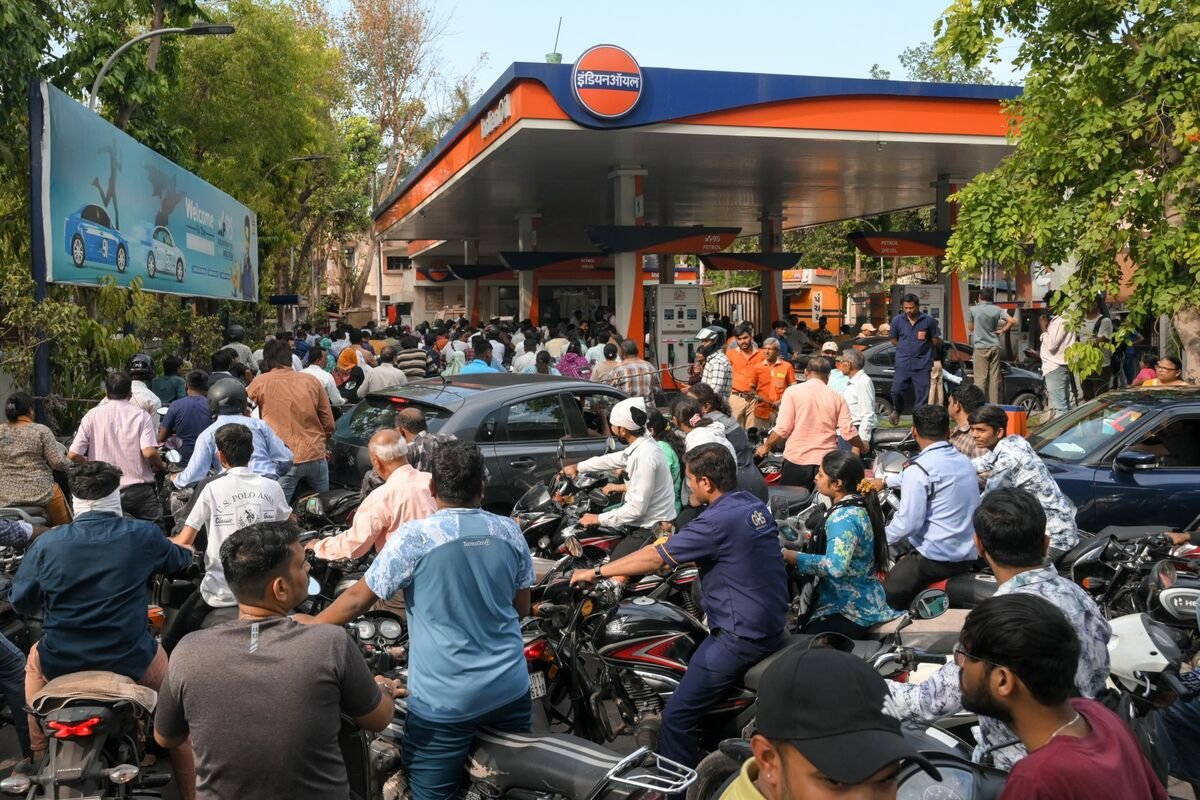
People stand in a queue to refill fuel at a gas station in Guwahati, India, on March 26, 2026.
David Talukdar | Anadolu | Getty Images
Foreign investors are on track to pull a record $12 billion from Indian equities this March as the Iran war disrupts oil and gas supplies, squeezing the economy and stoking fears of a growth slowdown.
With just two trading days left in the month, foreign portfolio investors have already pulled out 1.12 trillion rupees ($12.1 billion) — likely marking the worst monthly selloff, surpassing the previous record of 940 billion rupees in October 2024, according to data from depository firm NSDL.
“Large FII outflows in March 2026 are linked to the conflict in the Middle East,” said Peeyush Mittal, portfolio manager at Matthews Asia — FII refers to foreign institutional investors. “The longer the conflict persists, the deeper the negative impact on India’s economic growth,” he added in an email to CNBC.
Growth worries
HSBC‘s flash Purchasing Managers’ Index released Tuesday showed India’s private‑sector activity in March slowing to its weakest level since October 2022, as softer domestic demand outweighed the strongest rise in international orders.
Companies surveyed cited the Middle East conflict, unstable market conditions, and intensifying inflationary pressures as factors weighing on growth. Cost inflation is now near a four‑year high.
As the world’s third‑largest oil importer and second‑largest liquefied petroleum gas consumer, India is grappling with rising energy costs and panic‑buying amid tightening supplies due to the closure of the Strait of Hormuz.
If oil settles at $85-$95 a barrel after the war, that could lead to incremental outflows of $40 billion to $50 billion — more than 1% of India’s GDP — according to Renaissance Investment Managers CEO and Chief Investment Officer Pankaj Murarka, speaking to CNBC’s “Inside India” on Friday.
This could trim India’s economic growth to 6.5% from from 7.2%, he said.
India is “one of the most vulnerable [countries] to higher oil prices” as its net oil imports amount to 3.5% of GDP, said Hanna Luchnikava-Schorsch, head of Asia-Pacific Economics at S&P Global Market Intelligence. She added that “sustained higher oil prices” could keep the rupee under pressure, in an email to CNBC.
India’s finance minister Nirmal Sitharaman said the country has cut the special excise on petrol and diesel for domestic consumption by 10 rupees per litre each, in a post on X on Friday.
Hardeep Singh Puri, India’s minister for petroleum and natural gas, in a Friday post on X said that the government will take “huge hit” on taxation revenues to fund the losses faced by oil companies.
An increase in India’s energy bill and slowdown in remittances from the Middle East are projected to widen India’s current account deficits and fiscal deficit, Luchnikava-Schorsch said, warning that “capital outflows are likely to intensify due to global “risk-off’ sentiment and investors’ concerns over India’s economic growth.
Weak rupee meets ‘risk-off’ sentiment
Over the past month, the benchmark Nifty 50 has fallen about 7.4%, while the rupee has weakened sharply against the dollar, touching new lows. Despite regular interventions by the Reserve Bank of India, experts said that the currency is likely to remain under pressure as energy markets remain disrupted.
“The Indian equity market’s performance is tied to oil prices, which depend on Middle East geopolitics,” said Saion Mukherjee, head of equity research at Nomura, in an email to CNBC. He noted that India’s one‑year forward earnings multiple of 17.5 times compares well with the 16.9 times recorded at the onset of the Russia‑Ukraine conflict in early 2022.
Still, analysts warn that attractive valuations alone may not lure foreign investors back soon. The deepening impact of the Middle East conflict on the economy and a weaker rupee remain significant headwinds.

Subscribe now
“We don’t think the decline in valuations is compelling enough to draw foreign investors in the near term,” said Daniel Grosvenor, director of equity strategy at Oxford Economics, citing geopolitical uncertainty and elevated global risk premia in an email to CNBC.
The allocations data for Asia and APAC funds (excluding Japan) in February, compiled by Nomura, showed that more funds have turned underweight on India — 68% as compared to 63% in the prior month.
The global brokerage described India as “one of the biggest” underweights, in a March 23 report.