The United States-Israeli war on Iran has caused the biggest oil disruption in history, according to the International Energy Agency (IEA). The agency was founded in 1974 as a direct response to the 1973 oil embargo, which saw Arab nations, led by Saudi Arabia, cut production in response to Washington’s support for Israel during its war with Egypt and Syria that year.
In 1973, embargoed countries faced a combined shortage of 4.5 million barrels of oil per day, about 7 percent of the global supply at the time.
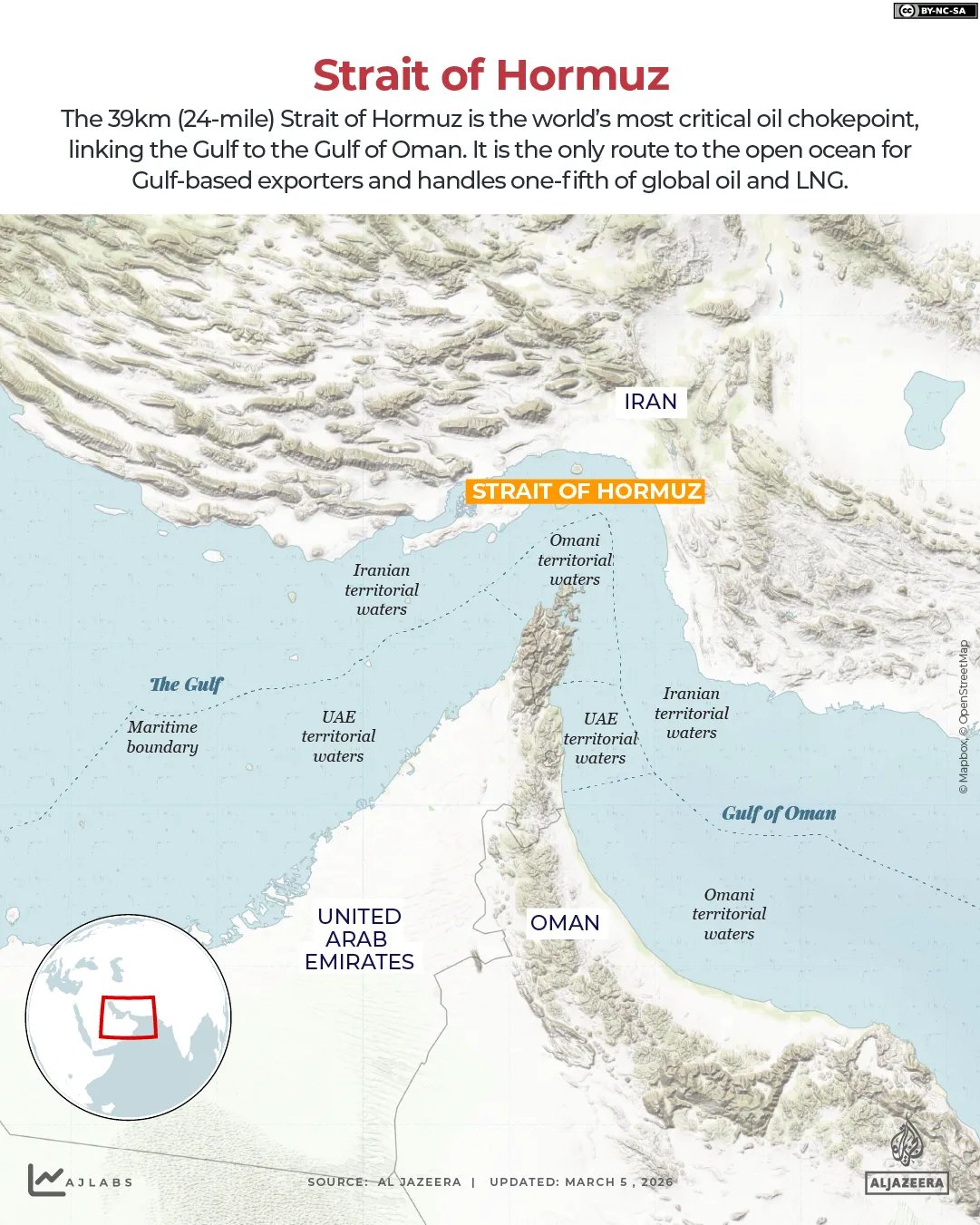
Today, Iran has strangled transit through the narrow Strait of Hormuz, allowing only a handful of ships to go through and halting the transport of more than 20 million barrels of oil per day – roughly one-fifth of global petroleum consumption.
Since the start of the war, the price of Brent crude, the international benchmark, has soared from $66 per barrel to more than $100.
In a bid to ease the crisis, the IEA’s 32 members have agreed to release 400 million barrels of oil from their strategic reserves.
The IEA also has issued guidance to consumers and businesses, recommending that they travel less, work remotely and use electricity for cooking rather than gas, as geopolitical risks drive up not just the price of crude but also the cost of diesel, heating oil and jet fuel.
But experts agreed these measures will do little to address a global oil shortage if the current situation persists.
More than 50 years after the 1973 oil embargo, Al Jazeera examines how that episode compares with today’s crisis.
What happened in 1973?
On October 6, 1973, Egypt and Syria launched an attack on Israel to reclaim territory Arab nations had lost six years earlier.
The 1967 Six-Day War had resulted in the Israeli occupation of Syria’s Golan Heights; Egypt’s Sinai Peninsula; the Gaza Strip, which Egypt previously controlled; and the West Bank and East Jerusalem, which Jordan had controlled.
To catch Israel off guard, the Egyptians and Syrians had chosen the date of the Yom Kippur religious holiday, the only day of the year in Israel in which there are no radio or television broadcasts, shops close and transportation shuts down as part of religious observations.
King Faisal of Saudi Arabia warned US President Richard Nixon that supporting Israel would jeopardise oil supplies. Despite that, Nixon authorised a large military airlift.
So on October 17, 1973, Arab oil-exporting nations belonging to the Organization of Arab Petroleum Exporting Countries (OAPEC) retaliated by raising the price of oil by 70 percent, cutting production by 5 percent per month and banning oil shipments to the US. The Netherlands, Portugal and South Africa were also targeted for their roles in providing diplomatic and military support to Israel.
At the time, the Middle East accounted for 36 percent of world oil production, and the embargo left the world short of 4.5 million barrels of oil per day.
How did the oil embargo affect petrol prices in 1973?
In the US, where oil imports dropped by 15 percent, the impact was quickly felt. The price of crude oil surged from less than $3 a barrel to more than $12 within months, equivalent in today’s money to a jump from $22 to somewhere between $75 and $80.
American drivers, who had been paying about 38 cents for a gallon (3.8 litres) of petrol at the start of 1973, were paying 55 cents by 1974, an almost 45 percent increase. Petrol stations also ran dry.
In November 1973, Nixon appeared on national television to ask Americans to make sacrifices. Nixon’s administration lowered speed limits, imposed fuel rationing and introduced year-round daylight saving time as an emergency energy conservation measure.
Western Europe and Japan also suffered acutely from the crisis. Japan at the time was importing about 235 billion litres (62 billion gallons) of oil annually with three-quarters of its energy coming from foreign crude oil, of which 77 percent was from Gulf countries. The United Kingdom introduced a three-day workweek, and European governments banned driving on Sundays.
How have petrol prices been affected now?
Before the US and Israel began their strikes on Iran on February 28, Brent crude oil cost $66 a barrel. Within the first week of the war on Iran, it had risen above $100 a barrel – a 60 percent increase.
As soon as the conflict began, Brent futures rose almost 7 percent. On Monday, prices for Brent futures had dropped more than 10 percent to about $100 a barrel after US President Donald Trump’s announcement of a five-day delay before threatened strikes on Iranian energy facilities to allow talks to take place.
At US filling stations, the national average petrol price climbed from less than $3 a gallon across the country to an average of more than $5 in some states – even hitting $8 in some states such as California.
In other countries, petrol prices have risen by more than 50 percent, including in Cambodia, where prices rose almost 68 percent from February 23 to March 11; Vietnam, where they rose almost 50 percent; Nigeria (35 percent); Laos (33 percent); and Canada (28 percent).
The Middle East is home to five of the world’s top 10 oil producers: Saudi Arabia, Iraq, the United Arab Emirates, Iran and Kuwait, who use the narrow channel between Iran and Oman to export their oil. It is the only waterway available to Gulf oil and gas producers needing to send supplies to the open ocean for shipping to buyers.
Gavekal Research, an independent macroeconomic research firm, has estimated that Gulf exporters, including Iran, could reroute at most 3.5 million barrels of oil per day (bpd) that they usually send by ship to terminals outside the strait via oil pipelines. But as long as the bulk of shipping traffic remains suspended at either end of the Strait of Hormuz, the world would still face a supply shortfall of about 15 million bpd.

What happened in the aftermath of 1973?
The oil embargo was lifted in March 1974, but its economic consequences took the better part of a decade to be resolved.
US inflation hit 12.3 percent in 1974, up from 3.4 percent in 1972. This is because movements in the price of oil have a far-reaching knock-on effect. Oil is used to manufacture many items we use on a daily basis, and natural gas is vital for the manufacture of urea, one of the world’s most common fertilisers. Without fertiliser, crop yields are much smaller, and food prices surge.
The recession that followed the 1973 oil shock was among the deepest of the post-World War II era, affecting those countries most dependent on oil, namely in the Western Hemisphere. In the US, unemployment climbed from 4.6 percent in October 1973 to 9 percent by May 1975 while its gross domestic product (GDP) grew by 5.7 percent in 1973 and contracted by 0.5 percent the following year.

Other major economies were hit hard as well, particularly Japan, whose GDP grew at 8 percent in 1973 and shrank by 1.2 percent in 1974. In the same period, the UK’s GDP saw figures of 7.3 percent growth and a 1.7 percent contraction.
The US Federal Reserve raised its benchmark interest rate from 5.75 percent in 1972 to a high of 12 percent in 1974 but still could not contain inflation. Fed Chairman Paul Volcker ultimately led the central bank to raise rates to 20 percent in 1980-1981, triggering a second, even deeper recession to finally break the high inflation rate. In the UK, the benchmark interest rate rose to a record high of 17 percent in November 1979 while other Group of Seven countries also saw double-digit interest rates.
What could happen now?
Many economists are talking about the prospect of stagflation, which is the combination of high inflation, stagnant economic growth and high unemployment, which defined the 1970s in Western countries like the US and the UK.
Major oil shocks have historically summoned such stagflation. Economists pointed to the crises of 1973, 1978 and 2008 as evidence that every significant spike in oil prices has been followed, in some form, by a global recession.
In lower-income countries, where populations spend a far greater share of their income on food and which import large quantities of grain and fertiliser, rising oil prices could rapidly translate into skyrocketing food prices and lower food supplies.

How did governments respond to the oil crisis of 1973?
Besides implementing energy conservation measures, such as reducing heating oil supplies by about 15 percent to homes and offices, heating homes at lower temperatures and reducing the amounts of fuel for aircraft, the Nixon administration also created the Federal Energy Office to coordinate the government’s response to the crisis.
Secretary of State Henry Kissinger brokered talks with Arab leaders and pushed for an Israeli withdrawal from the Sinai Peninsula and Golan Heights. Those negotiations bore fruit in January 1974 with the First Egyptian-Israeli Disengagement Agreement, and the embargo was formally lifted in March 1974 although the higher oil prices it had unleashed were there to stay.
The crisis left a lasting mark on energy policies worldwide. Nixon launched Project Independence, aiming for full US energy self-sufficiency by 1980, while governments across Europe doubled down on developing nuclear power. Investment poured into wind, solar and geothermal research, and fuel efficiency standards for cars were tightened.
The US is now energy self-sufficient and has been a net total energy exporter since 2019, according to the US Energy Information Administration.

Over the longer term, Japan underwent fundamental restructuring to reduce its dependence on imported oil and diversify into alternative energy sources, including liquefied natural gas. It also underwent a shift away from oil-intensive industries into sectors like electronics.
How are governments responding to the oil crisis now?
Within days of the conflict starting, the IEA’s 32 member nations coordinated the largest emergency drawdown of their strategic oil reserves in the agency’s history, and the 400 million barrels were more than double the volume released after the 2022 outbreak of the Russia-Ukraine war. The US alone is contributing 172 million barrels over the course of this year.
The IEA’s emergency architecture has been activated only six times since the agency’s founding in 1974: 1991, 2005, 2011, twice in 2022 and 2026. Member nations collectively hold more than 1.2 billion barrels in their strategic reserves with a further 600 million barrels held by the oil industry under government obligation.
The 400 million barrel release will compensate for about 20 days of oil flow through the Strait of Hormuz but will take months to implement fully. Even deployed at maximum scale, however, the emergency architecture built in direct response to the 1973 embargo cannot cover a sustained closure of the strait.
On Friday, in a bid to control oil prices, the Trump administration lent more than 45 million barrels of crude from its strategic petroleum reserve to oil companies.
Other countries have their own reserves as well.
China, for example, has strategic petroleum reserves that are estimated to be able to sustain about 200 days of normal consumption, according to Deutsche Bank Research. However, for many developing nations, the cushion is far thinner.
Why is this crisis different?
Analysts argued that the historical parallel between today’s crisis and that in 1973-1974, while instructive, obscures important structural differences.
In 1973, the shock was delivered by a unified, multinational bloc targeting specific Western countries. The current disruption stems from a single actor controlling a single transit point with no coordinated production cut among Gulf producers and some countries more vulnerable than others.
One of the most enduring legacies of 1973 was the resulting diversification of global investment in alternatives to Middle Eastern oil, such as North Sea oil, US shale, liquefied natural gas and nuclear energy. Oil’s share of global primary energy has fallen from 46.2 percent in 1973 to 30.2 percent today.
However, that diversification has been overwhelmingly concentrated in members of the Organisation for Economic Co-operation and Development with Europe, North America, Japan, South Korea and Australia all substantially reducing their oil dependency.
In 1973, the shock was concentrated on Western economies, which were the primary targets. In 2026, the most vulnerable economies are the developing Asian markets that have grown fastest over the past 30 years and about 80 percent of whose oil imports pass through the Strait of Hormuz. Vietnam holds fewer than 20 days of oil reserves. Pakistan and Indonesia hold about 20 days each.