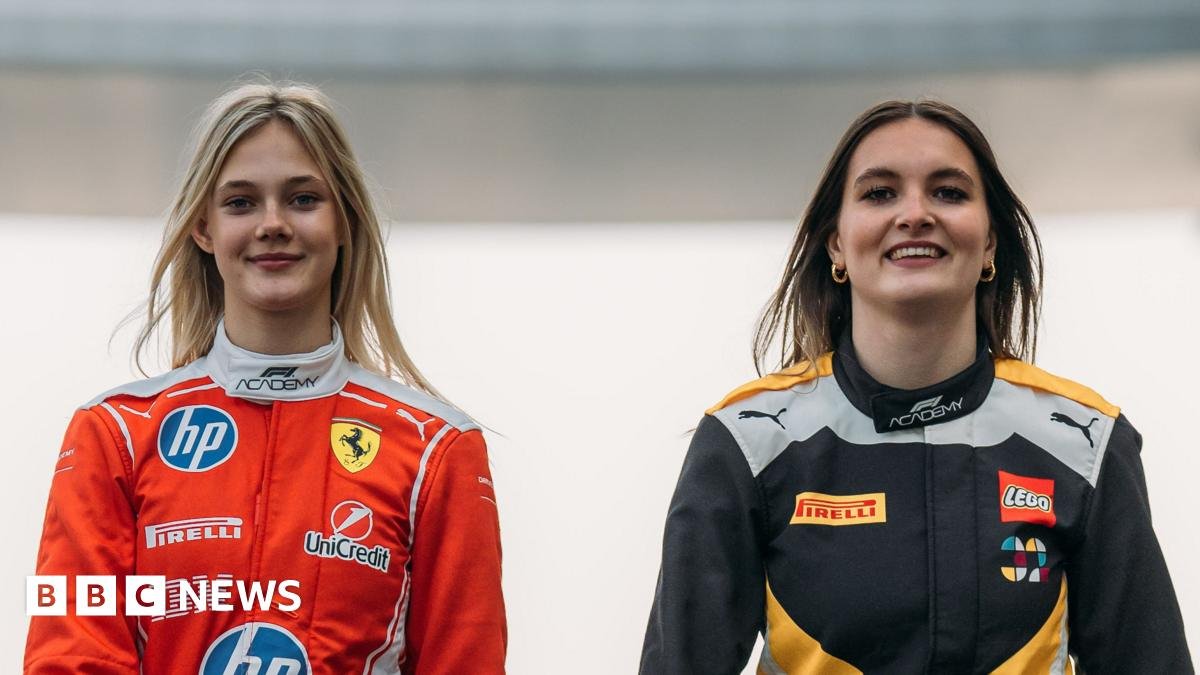
F1 Academy is not without its critics. Some, including four-time F1 world champion Max Verstappen, have expressed concerns the cars used in the series are too slow to allow women to properly advance up the F1 ladder.
Others have questioned the purpose of separating female drivers into their own category.
Larsen says there is a lot of pressure on women drivers.
“You can’t make too many mistakes because then people will say, ‘They’re women drivers, of course that’s what’s gonna happen.’ But that’s not how it is,” she says. “I can be aggressive too!”
Robertson is excited for the opportunity to learn from other women on the track after years of isolation.
“Women neurologically are not the same as men. There’s so many differences, and how that shows when all 18 of us are driving together, I’m very curious to see,” she says.
There is also financial pressure on female drivers. The cost of an initial racing kart alone can be upwards of £7,500 ($US10,000), and women often struggle to source early investment and sponsorship – a critical factor in being able to continue in the sport.
However, unlike other female-focused motorsport projects of the past (for instance, the defunct W Series), F1 Academy looks to be here for the long haul.
The category has a multi-year partnership with all 11 of the F1 teams, and the support of major sponsors.
Its most recent champion, France’s Doriane Pin, has stepped up as a development driver for the Mercedes F1 team this year. The drivers crowned in 2023 and 2024 – Spain’s Marta García and Britain’s Abbi Pulling – are also still on track, competing in regional and international championships.
“I remember when I was eight years old in primary school, writing on, ‘what do you want to be in the future?’,” says Robertson.
“I wrote ‘F1 driver.’ That’s the shining gold star.”