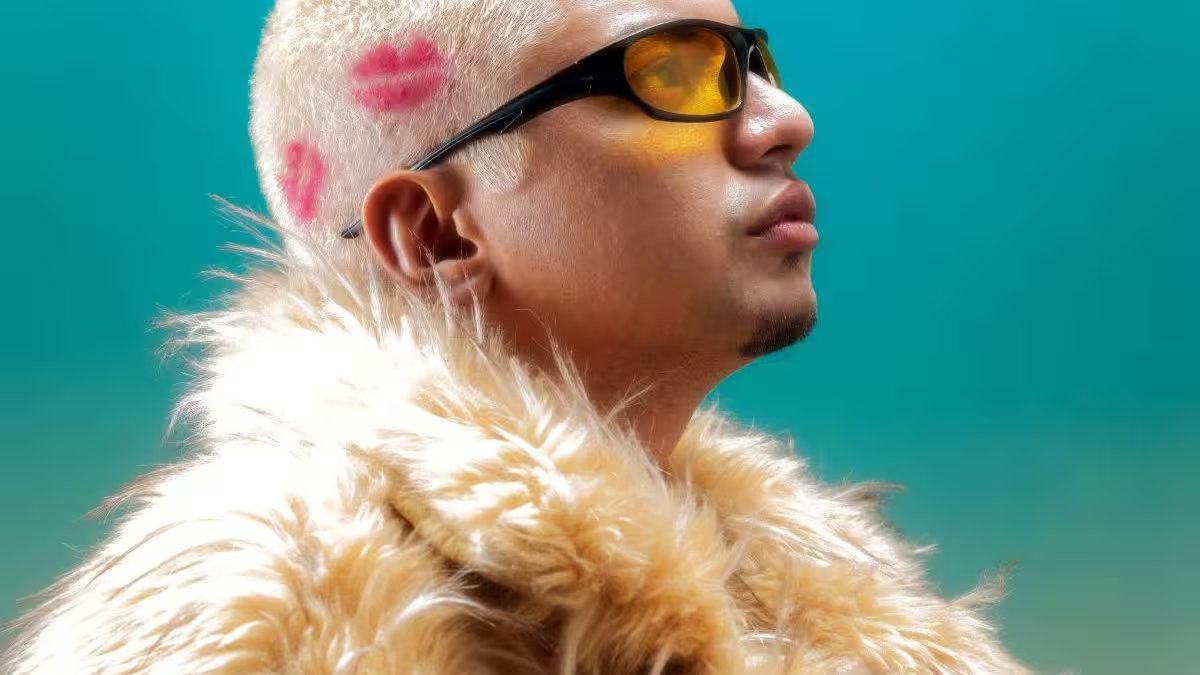
Before he became Nanku, the Delhi artist released music under the name Udbhav (his real name) that, he admits, people constantly mispronounced. The problem followed him everywhere: interviews, gigs, casual introductions. Ever since childhood I’ve had this problem,” he says with a laugh. “People would say ‘Udha’ or ‘Vaiva’ or some random thing. Nobody would pronounce it properly.” The change came after conversations with mentor Yo Yo Honey Singh, who offered a piece of advice that would reshape the artist’s identity.
The suggestion lingered. The name was short, playful, and easy to pronounce anywhere. Two syllables, five letters, instantly memorable. It ended up being more than a cosmetic surgery like change — today, Nanku describes what he makes with a kind of cheerful directness: “It’s just the next generation of Hindi pop music.” In many ways, that philosophy crystallises in Pyar N’ Stuff, the project that captures Nanku leaning fully into the possibilities of Hindi pop — bright melodies, playful lyricism and a willingness to draw from influences far beyond the typical pop palette.
A pop album that doesn’t overthink itself
For Nanku, Pyar N’ Stuff isn’t meant to be decoded like a conceptual art project. In fact, he’s refreshingly blunt about the purpose of the music. At one point in our conversation, he reflects on a phase when he worried intensely about making “serious” art — the kind of existential anxiety many young musicians feel when they’re trying to define their voice. Over time, he realised that most listeners weren’t searching for profound philosophical statements in pop songs. They simply wanted music that felt good.
“I’ve had my fair share of phases where I was like, ‘Oh my God, I’m an artist, I need to make something meaningful,’” he says. “But I think that comes from angst when you’re growing up and trying to find your place in the world. Most people don’t even care about all that,” he says with a laugh. “They just want something they can listen to while taking a bath, going to work, or driving somewhere.”
That ethos runs throughout Pyar N’ Stuff. The album moves easily between flirtation, humour and affectionate absurdity, often embracing lines that are intentionally goofy rather than poetic in a traditional sense. Nanku isn’t chasing solemn romance; he’s chasing the giddy, chaotic energy of attraction itself. The songs feel designed for everyday moments — late-night drives, group hangs, the idle scrolling of a phone — rather than dramatic emotional climaxes.
The Bhojpuri detour that became “DM”
Even within that playful pop framework, moments of unexpected experimentation slip in. One of the most memorable came while Nanku was working on a song that would eventually become “DM.” The track began as a smooth Hindi ballad built over an R&B-inspired beat. But the direction changed completely when his mother — who is from Gopalganj in Bihar — walked into the room while he was writing.
“She asked me what I was making,” he recalls. “And I said, ‘Tell me how to say this line in Bhojpuri.’”
The experiment snowballed. As his mother began translating phrases, Nanku started writing them directly into the song.
“I told her, ‘Wait, wait, don’t go anywhere,’” he says. “And then I just kept asking — how do you say this in Bhojpuri? How do you say that?”
Within an hour, the track had transformed into something entirely new. “We finished the whole song in about an hour — with the rap and everything,” he says. “And I was like, what the hell is this? I had never heard anything like that before.”
The response, he says, was immediate. Listeners from Bihar and eastern India reached out to him, often expressing surprise at hearing Bhojpuri woven into a contemporary pop sound.
“One girl from Patna told me, ‘Everyone thinks Bhojpuri music is only about certain things, but what you’ve done with this song is amazing,’” he recalls. “She said, ‘Please make more Bhojpuri music.’” For Nanku, the reaction confirmed something he had already suspected — that regional languages could thrive within modern pop contexts if artists approached them with curiosity rather than stereotypes.
Growing up on internet music
To understand how Nanku arrived at this genre-blurring approach, it helps to look at his early listening habits. Long before he was writing pop songs, he was a teenager wandering through the early internet’s vast musical rabbit holes. A cousin first introduced him to tracks by Linkin Park, which opened the door to a broader fascination with rap and hip-hop artists like Akon and Eminem.
But the moment that truly rewired his imagination came when he encountered Skrillex’s breakout EP Scary Monsters and Nice Sprites. The sonic intensity of the project — its distorted drops, jagged synths and unapologetic electronic chaos stunned him. More importantly, he discovered that Skrillex had created the entire EP largely on a laptop.
“That completely shattered my definition of what music could be,” he says. “I realised you don’t necessarily need a full band or expensive studio to make something powerful.”
What followed was a period of near-total immersion in production. He spent years teaching himself software, building beats and experimenting with sound design, sometimes working through the night simply because he couldn’t stop.
Building the Nanku sound
That obsessive DIY phase eventually evolved into a more structured creative process. Today, Nanku thinks about music in distinct stages. When he writes lyrics, he focuses entirely on storytelling and emotional tone. When producing, his attention shifts toward rhythm, arrangement and sonic texture. Recording vocals becomes a separate phase where performance and delivery take centre stage.
“I treat them like different jobs,” he explains. “When I’m writing, I’m only a lyricist. When I’m producing, I’m only a producer.”
Behind the scenes, another instinct shapes the final product: his role as a curator. It’s the instinct that determines how a song ultimately feels — what to keep, what to cut, what sonic colours belong in the track.
That curatorial sensibility is especially visible across Pyar N’ Stuff, where pop hooks coexist with hip-hop rhythms, R&B textures and occasional regional inflections.
Crafting a pop persona
The album’s visual identity reflects a similar blend of playful pop and careful construction. When developing the artwork, Nanku initially resisted the industry’s reliance on visual references. Eventually, however, he found inspiration while browsing classic album covers online, particularly the imagery of Madonna’s Like a Prayer.
The photoshoot that followed leaned heavily into sensual symbolism: fragments of jewellery, hands and body silhouettes arranged across images to form a larger narrative. Even the typography carried a mischievous pop sensibility, borrowing inspiration from the cartoonish lettering style of The Powerpuff Girls. The aesthetic mirrors the spirit of Pyar N’ Stuff itself — flirtatious, colourful and slightly tongue-in-cheek.
Chasing the next level
Despite the playful energy surrounding his music, Nanku insists he’s still deeply focused on improving his craft. Two ambitions currently guide his next chapter. The first is becoming a stronger songwriter — reaching a point where he feels completely satisfied with the emotional and lyrical depth of his work.
The second is expanding the sonic landscape of his productions by incorporating more live instrumentation. For someone who started out building entire songs on a laptop, it’s a natural progression: moving from purely digital soundscapes toward something more organic and textured.
Pop, without pretence
If Pyar N’ Stuff represents anything, it’s Nanku’s comfort with pop as a form of everyday joy rather than artistic burden. He’s no longer preoccupied with whether his music is “serious enough” or intellectually dense. Instead, he’s interested in something simpler: songs that people genuinely want to play.
Sometimes that means mixing Bhojpuri into R&B. Sometimes it means writing lyrics that feel goofy rather than poetic. And sometimes it simply means making music that fits naturally into everyday life. “Humans just need something to pass the time,” he says. “That’s where my fascination with the entertainment industry comes from.”
For Nanku, pop doesn’t need elaborate theory. Sometimes, he says, it just needs a good hook — and perhaps an iced Americano.
End of Article