It’s possible to get in on SpaceX (SPAX.PVT) before its initial public offering (IPO), but there are risks, trade-offs, and heavy fees.
The upcoming SpaceX IPO could happen as early as this June, with a potentially massive 30% retail allocation, with underwriters of major trading platforms providing retail investors with allocations post-IPO.
But for those who want in a little sooner, it’s a little complicated.
The most direct route to SpaceX stock before an IPO is through a private secondary market. These are transactions in which existing shareholders — employees, early investors, or former contractors — sell their vested stock to new buyers. SpaceX does not issue new shares in these deals; investors buy from existing shareholders.
It’s been quite a popular option in recent months.
“SpaceX is consistently one of the most actively traded names on our platform because there’s nothing else like it in the private markets today,” Greg Martin of Rainmaker Securities, which specializes in the secondary markets, told Yahoo Finance. “You’ve got a highly defensible, massive operating scale business, a multitude of major TAM [total addressable market] expansion opportunities, with a continuously evolving story.”
Added Martin, “Demand has also almost always outpaced supply, and that’s been true even during periods where broader secondary market activity has been more muted.”
Shares purchased on secondary markets are typically subject to a lockup period after an IPO — usually 90 to 180 days — during which you cannot sell. This is a standard limitation designed to prevent a flood of supply hitting the market immediately after listing.
Once the lockup expires, shares convert to tradable stock, and owners can sell, hold, or transfer them like any other public company share.
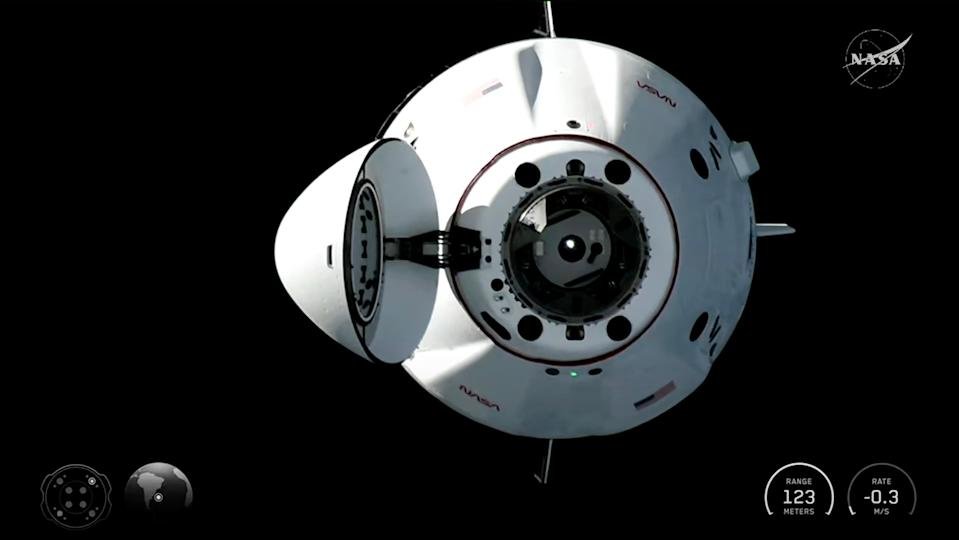
In this image from video provided by NASA, a SpaceX Dragon capsule carrying Americans Jessica Meir and Jack Hathaway, France’s Sophie Adenot and Russia’s Andrei Fedyaev, approaches the International Space Station for docking on Saturday, Feb. 14, 2026. (NASA via AP) ·ASSOCIATED PRESS
To participate in private markets, individuals must qualify as accredited investors — meaning they must have income above $200,000 per year (or $300,000 combined with a spouse) for at least two consecutive years or a net worth exceeding $1 million, excluding a primary residence. Investment minimums are steep: Most platforms require at least $50,000 to $100,000 per transaction.
Aside from Rainmaker, other secondary platforms of note include EquityZen, Forge Global, and Hiive. (Disclosure: Yahoo Finance’s Private Market Hub has a partnership with Forge Global and EquityZen.)
Hiive is a newer entrant with real-time pricing data. As of April 2026, Hiive lists SpaceX shares at around $832 per share.
Even Nasdaq, which will most likely list SpaceX stock once it goes public, has its Private Market offering. Nasdaq says it primarily serves institutional and high-net-worth investors, and it tends to facilitate larger block transactions directly from insiders and funds.
Other ways to “buy” SpaceX ahead of the IPO are structured through Special Purpose Vehicles (SPVs) or funds, rather than as direct share ownership.
Elon Musk attends the finals for the NCAA wrestling championship, March 22, 2025, in Philadelphia. (AP Photo/Matt Rourke, File) ·ASSOCIATED PRESS
In these cases, you hold an interest in a fund that owns the shares — not the shares themselves. Post-IPO mechanics can differ slightly, as some will give stock to their investors, while others will likely offer a cash payout.
One investor told Yahoo Finance that he invested in an SPV that provides exposure to a mix of both SpaceX common and preferred stock through a venture capital fund for accredited investors. While he was able to invest early on SpaceX shares, he noted that “fees are heavy.”
“An investor must be careful to avoid a situation where the combination of fees and a small percentage holding makes the investment unattractive,” Jay Ritter, University of Florida professor and director of the IPO Initiative, said to Yahoo Finance.
A simpler method to get exposure to SpaceX (and one that offers more liquidity) is several publicly available ETFs and mutual funds. The Fidelity Contrafund (FCNTX) is one of the granddaddies of growth investing, managed by William Danoff since 1990 and having huge hits with investments in Meta (META), Nvidia (NVDA), Amazon (AMZN), and Microsoft (MSFT), among other large-cap growth companies.
A Starlink satellite broadband antenna from SpaceX is on sale in the computer department of a Fnac store in the Victor Hugo shopping center in Valence, France, on March 8, 2025. (NICOLAS GUYONNET/Hans Lucas/AFP via Getty Images) ·NICOLAS GUYONNET via Getty Images
“We like SpaceX, in part, for its Starlink business focusing on low-earth-orbit satellites, which has created a web of broadband internet access to previously underserved communities in rural and remote areas,” the fund wrote in its 2025 end-of-year review.
Contrafund’s position in SpaceX is valued at around $3.5 billion, or just over 2% of the fund’s $170 billion in assets.
ERShares Entrepreneur 30 ETF (XOVR) holds approximately $205 million in SpaceX exposure through a special-purpose vehicle, making it an ETF with a stake in the company, though the ETF does not provide direct ownership of SpaceX stock.
Baron Partners Fund (BPTRX): A mutual fund with roughly 33% of its portfolio in SpaceX (it’s largest position), one of the heaviest weightings of any publicly accessible fund. Founder Ron Baron is a noted fan of Elon Musk and an early backer, so the fund’s high ownership of SpaceX is not a surprise, and it’s ahead of Tesla at 20.4%.
ARK Venture Fund is managed by noted tech investor Cathie Wood of ARK Invest, with the fund targeting private market disruptors. SpaceX is its largest holding at around 17% weighting. Note the ARK Venture fund is a closed-end mutual fund, and totally separate from the ARK Innovation ETF that boomed during Tesla’s big run, but cooled off recently.
For broader space sector exposure without direct SpaceX stakes, funds like the ARK Space Exploration ETF (ARKX) and the Procure Space ETF (UFO) track companies across launch, satellite, and defense — sectors that stand to benefit if SpaceX’s growth continues, and rerate the entire sector.
With SpaceX reportedly filing for an IPO targeting a $1.5 trillion to eye-popping $2 trillion valuation, the window for pre-public entry is narrowing.
Another option to keep in mind is timing — and whether it even makes sense to invest in SpaceX now.
“Investors make money by buying low and selling high. The price today is no longer low,” Ritter said.
“SpaceX might be a great company, but a great company is not the same thing as a great stock.”
Pras Subramanian is the Lead Transportation Reporter for Yahoo Finance. You can follow him on X and on Instagram.