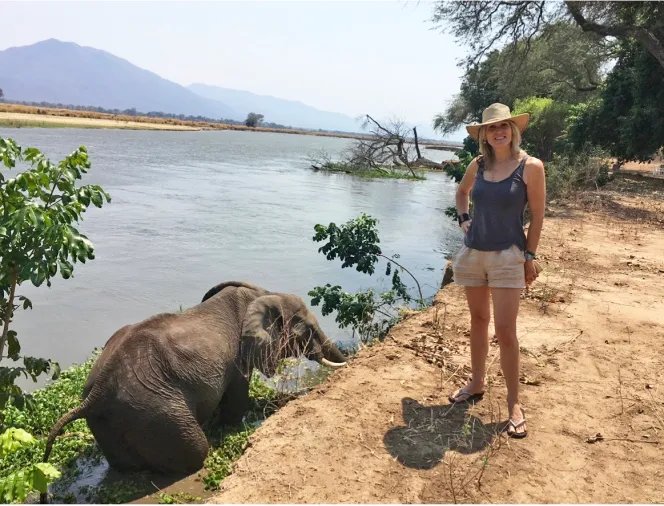
My first job was dreamy. I researched chimpanzee behaviour, looking after six baby chimps, teaching them to climb trees and forage. I went on to work across Africa, spending four years deep in the bush working on my Cambridge PhD on the mating habits of the lesser galago, a nocturnal primate. It was everything I had worked for. My life was fieldwork and scientific discovery. Then I met my husband and everything changed [says Samantha Corsellis].
He is an investment manager and his world is London boardrooms — a universe away from the remote campsites that defined mine. There was no way he could find work in the African bush, so a choice loomed over us from the beginning of our relationship.
The day he proposed was incredible. He’d hired out the whole of London Zoo. We arrived by taxi at three o’clock on a crisp April afternoon. He’d adopted a macaw and since it was the day before my birthday I assumed it was simply an unusually thoughtful gift. We wandered past the enclosures together and when an announcement came that it was closing at four, I said we’d better go.

He replied calmly, “Well, it’s closing but I’ve hired the zoo.”
I didn’t understand. He led me to a table set inside the tropical birdhouse, where champagne was waiting. At that point, my plan was to return to Botswana to undertake a post-doctorate on elephant migratory routes. I thought this might be a goodbye.
To my astonishment, he asked me to marry him. Later, he told me that when he’d called to hire the venue, they asked whether the booking was for “two hundred or two thousand”. It was incomprehensible that it was just for the two of us.
I had 45 seconds to make my decision, or that’s how it felt. In that fleeting moment, I saw two futures. One was the continuation of the career I had poured my soul into — the research, the life I had built in the bush. The other was him, love and the potential for a family. I chose him. I was devastated that my career as I knew it was over, but the choice was made.
Our wedding reception was held at the Natural History Museum — where else? Our guests dined under Dippy the diplodocus [the replica dinosaur skeleton at the museum’s heart], with green foliage, spotlights and chairs adorned with butterfly creations. Our three-tiered cake had an iced monkey climbing up it.


We moved to London and I became a traditional wife. I fell pregnant on our honeymoon and we had two children, now 21 and 23. We lived between Notting Hill and the Cotswolds.
I worked on a few NGO boards but I could never fully resume my career.
When you have small children, you cannot simply leave home and disappear into the bush for months. I am a very traditional mother and made the conscious decision to focus on my children. Having spent years observing mothers in the wild — primates, elephants, all fiercely protective — I understood that the pull to help your offspring survive is universal. My instincts were drawn from the animals I had studied for so long. I poured myself into motherhood. Then Covid hit and my children came of age.
Suddenly, I hit a wall. The combination of menopause and watching my children leave home sent me into a spiral of unhappiness. The identity I had built as a mother was shifting and I was left confronting the question I had buried for over two decades: who was I without the bush?

Picking up my career was the obvious solution. The joy of my work had never left me; it had only been dormant. I was appointed as chief scientific officer and trustee of Wild Survivors, a charity that builds beehive fences in Tanzania to deter elephants from raiding crops. It’s a response to the poaching epidemic and the conflict that occurs when elephants enter farmland. Crops are destroyed, livelihoods lost and farmers often retaliate.
I’ve got two trips to Tanzania coming up to see the progress, but we continue to live in England. My work brings me joy but it is the community aspect that fills a deeper purpose. Wild Survivors empowers women in Tanzania to become beekeepers, producing honey that supports their livelihoods while conserving elephant corridors. The profits are reinvested into the communities, helping women pay for school fees and start small businesses.
As a woman, to help other women change their fortunes gives me a great sense of pride. I am bridging the gap between conservation and human welfare that I spent my early career studying.

I made the right choice all those years ago — but it was also the hardest one of my life. I don’t regret choosing my husband or my children. But now I have finally found a way to have both the family I built and the wild that made me who I am.