India is considering releasing venomous snakes and crocodiles into its river border with Bangladesh as an alternative to building a physical barrier along parts of its eastern frontier.
Prime minister Narendra Modi’s nationalist party has ploughed significant resources into building a fence along the 4,096km border with Bangladesh, but around 20 per cent remains largely open. Of the 850km unfenced stretch, some 175km is considered unsuitable for a physical barrier due to the marshy terrain and the risk of flooding.
Now, the idea of dispatching dangerous reptiles into this riverine environment is being discussed in meetings and internal memos from the Border Security Force, according to local media reports.
An internal official memo dated 26 March was reportedly sent from BSF headquarters to field units along the Bangladesh border, asking them to assess this as a potential operational measure in areas where building physical barriers would be difficult.
The memo said the use of “reptiles is in line with home minister Amit Shah’s directions”, reported The Hindu, referring to Mr Modi’s home minister and close aide who has been the face of a crackdown on immigration in India’s eastern states.
The gaps in question are largely located in West Bengal, Assam, Meghalaya, Tripura and Mizoram, states where migration across the border has become a divisive political flashpoint. Human rights groups have repeatedly raised concerns about the ruling party’s populist rhetoric against immigrants from Muslim-majority Bangladesh, warning that minority communities in the region have been caught in the crossfire.

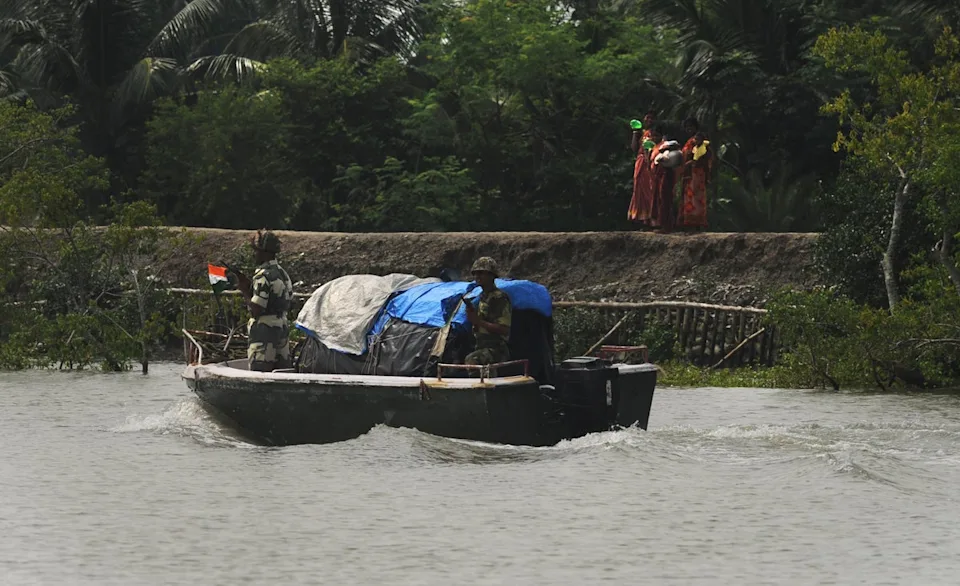
File: Indian Border Security Force (BSF) personnel patrol on the Kalnidi river in the Indian state of West Bengal, bordering Bangladesh’s Satkhira district, near Satnabad (AFP/Getty Images)
The memo about using reptiles to make border crossings more hazardous was first reported by local outlet Northeast News, which said the idea had been in discussion since 9 February, when BSF director-general Praveen Kumar chaired a meeting.
Sector commanders were instructed to assess the feasibility from an “operational perspective” and report back on actions taken by a specified deadline. Units were also asked to identify “dark or no-signal areas” where additional border security measures may be needed.
BSF officers are said to have flagged several challenges with the proposal, including potential risks to local communities living along the border and the practical difficulties of implementing such a measure.
The Independent has approached the BSF for comment.
While the reptile release idea might be unconventional, it comes at a time when the Indian government has invested in a range of new approaches to border management, including the deployment of drones and infrared or night-vision cameras.

Border Security Force (BSF) personnel inspect a truck carrying supplies to Bangladesh at the India-Bangladesh border in Fulbari on the outskirts of Siliguri on August 7, 2024 (AFP/Getty Images)
The Modi administration has taken a hardline stance on illegal migration, particularly targeting undocumented Bangladeshis and Rohingya Muslims, with many reportedly deported across the border without due legal process. Some alleged that they were blindfolded and left in a jungle to walk to Bangladesh.
Rights groups have said thousands of Indian Bengali-speaking Muslims have been rounded up, detained or forcibly sent to Bangladesh as part of the anti-immigration drive. They accuse the BJP of using national security and anti-terrorism laws to discriminate against the country’s Muslim minority.
BJP leaders at both state and national levels have framed the migrants as “infiltrators” from Bangladesh who pose a threat to India’s identity and the demography of the Hindu-majority nation.