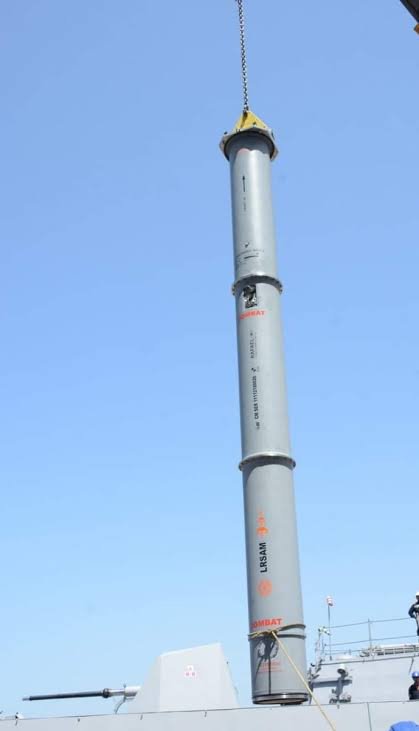
The Indian Navy has released a problem statement titled ‘Rearming by Drone (REARM-D) at Sea’ for the development of a multi-rotor drone for reloading surface-to-air missiles in VLS cells onboard warships at sea.
Faster depletion of Surface to Air Missiles (SAM) onboard warships while countering low cost drones and missiles is cited as the primary reason which necessitates re-arming at sea. Currently, the replenishment procedure involves jetty cranes in harbour which incurs significant operational downtime of the ship.
The Multi-Rotor Drone is proposed to have an endurance of over two hours and payload capability of over 900 kgs. An internal combustion engine will power the UAV for prolonged station keeping and flights amidst various controlled ship speeds, wind directions and weather patterns.
The UAV shall transfer the SAM canister from a supply ship to a receiving ship using a gyro stabilised platform to minimize payload swing. Once it reaches the warship, the UAV should hover above the Vertical Launch Unit (VLU) module with guided precision to align over the specific VLU cell. The lowering of the missile into the cell will utilize a winch onboard the UAV, with real time stabilisation to keep the payload steady. A suitable loading mechanism which is both portable & removable shall also be provisioned on the designated VLU cell for vertically loading the missile canister.

While the practicality of the concept is debatable, the problem statement is among the first public indicators that the Indian Navy is exploring at-sea rearming. The multi-rotor drone will not enable replenishment of strike weapons, with the primary strike missile of the Navy, the BrahMos, weighing close to 3,000 kg. However, the specifications will help replenish MRSAM missiles as well as future SAMs such as VLSRSAM.
The design and development of such a large UAV capable of weathering maritime conditions while maintaining extreme precision will be challenging. The UAV will have to be very large to accommodate the large mandated payload, with most multi-rotor defence UAVs under development in India having payload carrying capability of under 100 kg. Notably, the payload capacity is comparable to that of larger eVTOL aircraft, with India having multiple firms developing such aircraft.
The problem statement is a part of the 14th edition of the Defence India Startup Challenge (DISC). DISC is intended to support futuristic technology developments by startups. Navy’s problem statements in DISC 14 have a number of other uncrewed systems including VTOL UAVs for ASW, submersible ISR USVs and long range VTOL multi-role attack drones.
Globally, the US is at the forefront of testing at-sea rearming solutions. These solutions involve replenishment ships transferring the missile to the warship, which uses Transferrable Reload At-sea Method (TRAM) equipment to load the missile into the cell. Earlier this year, General Dynamics unveiled a destroyer tender concept which can reload four destroyers simultaneously. The French Navy is also experimenting with at-sea VLS reloading.