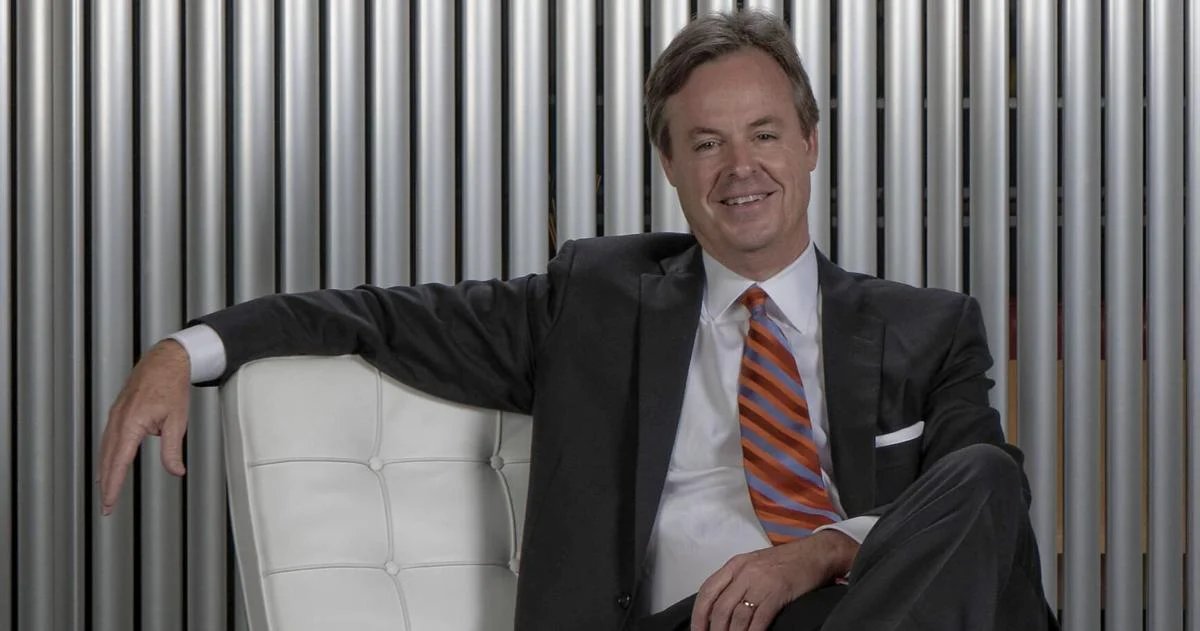
Shelby Russ, president and CEO of New Orleans-based AOS Interior Environments, has spent decades decking out offices, dorms, hospitals and more with high-end furniture, fixtures, modular walls and other interior elements. In 2025, his company had its best year ever, topping $50 million in revenue for the second time.
The work that AOS does gives Russ an insider’s perspective on which sectors of the economy are most active, and from what he’s seen since the pandemic, he’s optimistic about the direction of the state overall. That perspective informs his work as a director of the New Orleans branch of the Federal Reserve Bank of Atlanta, where he reports on local business conditions to help bankers make decisions about interest rates.
A big fan of New Orleans culture, Russ also is part of a team planning to develop a museum called the Louisiana Music & Heritage Experience.
This conversation has been edited for clarity and brevity.
What does AOS do?
We are a design-assist subcontractor for furniture, fixtures and equipment, or FF&E. While architects are focused on the design, we have very specific knowledge about the furnishings that go into the space. We also provide manufactured interior construction, which saves time. Interior walls aren’t just dumb design elements; they’re actually working tools in an office with whiteboards and other features embedded into them.
How did the business start?
It began with records management systems, showing people more efficient ways to store and retrieve their file folders.
My father had been an executive with the old Remington Rand company and then became a dealer for them. He started the business in Algiers in 1976.
This is the era back before computers, so having physical things to hold all your paper was really important. The big tech then was microfilm: taking records and moving them to one-thirtieth of their size on film. That was my first job — head of the micrographics division.
What’s the company’s bread and butter today?
It’s mostly furniture. We represent Knoll and Herman Miller, known for iconic midcentury modern designs. We also have products from 250 other manufacturers.
We do about 400 projects a year. They scale from multimillion-dollar jobs to something as small as a client who needs to order a desk or chair.
How does that compare to furniture made for the hospitality industry? Is it more or less rugged?
Hospitality furniture actually is a lower standard because the useful life is not as long. Hotels expect to change their look more frequently than an office would.
Big markets for us are higher education and health care, where there are some important structural considerations as well. They select materials for hospitals based on infection control, and in schools, if you’re doing a dormitory or a student union, you need the most hardy, robust furniture ever.
Through your work, you see who’s investing in offices. Where’s the action these days?
At one point, our real wheelhouse was corporations, but now we are doing more institutional work: schools, hospitals, government. We took a dip during the pandemic, but then it created opportunities for us as well because companies embraced hybrid models.
We’ve done work for The Port of New Orleans, and we just finished the Municipal and Traffic Court of New Orleans. It’s a wonderful rehabilitation of a midcentury modern building. We did a good bit at LSU Health Sciences Center New Orleans and Tulane and we’re getting ready to do projects at Ochsner.
I’m also optimistic about the investment Tulane is making downtown and the Louisiana International Terminal in Violet. In my youth, New Orleans was the second-largest port in the world, and it’s not the case anymore because of the way international logistics has changed, but there’s an opportunity for us to move way up the ladder there.
If you look statewide, where are you seeing the most action?
I’m very bullish on Baton Rouge, which has a great entrepreneurial culture. It’s a different economy than New Orleans, which is good. They’re growing in areas that New Orleans is not, and vice versa. The more we go to the world as a package, the better off we’re both going to be.
How did you become a Federal Reserve board member and what is your mission there?
They want to understand what’s going on in the economy at street level because the data has limitations. By the time you get it, it’s months old. In an economy like we have today, which is ever-changing and ever-nuanced, you have to know what’s going on at the moment. When they talk to members of these regional boards, it helps them understand the data and make more informed policy decisions.
Where and when do you meet?
Roughly once a month at the Federal Reserve in downtown New Orleans and occasionally in Atlanta.
Why is the culture of New Orleans so important to you?
What a gift and a treasure the city is. I live downtown because I want to be in the center of it all. We raised our kids on the northshore and the ‘burbs. As soon as we became empty nesters, my wife, who’s from New York, said, “Let’s go to the city.”
Pound per pound, New Orleans is the best entertainment value in North America. In Los Angeles, what you have to pay to get a decent seat at a concert is quadruple what you pay here. The shows that we get are disproportionate to the size of our own market. We have an NBA team; we have an NFL team. If you look at the size of the city, we shouldn’t have either one of those, but we do because our millions of annual visitors add to our buying power.
I’m all in on music, history and museums. There’s potential for us to market ourselves as a museum destination.
What’s the status of Louisiana Music & Heritage Experience?
We’ve received a significant commitment from the state Legislature. The design process has already begun, and we’ve raised close to $20 million privately. It’s going to be beautiful.