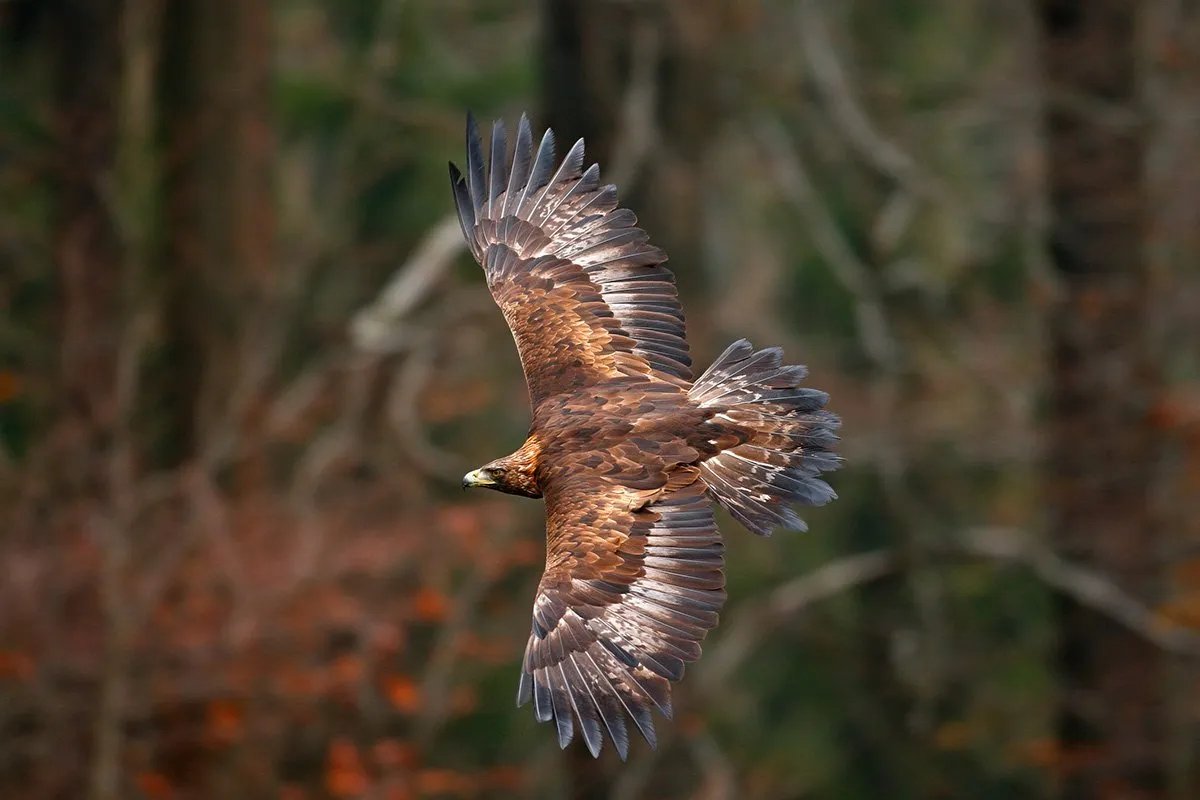
The magnificent sight of golden eagles soaring over the Cheviots and other parts of northern England for the first time for about 150 years may be seen from next year.
Once widespread across England and mentioned more than 40 times by Shakespeare, golden eagles were virtually wiped out by persecution during the Victorian era. Only a handful of pairs have been seen in England since and the last eagle died in the Lake District in 2016.
Now, following the successful reintroduction of the iconic birds into Scotland, an attempt is to be made to replicate the achievement south of the border. Environment Secretary Emma Reynolds has approved £1mn to explore the possibility. Juvenile birds, six to eight weeks old, could be released as early as next year.
Forestry England
A study published by Forestry England confirms that England has the capacity to sustain golden eagle populations once more, with eight potential, unnamed ‘recovery zones’, mostly in the north of the country, identified as being the most suitable areas.
Emma Reynolds said: “This government is committed to protecting and restoring our most threatened native wildlife – and that includes bringing back iconic species like the golden eagle. Backed by £1mn of government funding, we will work alongside partners and communities to make the golden eagle a feature of English landscapes once again.”
In southern Scotland, golden eagle populations have recovered to record numbers, thanks to the restoration efforts of the groundbreaking South of Scotland Golden Eagle Project, said DEFRA, the Department for Environment, Food and Rural Affairs.
Satellite tracking indicated that some of these translocated birds had already begun to fly across the border and explore northern England, said the Department. The new funding would help accelerate this re-establishment and, where appropriate, further reinforce it with targeted reintroductions.
Replicating their successful collaborative approach in the south of Scotland, charity Restoring Upland Nature (RUN) would lead the pioneering project in partnership with a group of core partners, including Forestry England.
Aside from being Britain’s second largest bird of prey with an impressive two-metre wingspan, the golden eagle was a keystone species that could play a vital role in nature recovery more widely, said DEFRA. As an apex predator at the top of the food chain, golden eagles helped to keep the whole ecosystem in balance.
Mike Seddon, Forestry England Chief Executive, said: “It is our ambition that the nation’s forests will become the most valuable places for wildlife to thrive and expand in England. And we know from our successful reintroduction projects that returning lost species is vital for nature recovery across landscapes.
“The detailed findings of our feasibility study will guide us with our partners, Restoring Upland Nature, to take the next steps to explore the recovery of golden eagles in northern England. This DEFRA funding means we can build on the good work we have begun, taking the time to build support and engage with local communities, landowners and land managers and conservation organisations.”
Restoring Upland Nature
Dr Cat Barlow, Restoring Upland Nature chief executive, said: ““This presents a truly exciting, and potentially game-changing moment for the return of golden eagles to northern England. Our success to date is testament to the strength of collaborative working between conservationists, raptor [bird of prey] study groups, gamekeepers and land managers, and to the incredible support of thousands of people across communities in southern Scotland.
“With the backing of DEFRA and Forestry England, we now have the opportunity to replicate and build on this approach in northern England. Our priority will be to listen, to work in partnership, and to ensure that golden eagle recovery supports both nature and the people who manage these landscapes, so that everyone can enjoy the thrill of seeing golden eagles flying high once again across the uplands of the UK.”
Forestry England’s research suggests that Scottish birds could be seen across northern England within ten years, but it will take longer for breeding golden eagles to become established in England.
With support from Forestry England, Restoring Upland Nature will now develop a programme of engagement with farming, game management, recreation, nature conservation, tourism and education interests in the region.
The move to explore reintroducing golden eagles was the latest milestone as the government’s worked to achieve the statutory targets set out in the Environmental Improvement Plan to halt the decline in species abundance by 2030 and to reduce species extinction risk by 2042 against 2022 levels, said DEFRA.
It followed the government’s landmark decision last year to allow the legal reintroduction of another keystone species, beavers, into the wild in England for the first time in hundreds of years, and a record £60m of funding announced recently to protect threatened native species. *This report is based on a press release from DEFRA