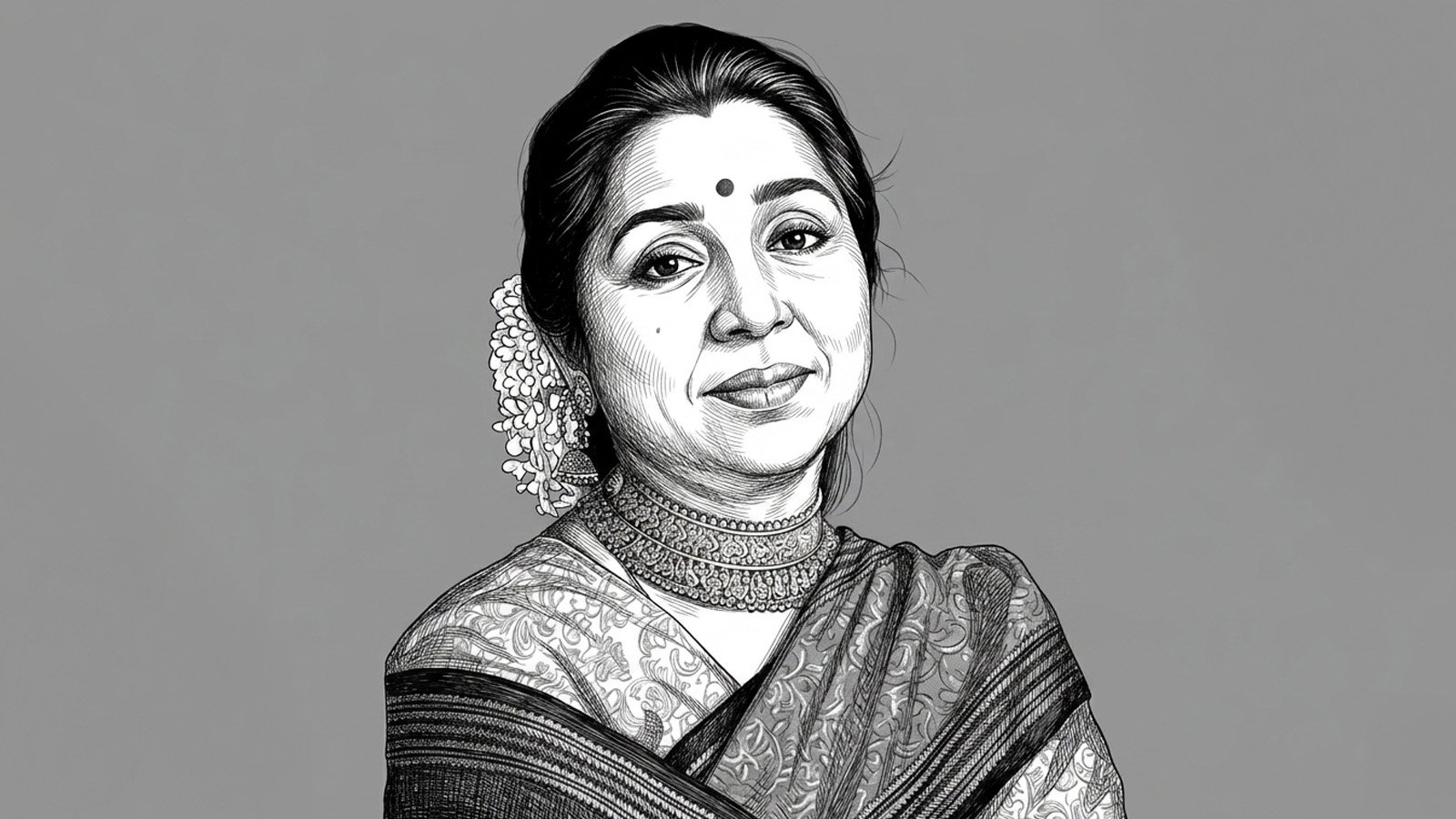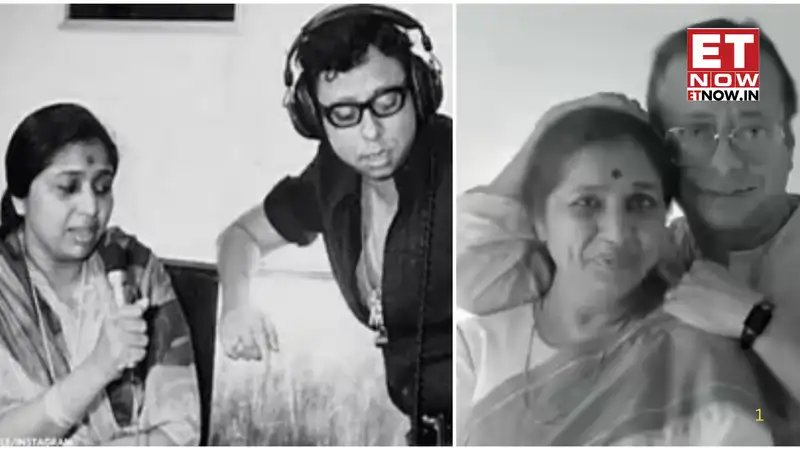

They called each other by nicknames that nobody else used. He was Pancham to the industry — named for the fifth note of the musical scale, a nickname given in childhood that stuck for life. She became Bab to him — a shortening of Babua, a term of endearment that grew out of a song she had recorded and that he quietly adopted as his name for her, used only in private, only between them. In front of colleagues and the wider world, he would call her Asha. But in the moments that belonged only to them, she was Bab. And he was hers.
This is the love story that Indian music does not talk about enough — not because it is unknown, but because the music itself is so overwhelming that it tends to consume all the available attention. Asha Bhosle and Rahul Dev Burman did not merely fall in love. They fell in love while in the process of changing Indian music permanently, and the two things are so thoroughly intertwined that it is genuinely impossible to separate them. The love shaped the music. The music expressed the love. And the result was a body of recordings that, five decades after they were made, still sound like the most joyfully alive thing Hindi film music has ever produced.
The Beginning: A Mother of Two and a Dropout With a Harmonium
-

Pancham and Bab — R. D. Burman and Asha Bhosle — a love story that turned music into something eternal.
The industry noticed. So did both of them.
The 1970s: When They Rewrote Everything
If Teesri Manzil was the announcement, the 1970s were the revolution. The decade produced a sustained run of recordings between Burman and Bhosle that collectively constitutes one of the most remarkable creative partnerships in the history of popular music anywhere in the world. Song after song, film after film, they pushed further into territory that nobody else in Hindi film music was willing to explore — and they made it all sound not just acceptable but inevitable.
Piya Tu Ab To Aaja from Caravan in 1971 was the song that established a new template for what a Hindi film cabaret number could be. Picturized on Helen, it combined a driving brass section with Asha’s most unrestrained vocal delivery to produce something that felt genuinely dangerous in the best possible way — joyfully, deliberately transgressive, a song that announced that Hindi film music had decided to stop being polite.
Dum Maro Dum from Hare Rama Hare Krishna, released the same year, was something different again — countercultural, druggy in its atmosphere, built on a rhythm that owed more to western rock than to any Indian musical tradition, and delivered by Asha with the kind of complete commitment that made it sound like a personal statement rather than a commissioned recording. It divided opinion immediately and has never stopped being played. Its cultural penetration into Indian life is so complete that most people who hum it today have no idea of the controversy it generated when it first appeared.
Each of these songs was an experiment. Each experiment worked. And with each success, they pushed further.
What Burman Heard That Others Missed
The critical question about the Burman-Bhosle partnership is not what they made together but why Burman chose Asha in the first place — and kept choosing her, kept designing recordings specifically for what her voice could do, kept pushing her into territories that no other composer of his stature was willing to explore with any singer at the time.
The answer, by every account from those who knew him, is that Burman heard something in Asha Bhosle’s voice that the conventions of Hindi film playback singing were actively suppressing in other singers. He heard physical energy — a rhythmic responsiveness that could lock into a groove the way western pop singers did and that Indian film music had never demanded of its playback singers. He heard range — not just in terms of octaves but in terms of emotional register, the ability to be mischievous and melancholic and seductive and devotional within the same recording session without any of it sounding forced. And he heard fearlessness — a complete willingness to go wherever the music required without stopping to calculate whether it was appropriate.
-
A love that sang through every note — R. D. Burman and Asha Bhosle changed Hindi music forever.
He encouraged her to try jazz inflections, cabaret structures, rock rhythms, western pop frameworks, all folded into Indian melodic sensibilities in ways that had never been attempted before. She met every challenge without hesitation. The results transformed both of their careers and the industry around them.
In the 2025 podcast conversation with RJ Anmol and Amrita Rao, Asha recalled Burman’s relationship with his own talent with an affection that illuminated the man behind the music. “He didn’t even know that he was such a big music director,” she said. “He made music, but he had no ego about it. People die for money, but if I gave him a diamond, he would say, ‘What is this? A stone? Instead, get a good song recorded.’ That record was more valuable to him than a diamond.”
It is the portrait of an artist so completely absorbed in what he was making that the external markers of success — money, recognition, material reward — simply failed to register as meaningful. What mattered was the next song. Always the next song.
The 1980s: Depth Replaces Energy
By the time the 1980s arrived, something had changed in the Burman-Bhosle collaboration — not diminished, but deepened. The physical energy and rhythmic exuberance of the 1970s recordings gave way to something more interior, more emotionally complex, more willing to sit in silence and let feelings develop slowly rather than announcing them immediately.
The pivot point was Ijaazat in 1987 — the Gulzar film that produced what many consider the greatest sustained body of songs in the entire Burman-Bhosle catalogue. Mera Kuch Saamaan, with Gulzar’s extraordinary lyric about a woman cataloguing what she wants returned after a relationship ends, is not a conventional film song in any recognisable sense. It is a piece of emotional portraiture — a character study delivered through music — and Asha’s performance of it is so interior, so conversational, so free of the conventional markers of playback singing that it sounds like something genuinely new even now.
-
A composer and a voice, bound by love and brilliance, redefining an era.
Khaali Haath Shaam Aayi Hai from the same film was equally remarkable — a song about emptiness that somehow fills the listener rather than leaving them hollow, a paradox that only the specific combination of Burman’s composition, Gulzar’s words, and Asha’s voice could have produced.
The album Dil Padosi Hai in 1987, a non-film collaboration between Burman, Gulzar, and Asha, extended this more reflective mode into fifteen tracks of what can only be described as a complete artistic statement — two people at the height of their powers making music for the sake of what the music could be rather than for any commercial calculation. Rishte Bante Hain from that album is among the most quietly devastating recordings in the entire catalogue — Gulzar’s lyric about a relationship ending before it has fully grown, set to a Burman melody of such restraint that the emotion arrives sideways rather than directly.
The Personal Becomes Public: Marriage in 1980
They married in 1980 — years after the professional partnership had established itself, years after what those close to them had always understood was a bond that went considerably deeper than creative collaboration. The marriage faced opposition, as second marriages often did in the India of that era, and the personal circumstances surrounding it were complicated. But by 1980 the complications had resolved sufficiently for them to formalise what had been evident to anyone paying attention for years.
In the private language of their marriage, the nicknames told the story. She called him Pancham — the industry name that had followed him since childhood. He started calling her Babua after she recorded a song with that name, and eventually shortened it to Bab. In the studio, in front of others, he called her Asha. The public face and the private tenderness existed side by side, each in its proper context.
She described the studio dynamic in terms that reveal how completely their personal and professional lives had become integrated. “In the studio, when a music director is around, it feels easier,” she said in the 2025 podcast. “But now that he’s gone, emotions take over on stage. My throat tightens, and my voice quavers. Memories rush back, those evenings, those letters, those…” The sentence trails into silence. It does not need completion.
The Difficult Years and What Loyalty Means
The later years of R.D. Burman’s career brought professional difficulties that the industry has discussed at length and that clearly caused him considerable pain. The composers who succeeded him in the late 1980s and early 1990s brought different sounds and different sensibilities, and the film industry — which has never been sentimental about yesterday’s genius when tomorrow’s is available — moved on with its characteristic efficiency.
Asha Bhosle did not move on. Through the period when Burman’s professional graph declined and assignments dried up, she remained beside him — recording with him when recordings were available, present when they were not. The loyalty was absolute and entirely unperformed. She did not announce it. She simply lived it.
He died in January 1994. They had not had children together, but the music they had made was inheritance enough — a catalogue so large and so varied and so consistently extraordinary that no single person can hold all of it in their head simultaneously. It exists in pieces in millions of different memories — this song at a wedding, that song on a radio, another song in a car on a highway late at night — and the pieces together form something that is genuinely without parallel in Indian music history.
What The Black Eyed Peas, Kronos Quartet and Cornershop Knew
The international dimension of the Burman-Bhosle legacy deserves its own accounting, because it speaks to a quality in these recordings that transcends cultural context — something in them that lands regardless of whether the listener knows what a Hindi film is or what playback singing means.
In 1997, British band Cornershop had released Brimful of Asha — a song that was literally about Asha Bhosle, about the experience of listening to her, about what her voice meant to a generation of South Asian diaspora listeners — and watched it become an international hit after producer Fatboy Slim remixed it. The song charted across Europe. Asha Bhosle was 64 years old when it was released.
These are not footnotes. They are evidence of something that the Indian industry sometimes takes for granted precisely because it is so familiar — that the recordings Asha Bhosle and R.D. Burman made together are not simply culturally important within India. They are genuinely great popular music by any standard the world applies to such things.
It is tempting, in the aftermath of Asha Bhosle’s passing, to try to separate what she contributed from what Burman contributed — to ask which of the two was more responsible for the revolution they made together. The question is unanswerable and ultimately beside the point.
What they were together was more than what either was separately. His compositions needed her voice to become what they became — the fearlessness, the physical energy, the emotional range, the complete commitment to whatever the song required. Her voice needed his compositions to find the full extent of what it could do — the jazz inflections, the rock rhythms, the western structures, the willingness to ask of a playback singer what no Indian composer had previously thought to ask.
They were, in the most complete sense, each other’s best work. And the recordings prove it — five decades of evidence, thousands of songs, a catalogue so vast and so consistently extraordinary that it will take generations of listeners to fully explore it.
She called him Pancham. He called her Bab. Between them, they made music that India will never stop hearing.
That is the love story. That is all of it.