The United Nations campus in Nairobi – home to the UN Environment Programme (UNEP) – was lush with colourful fauna and flora. The trees were alive with monkeys, which I heard had a knack for finding open windows and plundering the kitchens within.
What a fun place to work, I thought, as I began familiarising myself with the grounds, a charming medley of tropical trees, exotic screeches and beige concrete blocks that reminded me of my old secondary school.
I was attending the UN Environment Assembly, UNEP’s major biennial gathering where member states come together to discuss how best to manage our natural world. I was there to support an event raising awareness of environmental crime alongside a busy schedule of meetings.
This was my first time in sub-Saharan Africa and I was soon to learn that in Nairobi, monkeys aren’t the only wildlife one might encounter during the day job.
I had a video to edit and needed to find a space to work, away from the hubbub of the conference. Locating a ground-floor meeting room that seemed available, despite the door being open and the AV still on, I set up my laptop and headphones, and got to work.
A while later, locked away in my little world and quite oblivious to what was going on around me, I felt a tap on my shoulder. A security guard.
“Excuse me, sir,” he said. “I’m afraid you have to leave.” They probably needed the room for a meeting, I thought.
He continued: “There is a snake.” Then I spotted it.
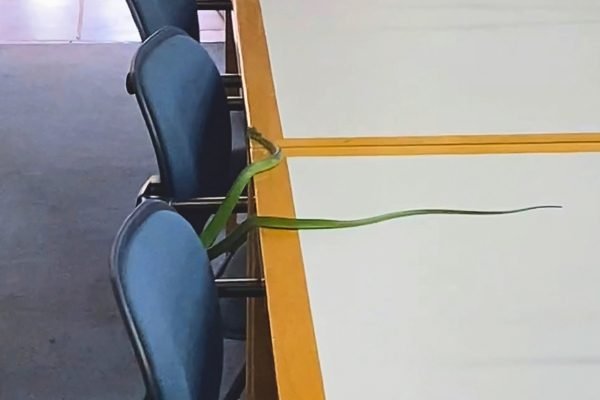
Winding lazily across the table towards me was a beautiful, bright green snake, perhaps a metre in length. Its vivid shade of green mellowed at the belly and darkened at its long, whip-like tail.
It was just half a metre away but, if it hadn’t been for the guard, I don’t think I’d have known about it until it slithered right onto my keyboard. At first, I was alarmed and sprang up from the desk.
But then the snake paused, at which point – and keeping a safe distance – I became rather engrossed in my new reptilian colleague.
“What kind of snake is it?”, I asked over the somewhat excitable radio chatter.
“A green mamba,” the guard replied. “Don’t worry,” he added, detecting some trepidation. “It’s not dangerous.”
By this time, a second guard had arrived and a small crowd had gathered in the doorway. They seemed slightly amused.
Perhaps sensing a bit of unwanted attention, the snake slithered serenely down through the chairs beneath the tables, and made its way to the corner of the room. I noticed that the guards kept their distance.
With the snake sheltering in the corner, I reluctantly left the room and headed to my next appointment. The first thing I did en route, of course, was to look up the green mamba. I learned that its venom is highly potent and capable of killing a human within hours.
However, the species is not aggressive and usually avoids confrontation. If treated appropriately, it poses little risk.
But was it a green mamba? It certainly looked like one, but these snakes prefer the coastal regions of Kenya.
It’s more likely that my companion was a type of Philothamnus bush snake, which are much more populous in the capital. They dwell mainly in trees and are normally hard to spot due to their vivid green colouring, which helps them blend in with the bright greenery of Kenya’s flora.
Such camouflage is less effective on a white office desk. Even if the guard was mistaken in his identification (or was winding me up), the caution he and his colleague exercised was real.
If it was a green mamba, I will always be grateful for their swift intervention. Whatever the species, being in a room with such an exotic animal was a new and special experience – one I won’t forget.