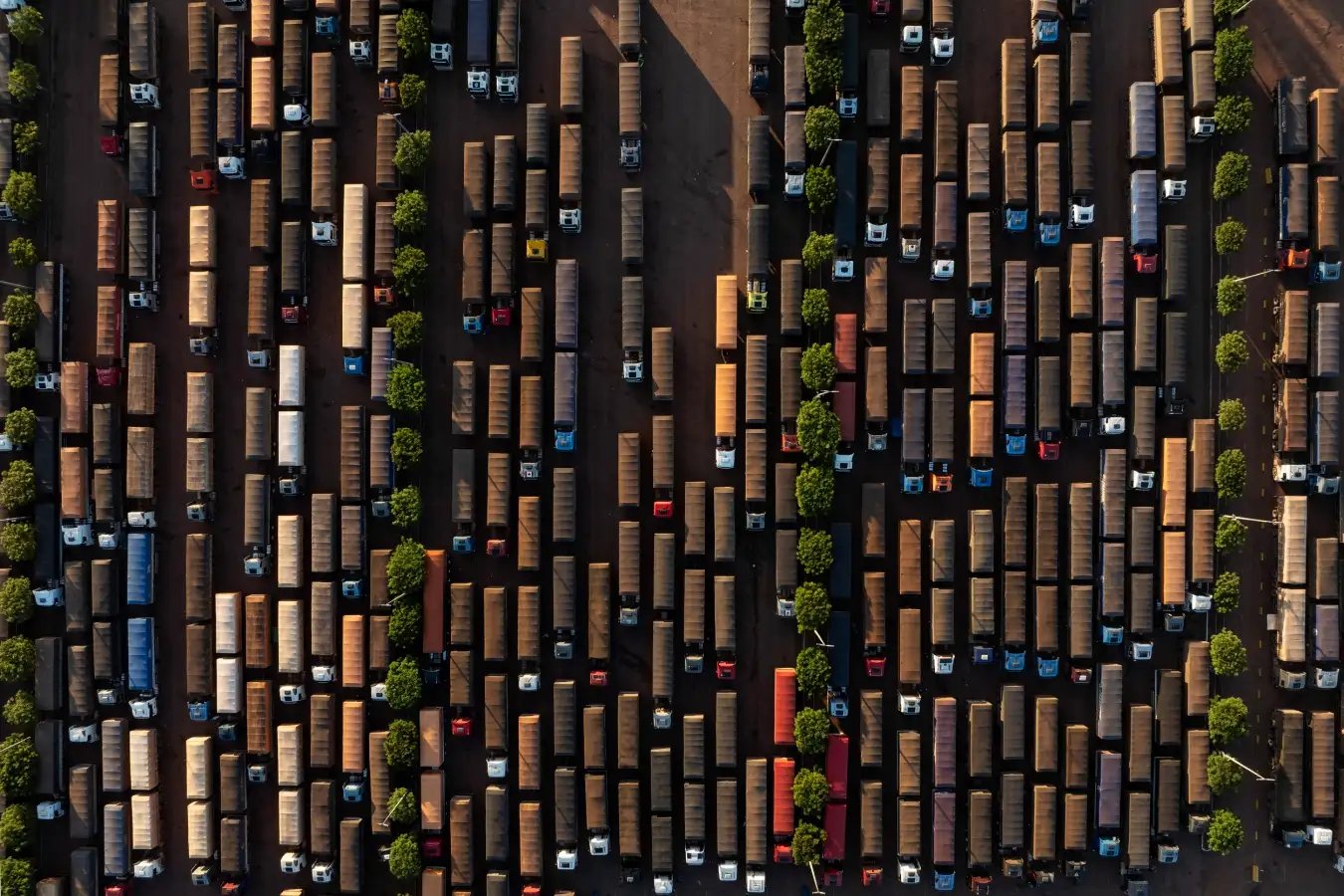

Some of the thousands of trucks that transport soya beans down a road in the Amazon
Lalo de Almeida/Folhapress/Panos
The myriad ways in which deforestation in the Amazon could deleteriously impact the climate aren’t a new revelation. In fact, climate scientists and activists have long been sounding alarms about protecting the rainforest. Yet the Brazilian government has recently relaxed environmental controls on several large industrial developments in the region, opening the door to even more harmful changes. Photographer Lalo de Almeida has been documenting the rainforest, focusing on areas where new projects are already taking place as well as those where the life of the rainforest is about to change.
In the main image, above, he has photographed some of the thousands of trucks that transport soya beans down an Amazonian road near Miritituba, which will be the final stop of a new railway that will be used to carry the beans to the Tapajos river. Below, three men collect soya beans from a truck in the aftermath of a traffic accident, a common enough occurrence for them to make a living from recovering crashed cargo.

Workers collecting soya beans from an overturned truck that has spilled its cargo
Lalo de Almeida/Folhapress/Panos
In addition to the scale of agribusiness’ intervention in the Amazon, de Almeida’s photographs aim to capture local communities that are often treated as invisible in political negotiations. “Indigenous lands, riverside communities and conservation areas along the route of the railway will be all be directly affected while none of the people in these areas have been consulted,” he writes about the new soya bean transportation route. Children shown playing in a canoe in the image below reside in a village in an Indigenous territory that will be put at risk by another upcoming project, this one exploring the prospects of oil extraction.

Children play near the village of Santa Isabel in the Uaca Indigenous Territory
Lalo de Almeida/Folhapress/Panos
The image below, however, offers a somewhat hopeful counterexample. Here, workers construct an electricity pylon as part of a project to build a power line within the territory of the Indigenous Waimiri Atroari people. This large-scale construction project involves members of this community, with the intention of making it less damaging.

Workers assemble a pylon for the Manaus – Boa Vista power line within the Waimiri Atroari Indigenous Territory
Lalo de Almeida/Folhapress/Panos
But plenty of damage has also, simply, already been done. De Almeida photographs burnt Brazil nut trees (below) near an illegal branch road off another highway which is due to be paved, the prospect of which has fuelled deforestation and land grabbing in the region. Their charred branches, curling and coiling against the yellowing grasses and the blue sky, are a stark reminder that something that was very much alive had to die for the sake of business profits.

The burnt remains of Brazil nut trees in a deforested area in the district of Realidade
Lalo de Almeida/Folhapress/Panos
Topics: