Sudhir Rentals has grown from a manufacturer of gensets to become one of India’s foremost generalist rental companies through rapid growth, and taken the leap into the highly competitive markets of the Middle East and the UK,
As Ankit Bhati, who heads up the company’s rental business in India and is in charge of fleet procurement across the group, explains, Sudhir is now using its global experience to help develop it markets both at home and abroad.
 Ankit Bhati, Sudhir Rentals.
One of the company’s key promises is that it provides all its rental product types at every depot – no mean feat in fledgling general rental market such as India. “We are a pan-India rental company and pan-product rental company. Whatever products we offer, we offer them across India,” says Bhati.
Those products include power, compressors, lighting towers, cranes and material handling, as well as aerial lifts with the latter representing 50% of the business.
“Part of the business model is that customers don’t need to go to various places to scout for equipment. We fulfil most of our customers’ requirements under one umbrella,” says Bhati.
In India, Sudhir operates around 3,000 machines in total, and 1,500 aerial lifts, with around 75% being boom lifts and scissors making up the majority of the remaining 25%, although truck mounts and spider lifts are represented in the fleet too.
The majority of booms reflects India’s level of rental maturity. “Any developing rental market will have more booms than scissors and this is the case here,” adds Bhati.
The move into rental
Sudhir’s rental division is split into three segments Power & HVAC, Ariels and Material Handling, however the company has a long manufacturing history, having started out as a generator producer more than 50 years ago, in 1973, and for 40 of those years has manufactured for Cummins in India.
It was here that Sudhir first moved into rental, explains Bhati. “We kept some generators in our factory in case we needed to support our customers, maybe if we were late in delivering their units or any other issues, so that we can lend it to them for a week or even a day.
“Sometimes the customer paid and sometimes they didn’t – it was just to support them, and that’s where the rental side of the business started.”
Bhati continues, “We thought, ‘why don’t we make this a fully-fledged business?’ Those 50 or 60 gensets then became 200 units, then we expanded our horizons outside of India and we began doing business in Dubai. Then in Dubai we found aerial equipment and started the aerials business simultaneous in India and Dubai.”
And as Bhati adds, “The rest is history. We got the kick that we wanted and we hit the accelerator and bought more machines.
“One customer told us, ‘now you are doing generators and aerials I need cranes,’ and another said, ‘why don’t you do compressors?’ then another asked if we did forklifts.”
“We matured and we kept maturing, adding new products to our portfolio. Our philosophy is that we wanted to serve the customer in as many ways as possible.”
The Covid effect
Then Covid struck, and while being challenging initially, it resulted in Sudhir becoming even stronger. “The market changed 360 degrees in India from purchasing to a rental model,” Bhati says. “After Covid people realized that the rental model was very convenient and conserves a lot of capital that can be allocated to other things which are more core to the business.
“If I am a shoemaker I should focus on making and marketing shoes rather than thinking if my factory generator or scissor lift is working or not.”
According to Bhati, the Sudhir team understood the potential just as India’s equipment users were changing their mindset towards rental, and it led to 40% year-on-year revenue growth for the rental segment of the company. “2021 – 2024 were amazing years for us.”
Post-Covid also saw the Indian government increasing its spending on infrastructure to boost the economy, leading to new airports, railway stations. “All the infra-activity added fuel to that fire, and it went up for us.”
Despite the growth Bhati does not believe that the Indian rental market has become that much more mature. “It is still evolving. If you look at aerials the adoption rate is still not very significant, even though if you compare today with 2019 the new machines have gone up by five times.”
Pre-2020 there were barely 400 new aerials entering India per year. That compares to last year when an estimated 2,500 new machines were sold into the country. “However,” comments Bhati, “This is not a very large number for a country the size of India – that’s what makes me feel the maturity is far ahead of us right now.”
One positive development is that there is no longer the need to teach customers what a scissor or boom lift is. “In the past we had to show them a picture on our phones so they knew what it looks like. There has progress but there is still a lot to be done.”
Turning to electric
Sudhir has also been a trailblazer in electric-powered equipment. Material handling in terms of forklifts and reach trucks has traditionally been a fairly mature market in the country, but in the last six years that there has been a move from diesel powered machines to batteries. “The trend started in 20217 – 2018 and it meant again we were in the right place at the right time when the market was moving from diesel to electric.”
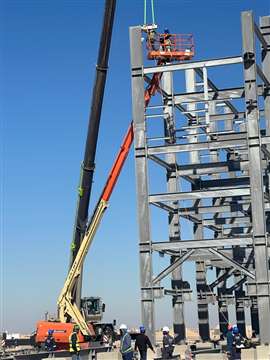 Sudhir Rentals helps build a steel structure.
“There was a time when we were the only ones offering electric machines because everyone else was neck deep in diesel and didn’t have those machines. We built our business on that model.”
Telehandlers, on the other hand, despite existing in India for some time have not grown at the same rate, as is the case in many other Asian markets. Compare this to gensets, which Sudhir has produced for 40 years and is a fully mature market, it is clear product categories are at very different growth phases in India.
One thing is certain, with 3,000 units across its fleet, Sudhir is comfortably the largest multi-product rental company in India, while its number two in power generation and material handling individually, Bhati.
Focusing on access equipment, is there potential for the same extreme level of growth that was seen in China between 2017 until 2024 before the market crashed?
Bhati is clear. “I am not anticipating a China kind of growth. We are democratic country and have our way of doing things and India has always been a stagnant market that has grown at 10%. And I anticipate in the coming four to five years we will grow at this rate.”
Another major issue impeding growth is that every piece of access equipment must be supplied with an operator, under Indian law.
“So, the scalability of this business in India becomes very difficult – because if you have 1,500 machines you need you will need 1,100 – 1,200 operators minimum, which is a nightmare,” says Bhati. “That is the biggest problem that holds this sector back and means it will continue to grow at a very stable rate.”
Unfortunately, there are no indications that policy around MEWPs will change. “It’s been 8-9 years since we entered into the business and everyone involved advocates this change, but there are no statutory, norms or guidelines being led on this product. So, adoption is growing but at a meagre pace.”
“It’s purely about individual choice, and some of the international contractors working in India have made it mandatory on their sites, and now even the top Indian contractors have mandated it, but any kind of government intervention to use a certain type of access equipment at a certain height is yet to come – let’s be hopeful that it will come in the future.”
And, following the years of great growth, Sudhir’s growth has slowed to 15% last year and around the same this year, partly due to some infrastructure mega projects ending in 2025, along with other government spending, but also because Sudhir has now more naturally maligned with wider domestic growth.
“We anticipate that some large project will be announced – if that happens there might be higher growth,” adds Bhati.
Considering that the individual end user rental business in India is a very small – in single digits of total revenue, developments in infrastructure, along with commercial construction are fundamental to the business.
The international landscape
Looking beyond India, the company has a rental fleet of between 7,000 units in the Middle East and close to 4,000 in the UK following its acquisition of Star Platforms in 2020, with the latter focusing purely on aerials.
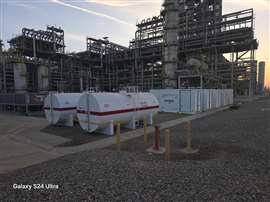 Sudhir Rentals rentals supplies a wide range of equipement. (Image: Sudhir Rentals).
In the Midde East the company works in Dubai, Abu Dhabi, Bahrain and Saudi Arabia.
According to Bhati, growth was good from 2021 but in 2025 there was a dip in the market. “Again, infra projects have slowed a bit, particularly in Saudi, along with that a lot of large Chinese rental companies have come in with thousands of machines. This has filled the gap of demand and supply and created a surplus in the market… and a slowdown there.
“Although I wouldn’t say it is bad, just not as great as before,” says Bhati, adding that growth now sits at 10-15% annually.
Sudhir has become an established business in the Middle East due to its quality, service and wider benefits, says Bhati. “Rental rates have to come down a lot, maybe 10% but we have a loyal customer base that is prepared to spend 10% more for good service.
“It means our customer base is intact, we’re just not taking all the orders that are available in the market. So, from that point of view, we are not in trouble, it’s just that rental rates have been shaved by 8-10%.”
“Sometimes our customers go to these new companies, use their services and then they always come back. So, in that way we are intact.”
Furthermore, the company is looking to expand in the Middle East. “We always scout for new opportunities. But we have very stringent criteria for opening depots at new locations and we will not add branches if it does not add value to me and my customers.”
One may think that entering the mature access and rental market in the UK with Star Platforms is departure from the company’s standard model, but Bhati believes differently. “The UK is an old story in access, and we have been there five years now. We wanted to grow the aerials business – we were still learning at that stage, and it was a good acquisition opportunity.
“And that helped us understand and learn the business from the perspective – it helped us get into a multi directional approach. The maturity of the UK market helped the company understand the requirements in the sector.”
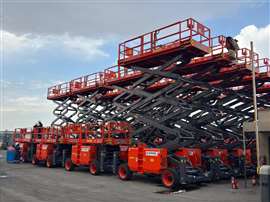 RT scissors in the Sudhir Rentals fleet. (Image: Sudhir Rentals).
“Now that we are operating in both kinds of markets, we understand the business much better and what’s coming to us in the next 15 years in the Middle East and India. Both these markets will become developed and it’s helping us prepare better for that.”
One of Bhati’s roles at Sudhir is the procurement of equipment across the group. “We can always have better bargaining power when buying for two or three countries together. When I go to my venders for 200 machines my bargaining power gets better and that’s why we have consolidated it.”
A significant change in the area is the arrival of the Chinese OEMs over the last five years. “The market has changed to Chinese equipment.”
“Given the markets in all geographies have become tough and rental rates are down – the kind of pricing and payment terms the Chinese OEMs are offering, means one is not left with many options but to choose them – obviously they cannot be ignored. So, over a period of time, we have also made them a part of our business.”
And, says Bhati, there are no reasons to ignore them. “The pricing is good, they understand the market better, the service has improved significantly with certain brands and the product is better – they are not the same as they were on day one.”
One benefit is that lead times are short. “You don’t have to wait 8-10 months; they deliver in six days. Their capacities are huge and this helped us to grow our numbers as fast as possible.”
Access equipment becomes younger
Another traditional dynamic in India is the prevalence of very old used equipment. “With the introduction of these OEMs, one of the things that has happened is that the age of the overall fleet in India has come down.”
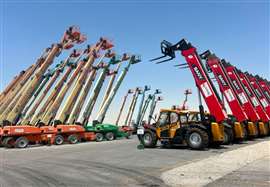 A small selection of Sudhir Rentals’ fleet. (Image: Sudhir Rentals).
“Earlier people used to bring the oldest of the old – the junk – and put them on rent. Now if people are buying used machines, they are buying them at a younger age of around 7-8 years.”
In addition, Chinese companies have created a network across the Indian MEWP customer base. “So, now, when customers ask for new equipment, they are not left with many options but to buy a Chinese machine.”
While the used market will not disappear quickly, Bhati thinks the age of the equipment will gradually lower. Currently, around 3,000 used machines enter the market annually, amounting to 5,000 – 6,000 machines coming in each year.
In total there are 17-18,000 aerial platforms working in the country. How that will develop over the next decade depends on the infra story in India, says Bhati, and the geopolitical situation. “But I can comfortably say it will be better than the last 10 years. The future is bright, the adoption will be high – the country needs more infrastructure, so government has no choice but to invest in it.”
The Middle East also has a positive outlook. “I feel that they should be doing well in the next three to five years.”
“We will be satisfied if we grow 12-15% based on the current geopolitical situation across the region.
“Growing at 30-40% annually is not normal and is not sustainable. So, our time for that is gone – never say never – but it is not coming back shortly.”