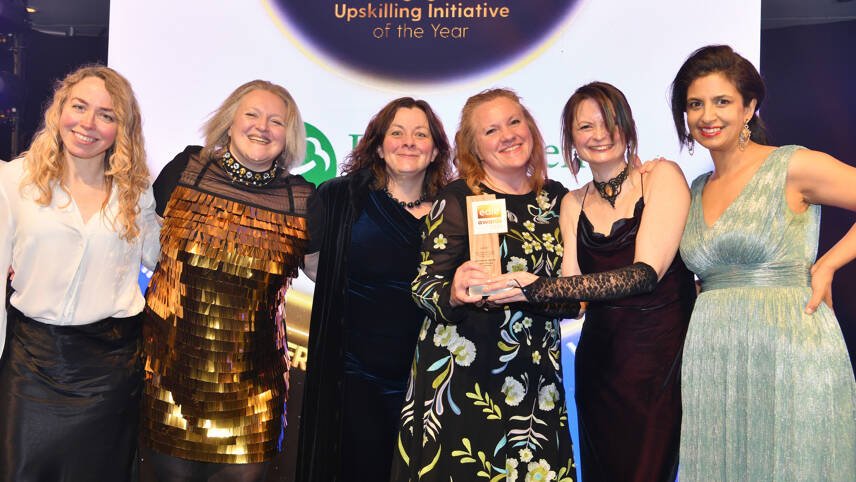

Celebrating success at the Staff Engagement & Upskilling Initiative of the Year award. The team proudly display their trophy on stage.
At a glance:
Who: The Environment Agency
What: The Nature Literacy Programme
Where: UK
Why: To embed nature-positive thinking and nature recovery actions across all roles
When: 2025
The challenge
Nature recovery and biodiversity loss require action at scale, but that delivery at scale depends on far more than a small number of sustainability specialists. Nature-positive outcomes often hinge on routine decisions made by non-specialists, including project design and site management. Without shared goals and capabilities, nature recovery can become fragmented, inconsistently applied, or considered too late to be cost-effective.
The Environment Agency also faced engagement barriers typical of workforce-wide training, including dispersed teams, varied working patterns and the risk that conventional e-learning would fail to reach or motivate those most involved in operational delivery.
The solution
The Environment Agency built the Nature Literacy Programme to combine credibility, accessibility and behaviour change in a single model. It worked with MindTools to develop a gamified approach that keeps learning practical and decision-focused, using eight smaller modules that simulate director-level choices and challenge learners to apply nature recovery thinking to realistic scenarios.
To ensure quality and build trust, the programme secured independent accreditation from the Institute of Sustainability and Environmental Professionals as four hours of CPD and endorsement from the Chartered Institute of Ecology and Environmental Management.
Accessibility was treated as a design requirement, with an internal Accessibility Steering Group drawn from staff networks shaping inclusive delivery, including the creation of “Nature Literacy: Out Loud” as a podcast alternative. The programme also extends beyond organisational boundaries through collaboration with the Supply Chain Sustainability School, recognising that nature outcomes are strongly influenced by suppliers and partners involved in project delivery.
How the project works
The programme is structured to take participants from awareness to action over time. Staff complete the modular learning in a format optimised for different devices and working contexts, and they reinforce learning through Toolbox Talks and “Connecting with Nature” activities that require participation and reflection. These actions span a wide spectrum, from small operational changes through to habitat restoration, citizen science, mindfulness in nature and community engagement events, ensuring that nature recovery is not only understood but experienced in real settings.
Engagement is sustained through a resource library and an online community where participants share experiences and solutions, while progress is tracked through a tree-based completion system that moves from “Acorn” to “Sapling” to “Oak” and ultimately a wider “Forest” spanning partners and suppliers.
The results
The Environment Agency reported strong engagement, with more than 3,000 employees participating so far, including senior leadership figures such as the chairman and board and a quarter of executive directors, and with additional staff and suppliers being certified nature literate each week.
The programme is driving measurable behaviour change by reducing reliance on sustainability specialists and enabling wider teams to identify and act on nature recovery opportunities within their own work. Early examples include operational teams replacing fencing with native hedgerows and integrating nature-based solutions into maintenance plans, while Toolbox Talks have generated commitments that combine biodiversity benefits with carbon and resource efficiency improvements.
The Environment Agency also reports that its accessibility innovations, including podcast learning and inclusive design, are influencing broader knowledge-sharing and training practices internally, while the extension of Nature Literacy via the Supply Chain Sustainability School is helping embed common principles into partner and supplier activity.
© Faversham House Ltd 2026 edie news articles may be copied or forwarded for individual use only. No other reproduction or distribution is permitted without prior written consent.