It’s 2pm, and the platform at Wankaner station is already full.
Families step off rickshaws carrying bedding, bags and suitcases. They move slowly through the heat, scanning for space, then settle in clusters on the platform floor.
The train to Jabalpur is running late. When it arrives, it will be packed. The journey will take nearly 20 hours.
Most of the people waiting here are migrant workers leaving the industrial town of Morbi.
Until a few weeks ago, they had jobs.
Morbi, in western India, is home to the world’s second largest ceramics industry, worth $11 billion. Nearly all of India’s tiles and bathroom fittings are made here — exported to construction markets across America, Asia, Africa and Europe.
The industry depends on two things: constant heat, and a large migrant workforce. It directly employs more than 400,000 people.
For years, both were steady.
Workers came from across northern and eastern India — Uttar Pradesh, Bihar, Madhya Pradesh, Jharkhand and Odisha — drawn by the promise of regular wages. The factories ran around the clock, fuelled by imported propane and natural gas.
That balance was disrupted in late February.
As conflict escalated in the Middle East, shipping through the Strait of Hormuz — a key route for India’s energy imports — was constrained. Gas supplies tightened. Prices rose sharply.
Within days, factories began shutting and more than 500 units stopped production.
“Gas is our maximum expense and the heart of ceramics,” manufacturer Kishor Dulera says.
“If gas isn’t available, manufacturing is not possible at all.”
Work disappears overnight
For workers, the consequences were immediate.
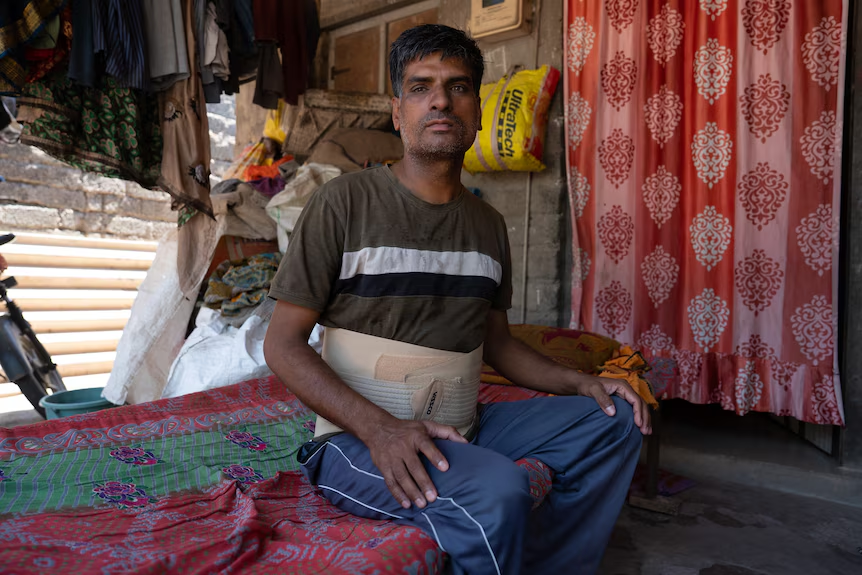
Hari Gupta has lived in Morbi for 20 years. He worked as a kiln operator, earning about $250 a month — enough to support his wife and three children, but little more. He has no savings.
His situation was already fragile after a back operation kept him from working and his 10-year-old son needed surgery for a heart condition.
To cover both, he borrowed more than $2,000. Then the factory closed.
Hari Gupta is an Indian worker impacted by the ceasefire. (ABC News: Som Patidar)
“My younger son hasn’t gone to school in six months. I haven’t been able to pay his fees,’ he says.
Most of the people he knows have already left the city for their home towns.
Mr Gupta hasn’t. He says his health makes travel difficult. For now, he stays at home, relying on borrowed money to cover daily expenses.
“There is no cooking gas, work has shutdown, my kids need to go to school. I’m the sole breadwinner … how will we manage? There is only one solution, going home,” he says.
Forced to leave
At railway stations and bus depots, the departures continue.
Some say they will return when the factories reopen. Others are less certain.
Railway officials and bus drivers say passenger traffic has risen sharply in recent weeks. Long queues form at ticket counters. Seats are scarce.
“These poor people do not understand war,” bus driver Salim Pathan says.
“All they understand is their war with hunger.”
Bus driver Salim Pathan says the numbers of workers going home has risen sharply in recent weeks. (ABC News: Som Patidar)
The disruption has spread beyond ceramics. Packaging units, transporters and other linked industries have slowed or stopped, leaving more workers without income.
Struggling to survive
Anita Devi has not yet decided whether to leave.
She is 32, a single mother of two, and works checking bathroom fittings, such as sinks, lavatories, or toilet bowls. Her monthly income — about $120 — covers rent, school fees and basic food.
Travelling back to her village would cost several thousand rupees, money she does not have. Her children’s exams are underway. Pulling them out now would mean losing another year.
Anita Devi does not have enough money to travel back to her village. (ABC News: Som Patidar)
“No-one can give a clear answer when the company will reopen,” she says.
“Everyone is hopeful that factories will reopen in fifteen, twenty days.”
Even cooking has become uncertain. Gas cylinders are harder to find, and more expensive. When hers runs out, she says she will switch to wood.
“No-one thought a war in another country could have such an impact on our lives,” she says.
Loading
The cost of disruption
Manufacturers say the disruption has exposed how dependent the industry is on global energy flows.
Some have tried to switch to piped natural gas, but at significantly higher prices.
Before the war, Mr Dulera’s factories produced 20,000 boxes of tiles a day. His annual turnover was about $25 million.
He’s down to a handful of workers who are just doing bare maintenance work. Even when he restarts operations on April 15 using piped gas, he can only operate at half capacity.
“It is not a 100 per cent sustainable solution,” Mr Dulera says.
“Customers won’t accept rising costs because of the war, and factories can’t absorb it.”
Others have chosen to remain shut rather than operate at a loss.
Even with the two-week ceasefire now in place in the Middle East, there is little expectation of a quick recovery.
It could take two to three months to return to normal operations — assuming fuel supplies stabilise. Workers who have left will need to return. Equipment will need to be repaired. Orders will need to be rebuilt.
Until then, there is uncertainty. Mr Dulera says the industry that had seen so much momentum in the last decade will slow. If the war was to restart and persist for months, the situation could become existential for many units.
‘A labourer’s life is no life’
In Morbi, this is not the first time an external shock has disrupted life.
During the pandemic, many of the same workers left in similar circumstances — returning to villages as jobs disappeared.
For workers like Mr Gupta and Ms Devi, the margins are too thin to absorb even a short break. They’re terrified of a repeat.
Hari Gupta barely earns enough to support his wife, Sheela (pictured here), and their three children. (ABC News: Som Patidar)
“A labourer’s life is no life,” Ms Devi said.
“We earn and eat. If we don’t earn, we cannot eat.”
Back at the railway station the train stops for a few minutes and leaves. Thousands will continue to leave the next day, from here, bus depots and even crammed into the back of trucks.
It is no longer tenable to wait for the factories to reopen. For the moment, going back to their villages is the only way these workers can survive.
Loading…