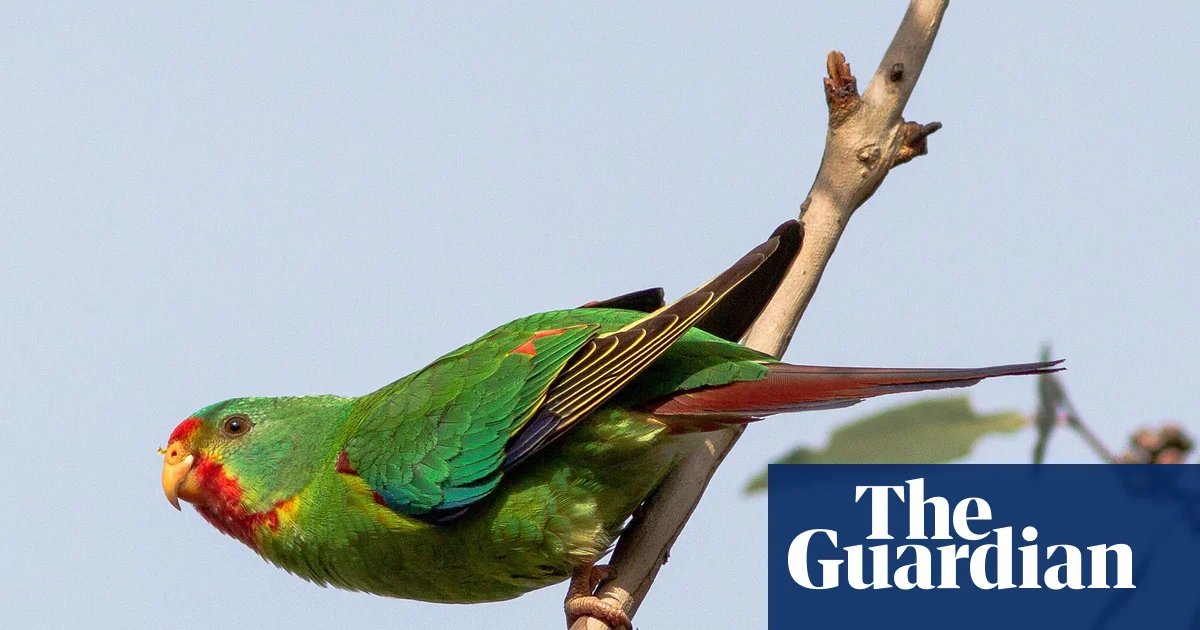
They are sounds from a section of forest that no longer exists. In December and January, scientists for the Bob Brown Foundation captured the call of the swift parrot, a critically endangered migratory species. The environment campaign group says it was recorded in an area marked for clear-felling in the Wielangta forest in Tasmania’s south-east.
The foundation’s Dr Charley Gros said the vocal mark of the world’s fastest parrot was unmistakable. “It’s a tiny bird but has a very loud call,” he said. “It’s very sharp and quick and fast. You can’t confuse it with something else.”
All up, 68 observations were recorded by two scientists employed by the foundation and volunteer citizen scientists over two months. They were reviewed by a government scientist and uploaded to an environment department website. Gros said it was evidence the forest was used by the species for foraging and nesting. “If they’re there every day, that is [their] habitat. They’re not just passing through,” he said.
Swift parrots in Tasmanian logging area
Recorded in a logging coupe in Wielangta forest
After receiving the recordings of the critically endangered species, the state regulator, the Forest Practices Authority, sent an ecologist to survey the area – known as coupe WT003E – on 10 February. It told the Bob Brown Foundation that “no swift parrots were observed breeding in the harvest area”.
Gros said he was not surprised. He said the forest in which the recordings were made had already been cleared by the time the government ecologist arrived. “Of course there were no parrots by then,” he said.
Logging agency Sustainable Timber Tasmania, formerly known as Forestry Tasmania, said it acted within the law. “We are committed to operating within Tasmania’s strict forest practices framework and protecting environmental values through careful planning and oversight,” said the agency’s general manager for conservation and land management, Suzette Weeding.
At the heart of the dispute are questions over whether the law does enough to protect threatened species – and whether that will substantially change when an overhaul of national environmental law that passed parliament last year takes effect in July 2027.
Scientific advice to the state government has previously warned all potential swift parrot foresting and nesting habitat on Tasmanian public land should be protected, whether the birds are present at the time of planned logging or not, given how much has been lost.
The species spends winters in Victoria and New South Wales, and summers nesting in forests scattered across Tasmania depending on where its main food sources – blue and black gums – are flowering. A CSIRO-published guide in 2021 estimated the population had slumped to about 750, down from 2,000 a decade earlier. A flock of more than 600 was observed near Bendigo last year.
Peer-reviewed studies have found the swift parrot could be extinct by the early 2030s and forestry is the biggest threat to its survival, but bureaucrats have attempted to play down that link.
The Bob Brown Foundation accused the federal and state governments of “blatantly ignoring scientific advice and allowing Forestry Tasmania to drive the species toward extinction”.
A Tasmanian government spokesperson did not directly address the Bob Brown Foundation’s claims, but said the state had a strict “science-based forest practices system” and “does not permit deforestation of swift parrot habitat”. “Nesting trees are retained and harvested areas are regenerated as native forest driving renewal of key eucalypt species and fresh flowering for foraging,” they said.
An Albanese government spokesperson said a regional forestry agreement between the Tasmanian and federal governments gave the state responsibility for forestry management, including ensuring habitat for threatened species was protected. They noted the exemption for state-run forestry from national environment law would end in 2027. After that, logging may require approval from Canberra where it has a significant impact on threatened species.
Campaigners are attempting to pressure retailers not to sell timber from contentious areas – an approach that has worked in the past. The Wilderness Society is focused on Bunnings, lobbying it to stop taking wood from a mill that it found takes logs from the WT003E coupe. It said it showed that the global Programme for the Endorsement of Forest Certification, which has been awarded to logs from the coupe, is not a true representation of sustainable forestry.
Alice Hardinge, the Wilderness Society’s Tasmanian campaigns manager, said: “Bunnings customers don’t want to be sold timber that destroys unique forests and pushes the swift parrot to extinction.”
A Bunnings spokesperson said the company had conducted a review of the issue after a complaint was made and was satisfied there was “no evidence to indicate non-compliance with Tasmanian environmental or logging laws at this site”.
“We’re committed to sourcing timber and wood products which originate from compliant and well-managed forest operations,” they said.