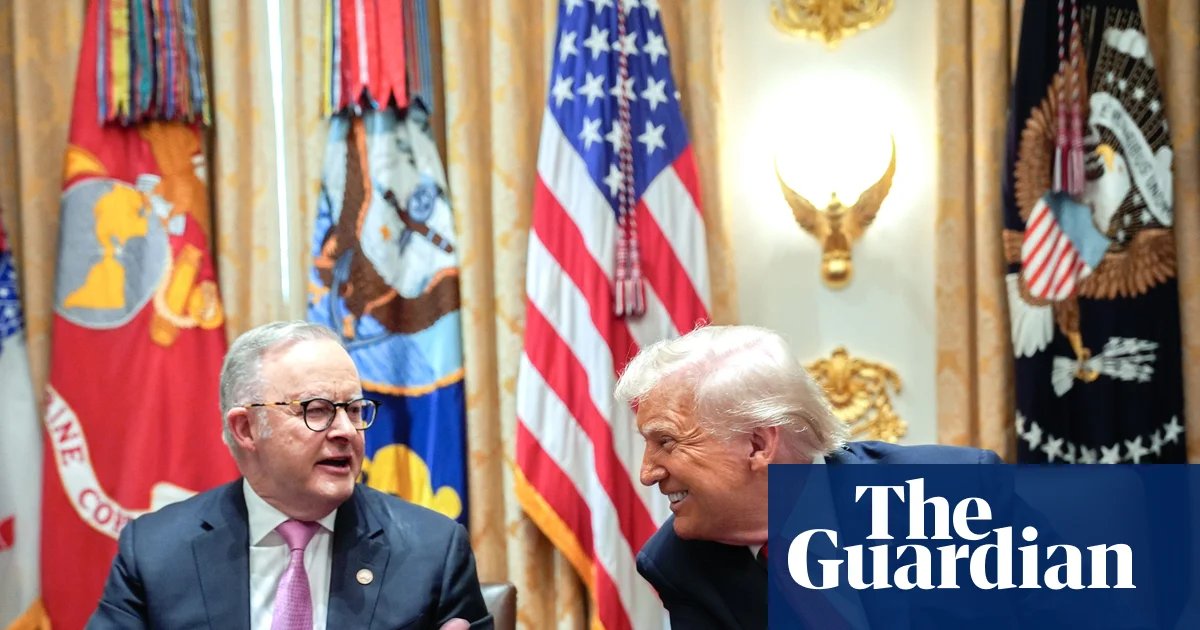
Donald Trump has taken another swipe at Australia, alongside Nato, the UK and most of the rest of the world, for not getting more involved in the US-Israel war against Iran.
But Australia’s defence minister and deputy prime minister, Richard Marles, said again the Albanese government had not received any direct requests for help from Trump, and declined to say whether more Australian military assets could be sent to the Middle East or the strait of Hormuz.
At a press conference on Thursday at the White House, the US president was asked to reflect on phone calls with the UK prime minister, Keir Starmer. He began by describing Starmer as a “lovely man”.
However, he continued, “[Starmer] did something that was shocking: he didn’t want to help us. And maybe in particular that country, you know, the longest bond, the longest ally.
“Australia, too, Australia was not great. I was a little surprised by Australia.
“I wouldn’t say anybody was great, other than the five countries in the Middle East. We never really had very much support.”
The Albanese government deployed an E7 Wedgetail surveillance aircraft and around 85 defence personnel to the United Arab Emirates, in what has been described as a defensive effort to help assist Australians in the region; Australia also operates military assets from a base in the UAE, and supplied missiles to the country’s government. The plane is feeding information into the Combined Air Operations Centre in Qatar, the facility that helps the US coordinate Middle Eastern operations.
Marles this week did not rule out extending the deployment of the Wedgetail, which is now two weeks into what was described as an “initial four weeks”.
Trump described the Middle East conflict as “little league” and said: “If there’s ever a big [conflict], which I hope there’s not, but if there’s ever a big one, I don’t think they’re going to be there.
“And that’s not fair, and we have to remember that as a country, because we spend trillions of dollars protecting Europe.”
It followed an exchange where Trump had taken aim at Nato countries for their lack of involvement in the joint US-Israeli strikes on Iran.
He said: “Actually made a statement, a couple of them, that ‘we want to get involved when the war is over’. No, it’s supposed to get involved with the war’s beginning, or even before it begins.
“We had the UK say – this is three weeks ago – ‘we’ll send our aircraft carriers’, which aren’t the best aircraft carriers, by the way. They’re toys compared to what we have. But ‘we’ll send our aircraft carrier when the war is over’. I said: ‘Oh that’s wonderful, thank you very much. Don’t bother. We don’t need it.’
“Now they all want to help. When they’re annihilated, the other side is annihilated, they said ‘we’d love to send ships’.”
Trump made a similar comment about Australia a week beforehand, when he was asked by an Australian journalist what he wanted from Australia in the Iran conflict. He responded: “Well, they should get involved, and I was a little bit surprised they said no, because we always say yes to them”.
On Friday, Marles said Australia had not rejected any requests from the White House but refused to comment directly on the president’s statements.
“The one request we’ve had from the United States is to provide support for Gulf States, which is in fact what we are doing, and that’s where we see our national interest. We do that because of the relationship we have with the Gulf States but also because in the UAE specifically it is home to one of the largest expat populations that Australia has, and so it’s a really important contribution,” he told the ABC.
Asked whether Australia would assist in any operation to secure or protect oil ships in the strait of Hormuz, Marles said it was “really important” but declined to say whether or how Australia would participate.
“We are utterly committed to that. We will work through the specifics of what we can do with our friends and partners … [but] I’m not about to speculate publicly about what would be the best way in which we could contribute,” he said.
Marles told Channel Nine that the government would consider any requests they get, but that “we don’t have a request from the United States in respect of the Straits of Hormuz right now.”
Opposition leader Angus Taylor said any decision about deploying Australian military to the Middle East “needs to be in our national interest, in line with our sovereignty.”
“But there is a big question about this, which is, what requests have the government received from the United States for support in the Middle East? Beyond what we already know, what requests have been received?” he said on Friday.
“What [Trump’s] comments suggest is there have been requests received. We’d like to know what they are.”