Anthony Albanese was enjoying a hit of tennis on Saturday 28 February at a charity event at Coogee Beach Tennis club in Sydney’s eastern suburbs.
The prime minister is known to use the sport as a mental pressure valve, precious moments of distraction from the stresses of leading the country in a time of relentless upheaval.
That evening, the US and Israel would launch the first strikes on Iran, triggering a war, a historic global energy shock and a new era of uncertainty for Australia and the world.
The Australian government was not consulted before Donald Trump ordered Operation Epic Fury but was quick to endorse it on the grounds it was necessary to prevent the Iranian regime acquiring nuclear weapons and from “continuing to threaten international peace and security” via its militant proxies.
As Trump’s objectives in the Middle East soon blurred and the price of petrol soared at home, the conflict evolved into the second major test of Albanese’s leadership in a matter of months following the Bondi beach antisemitic terror attack.
Under intensifying political pressure, the prime minister has in the past week rushed out billions of dollars worth of relief for motorists and businesses and, for the first time, questioned the ongoing purpose of Trump’s increasingly unpopular war.
Albanese has also sought to frame the international turmoil as a reason to pursue – rather than delay – the sort of structural economic reform he has shirked in the past.
The collective shifts point to a realisation of a new reality: the world has changed and so too must the government.
“There is no security in maintaining a status quo that doesn’t work for people,” Albanese said in an address to the National Press Club on Thursday.
Is this a crisis – or not?
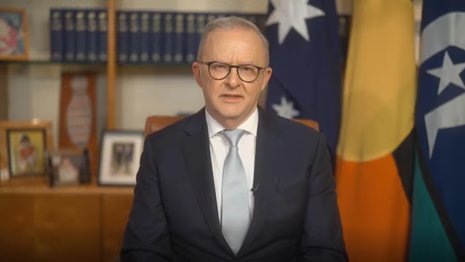
Thirty-two days after the first strikes on Tehran, the prime minister was in his Parliament House office recording a primetime address to the nation.
The message attempted to quell fears about Australia’s fuel supplies while at the same time cautioning that the “months ahead may not be easy”.
The mixed signals reflected a confusion inside the government as it grapples with the task of explaining the severity of the situation to a community still scarred by the experience of the Covid-19 pandemic.
Is this a crisis, or not?
The government was immediately alert to the possibility of an international oil shock in the likely event Iran retaliated against the strikes, including by effectively closing the strait of Hormuz shipping channel.
“Australia is much better prepared today than we were in 2022 for this sort of shock, because we’ve added more energy,” the energy minister, Chris Bowen, said the morning after the conflict started.
When MPs returned to Canberra the following day, the federal opposition’s focus was not on fuel supplies but rather the Islamic State-linked women and children attempting to escape a Syrian detention camp and return home to Australia.
Bowen was asked about Australia’s fuel stocks just once in question time on 2 March – by One Nation MP Barnaby Joyce.
The minister confidently said Australia’s stocks were the “highest they’ve been for any time in the past 15 years”, as he pointed out that four of the nation’s six petroleum refineries were shut under the Coalition.
But while cargoes of fuel were continuing to arrive in Australia, a crisis was rapidly unfolding in the domestic supply chain with dire consequences for regional communities.
‘We know it’s going to get worse’
The war had triggered a frenzy on the oil market. Large companies with standing contracts raced to buy up their full allocation at the same time as the spot market experienced a rush of demand.
Smaller independent retailers were struggling to secure fuel from the four majors: Mobil, BP, Ampol and Shell, which is run by Viva Energy in Australia.
The reports of service stations running dry conflicted with the public assurances that everything was OK, prompting the Coalition to accuse the government of ignoring the extent and impact of the disruptions.
The government’s pleas for motorists to avoid panic-buying of fuel – which Bowen warned on 10 March was the “biggest risk to availability” – were criticised as shifting blame for a problem of their making.
Government sources have dismissed accusations it was flat-footed in response, insisting work was under way immediately to insulate Australia from the worst of the oil crisis.
Within a week of the start of the Iran war, the government feared that without a major intervention, farmers – who would also face a shortage of fertiliser – would not have enough diesel for the upcoming seeding period.
On 12 and 13 March, Bowen announced a temporary lowering of fuel quality standards and the release of 20% of the nation’s stockpile in an urgent move to boost supplies to regional Australia.
At that point, the average price of diesel had surged past $2.60 a litre and unleaded petrol was tipping $2.20 a litre in the capital cities.
After questioning from the opposition in parliament, the energy minister started listing the number of service stations without fuel in different states and territories, exposing the scale of the crisis. Bowen, Albanese and the foreign affairs minister, Penny Wong, made a flurry of calls to Asian partners, using Australia’s gas exports as leverage to push for guarantees that fuel would flow in the other direction.
Treasury also began running the numbers on the potential economic scars of a protracted war in the Middle East, revealing inflation could spike above 5% if the conflict drags on.
By Friday of last week Albanese was leaving the door open to halving the fuel excise, an expensive, populist measure that the opposition had called for. It was a sign of how serious the government was taking the pressure on motorists but also a concession of the political pain it was feeling.
“We know it’s going to get worse before it gets better,” one Labor source said at the time.
Albanese confirmed a three-month halving of the fuel excise and pausing of the heavy vehicle road user charge after a meeting of national cabinet on Monday, in which premiers and chief ministers endorsed a four-phase strategy to manage fuel supply if the crisis worsened.
The temporary relief for motorists and truckies will drain the budget by $2.55bn but sources familiar with the decision argued the cost was necessary to maintain faith with the public, particularly if the government would be asking for behavioural change to reduce fuel demand.
“We understand the cost pressures for people are very real as the impact of the war on the other side of the world plays out right here. We’re acting now to be overprepared,” Albanese said.
‘What are the objectives?’
Trump spared no friend in a 18 March social media outburst mocking allies for not directly assisting with the war in Iran.
Australia was listed among the holdouts even though the US had not formally requested its support to help reopen the strait of Hormuz.
The Albanese government had agreed to send an E-7 Wedgetail aircraft and stocks of air-to-air missiles to help protect the United Arab Emirates – and the thousands of Australians living there – from Iran’s retaliatory strikes. But it was adamant there would be no boots on the ground.
Albanese chose not to bite back at Trump, maintaining his strategy of avoiding commenting on the volatile president. But privately, the government was beginning to question Trump’s “flip-flopping” objectives of the Middle East conflict.
There was a view that the original goals of Operation Epic Fury had been achieved, meaning there was no need for the ongoing conflict – and the international economic crisis it was fuelling – to continue.
At a press conference on 27 March, Albanese emphasised that Australia was not consulted on the war. Three days later, when asked directly for his view on Trump’s actions, he said: “I want to see more certainty in what the objectives of the war are, and I want to see a de-escalation.”
The careful rebuke was muted compared with the explicit criticism of the president from other world leaders.
But it represented a notable shift for Albanese, who hadn’t so much as questioned the legality of the first strikes on 28 February.
On Thursday night Australian time, Wong joined representatives from more than 40 countries at a UK-convened virtual summit to discuss options to reopen the strait of Hormuz. The US was not among them.
Albanese has deliberately distanced himself from Trump before, including during the 2025 election campaign as part of a strategy to link Peter Dutton with the president and to contrast Labor’s “Australian way” with the Maga agenda.
The tactic served a short-term domestic political purpose but was mostly shelved as soon as Labor returned to power.
But there are signs the war and resulting fuel shock is pushing Albanese to resurrect the second part of the strategy – this time in pursuit of the sort of longer-term changes he has shied away from in the past.
In his press club speech, the prime minister set the scene for his most “ambitious” budget yet on 12 May, combining economic reform – including potentially on housing tax concessions – with interventions to make Australia more resilient to global shocks.
“International uncertainty is not an excuse to delay, or hold back reform, it is the reason we must press ahead,” he said.
“Because we will not generate the same prosperity or create the same opportunities if we continue to rely on an economic model designed in a different time and built for a more predictable world.
“Nor can we go back to those days.”