
Northern Arizona Healthcare and City of Flagstaff supporting mental health care for community heroes.
Matt Shaw knew it was time to talk to somebody when the boy he had tried to save showed up in his dreams and on the face of his own son. “Our job in the emergency medical services is to be there for a person’s worst day,” said the Guardian Medical Transport battalion chief. “But for us, that’s just Monday.”
What first responders experience on the job doesn’t necessarily go away when their shift is over. Often, they carry the trauma from a single horrific call – or the cumulative effect of many – into their homes and other areas of their lives.
Traditionally, these community heroes were expected to continue to show up fully present and unaffected, as they moved from one emergency call to the next. “Thankfully, that culture is starting to change and people are realizing that as soon as you can get the mental health support and the counseling and the debriefing sessions, the longer your career can be and the healthier your career can be, which is really the important part,” said Shaw.
Today, Northern Arizona Healthcare is issuing a distress call of its own, sounding the alarm that mental health care for first responders is a critical concern affecting individuals, families and the community.
“It really hit me when I ran into one of our battalion chiefs for Guardian Medical Transport,” said NAH Office of Philanthropy Vice President Maraka Oltrogge. “This battalion chief just looked worn down – like they couldn’t get through the day. It just gutted me to see how much of a shell of a person they had become from all of the incidents they had been living through.”
Oltrogge, whose husband is a battalion chief with the Flagstaff Fire Department, is familiar with the kind of stress that first responders face and the emotional and physical toll it can take.
“We don’t think about them having to go home and look at their families after just witnessing an atrocity in the community,” she said. “Their job is to show up on your worst day and be their best selves.”
She began searching for a way the NAH Office of Philanthropy could support a mental health program for the organization’s first responders that would be accepted by a culture that has long valued self-reliance, independence and resilience.
She was familiar with efforts made by Flagstaff Fire Deputy Chief Chris Fennell, who had been pushing for a free, accessible and confidential mental health program for local firefighters.
“There have been a lot of traumatic events that have affected our first responders,” said Fennell. “Most responders manage it well, but without support, unhealthy coping can develop. We are used to quashing those feelings and going back to work. That is not sustainable. It tears down the soul and erodes you after a while.”
He was eventually successful. In 2020, he brought in the Redemption Counseling Center of Flagstaff to support the Summit Fire and Medical District. That partnership grew into a coordinated regional effort among fire departments including Highlands and Pinewood fire districts and in 2025, expanded to include both the Flagstaff Fire Department and the Flagstaff Police Department.
“There are a lot of specific struggles that first responders have around mental health that the average population doesn’t have with witnessed and vicarious trauma and the incredible stress and strain the job has on mental and physical health.” said Redemption Founder and Executive Director Emily Neuman Bauerle.
The center uses Eye Movement Desensitization and Reprocessing (EMDR), a psychotherapy approach used in the military and one of the leading evidence-based treatments for post-traumatic stress disorder (PTSD), helping people process and recover from distressing memories, anxiety and emotional triggers, she said.
Neuman Bauerle also created a program specifically for first responders, providing them with ongoing crisis and debriefing support after critical incidents, an annual check-in session and an hour of counseling as quickly as possible upon request.
As a result, the department began noticing a positive change in individuals and the organization as a whole. “One of our people was contemplating suicide. We had no idea,” said Fennell. “This was caught during their annual check in. Luckily, there was intervention. A year later, the person came in and was totally fine and was able to work through it.”
Oltrogge broached the subject of mental health support with the Guardian Medical Transport and Guardian Air teams. “I was expecting the same push back that Deputy Chief Fennell received when he first suggested such a program. It was the exact opposite!”
Inspired by the response, Oltrogge and the NAH Philanthropy Office began seeking grants and raising money from individuals and corporate sponsors to cover the cost of mental health care for the hospital’s first responders. In 2023, they, too, contracted with Redemption Counseling Services.
“We had a waitlist within the first month, with first responders reaching out and wanting to be part of our Mental Health for First Responders program and getting the help that was needed,” she said, noting that having a third party involved that keeps files confidential and separate from the individual’s workplace has been key to participation.
“I try to think about mental health the same way we think about physical health,” said Shaw. “When someone’s mental health is struggling, you start to see physical signs as well.”
Warning signs of depression and anxiety may include personality changes; withdrawal from conversations and activities that used to bring joy; abuse of substances, such as alcohol; irritability; fatigue; and weight gain.
“When first responders suffer, the community suffers,” he said. “The most direct relationship is with the family and Redemption allows family counseling as well. And the community wants healthy first responders who are going to be there when they call 911. Their healing is for all of us.”
Fennell says the helicopter crash near Mars Hill on Feb. 4 that killed Arizona Department of Public Safety Ranger 56 Pilot Robert Skankey and DPS Trooper-Paramedic Hunter Bennett demonstrated how deeply the community is connected to its local heroes.
“It rocked the public safety world pretty hard – the police department was involved, the fire department was involved, Guardian was involved – and it also rocked the community. So many people came out and lined the streets to show their respect and gratitude.”
For Fennell, taking care of his mental health equates to personal growth. “Instead of letting tragedies change who I am, I now reframe the incident in my mind, embrace the hurt, learn the lesson and move forward. You can’t pack that stuff along.” FBN
By Bonnie Stevens, FBN
Oltrogge and the NAH Office of Philanthropy, in partnership with local organizations and businesses, are hosting a series of Mental Health Matters for First Responders events in May during Mental Health Awareness Month. Speakers, panel discussions and a film featuring a local first responder who lost her eyesight in the line of duty will be part of the program. For more information, visit nahealth.care/mental-health-matters.
Hear more from Maraka Oltrogge and Matt Shaw on Zonie Living at https://starworldwidenetworks.com/episodes/understanding-the-hidden-trauma-of-first-responders.
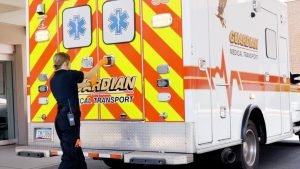
Courtesy Photo: The memories of accidents and other tragic events often follow first responders home. NAH is creating awareness with Mental Health Matters for First Responders through a series of public events in May.