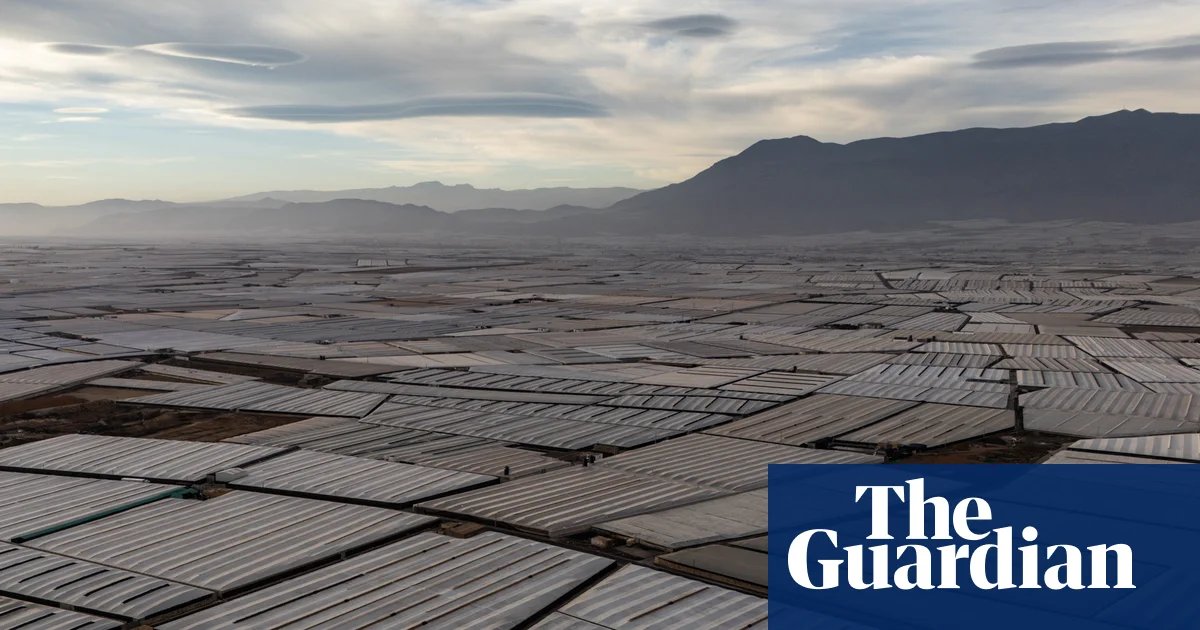
Europe’s vegetable garden is in Andalusia, southern Spain. It is so vast that it can even be seen from space: if you open Google Maps and look west of Almería, you will see a white patch that looks like a glacier, but as you zoom in, you realise it is the highest concentration of greenhouses in the world. More than 30,000 hectares (74,131 acres) of land are covered in plastic, a geometric labyrinth five times the size of Manhattan, where 3.5m tons of vegetables are produced every year – from tomatoes to cucumbers, peppers to courgettes, aubergines to melons – enough to feed half a billion people and generate a turnover of more than 3bn euros.
-
Workers prepare peppers inside the Hortamar cooperative, a fruit and vegetable producers’ organisation in Roquetas de Mar, founded in 1977, that now has more than 240 members and sells throughout Europe, the US and Canada.
“We call it the ‘sea of plastic’; it is the largest monument on the planet dedicated to food production,” says Guadalupe López Díaz, project director of the Fundación Tecnova experimental centre. “But it is also a place devoted to innovation and development, elements that guarantee companies control and, above all, vegetables 12 months a year.”
-
Left: in the laboratories of Fundación Tecnova, robotics and artificial vision applied to the sorting and handling of bell peppers are being tested. Right: Biosur’s laboratories in Vícar sell organisms for the ‘biological control’ of crops, such as Nesidiocoris tenuis, a small green predatory insect that feeds on other insects and mites, such as whiteflies.
“Today, a sustainable technological revolution is under way,” López Díaz continues, “a transformation focused on producing healthy, high-quality food using less water and energy, while remaining resilient to the impacts of climate change. Ultimately, the innovative and entrepreneurial spirit of our farmers has already transformed this land several times.”
-
Shepherd José Vinces Tamajo, 37, originally from Manabí, Ecuador, grazes his sheep in the middle of the ‘sea of plastic’ in El Ejido. José has been in Spain for more than 20 years but has been working in Almería for almost 10.
-
Two friends, Karina Milonchikova and Alba Martínez Redondo, both 19, take a walk in the middle of the ‘sea of plastic’ with two horses from the Cortijo Blanco equestrian club.
-
Left: a chromotropic insect trap in a greenhouse; the yellow colour attracts many insects that damage greenhouse crops, including whiteflies. Right: in the chemical laboratory of the Municipal University Analytical Centre (CUAM), analyses are carried out mainly dedicated to agriculture and the environment, such as the study of this tiny and highly damaging nematode.
This economic miracle began in 1963, in an arid and sunny peninsula called Campo de Dalías – where the region then recorded some of the lowest economic growth rates in all of Europe and extremely difficult conditions for horticulture – when farmers stubbornly began to protect crops from the wind with rudimentary plastic greenhouses. They soon realised that greenhouses could also diffuse light, retain heat and preserve humidity, and thus control the microclimate. This – together with drip irrigation, natural pest control and genetic research – made it possible to increase the number of harvests, even allowing them in winter. The sea of plastic thus became a true intensive agriculture district, where, alongside the greenhouses, there are nurseries, chemical laboratories, vocational schools and research centres (such as Fundación Tecnova, where more efficient plastics and climate-adapted crops are studied), as well as packaging companies and distribution cooperatives. The products are exported everywhere, especially to northern European countries.
-
A technician at the Campo de Dalías desalination plant in Balanegra, managed by the public company Acuamed. One of the largest in Europe and operational since 2015, the plant draws more than 120km3 of water from the sea every day and desalinates the equivalent of two Olympic swimming pools an hour.
In Balanegra, along the western coast of Campo de Dalías, technician Patricia Baldan Cruz is chatting with her colleague María José Araos Fuentes outside a large desalination plant run by the public company Acuamed. “The sea of plastic,” Patricia says, “has become a global benchmark for efficient, safe and responsible food production.
-
In El Ejido, Lola Gómez tells a group of tourists about the history and characteristics of the ‘sea of plastic’ inside her greenhouses. Lola is the owner of Clisol, a family-run farm that grows vegetables on two hectares (4.9 acres) of land, but also offers guided tours for tourists.
“Today, as the planet faces the dual challenge of feeding a growing population and protecting natural resources, Almería stands as a living laboratory of solutions. It produces fresh, healthy food all year-round with strict environmental standards, advanced technology and minimal water consumption. Our desalination plant, for example, is one of the largest in Europe and has been operational since 2015: every day it draws seawater and desalinises more than 120 cubic kilometres of water, the equivalent of two Olympic swimming pools per hour.”
What will be the future of the sea of plastic? A possible answer can be found within the walls of the Escuela Agraria de Vícar, founded in 1972 on the outskirts of the village of La Gangosa. Here, 480 students from various parts of Andalusia study the latest agricultural techniques and prepare to enter a working world that “in the next 20 years,” says the school’s director Francisco Valverde, “will lead to agriculture powered by applied AI, IoT and advanced sensors, strengthened by agrivoltaic systems and bio-composites, using resilient crop varieties and a mindset oriented toward the circular economy.
“We teach our students both theory and practice, cultivating and marketing products on a two-hectare plot next to the school. We aim to pass on new technologies that in the future will not only ensure sustainability and food security, but also strengthen Almería’s role as a global benchmark for innovative growth combined with social development.”
-
An African migrant worker in farmer Paco Moreno’s greenhouse in Santa María del Águila. Paco, who owns almost one hectare (2.4 acres) of land, is a typical farmer in the area: small and independent, his is a family business that employs three or four African migrant workers.
The problems generated by such intensive agriculture cannot be denied. The main issues are linked to human exploitation. In the sea of plastic, the workforce consists of more than 70,000 foreign workers, mostly from Morocco and sub-Saharan Africa. While it is true that many live in decent and dignified conditions, often in clean towns with full services, many are frequently underpaid, and some live in precarious conditions, in rural houses next to or among the greenhouses.
-
Along the shores of a lake in the middle of the ‘sea of plastic,’ Las Norias De Daza, there is abandoned plastic waste. Although most farmers comply with environmental laws and send their plastics to recycling companies, illegal dumps can still be found in the area.
Moreover, although a significant percentage of the plastic used is properly recycled (85% according to some sources), critical situations still exist involving illegal dumping and abandoned waste. Sustainable development must become a concrete objective and cannot be reconciled with human exploitation.