Two years into her mandate, the UN special rapporteur on the right to a healthy environment, tells Geneva Solutions about the right’s emerging threats from wars, the latest wave of mining, and misinformation.
Recognised by an overwhelming majority of countries at the United Nations General Assembly in 2022, the right to a healthy environment emerged from a vast civil society-led coalition that included Indigenous communities, women and youth, explains Astrid Puentes Riaño, the UN expert on the issue. But, she stresses, much still needed to be done by governments and the private sector to keep people safe and healthy.
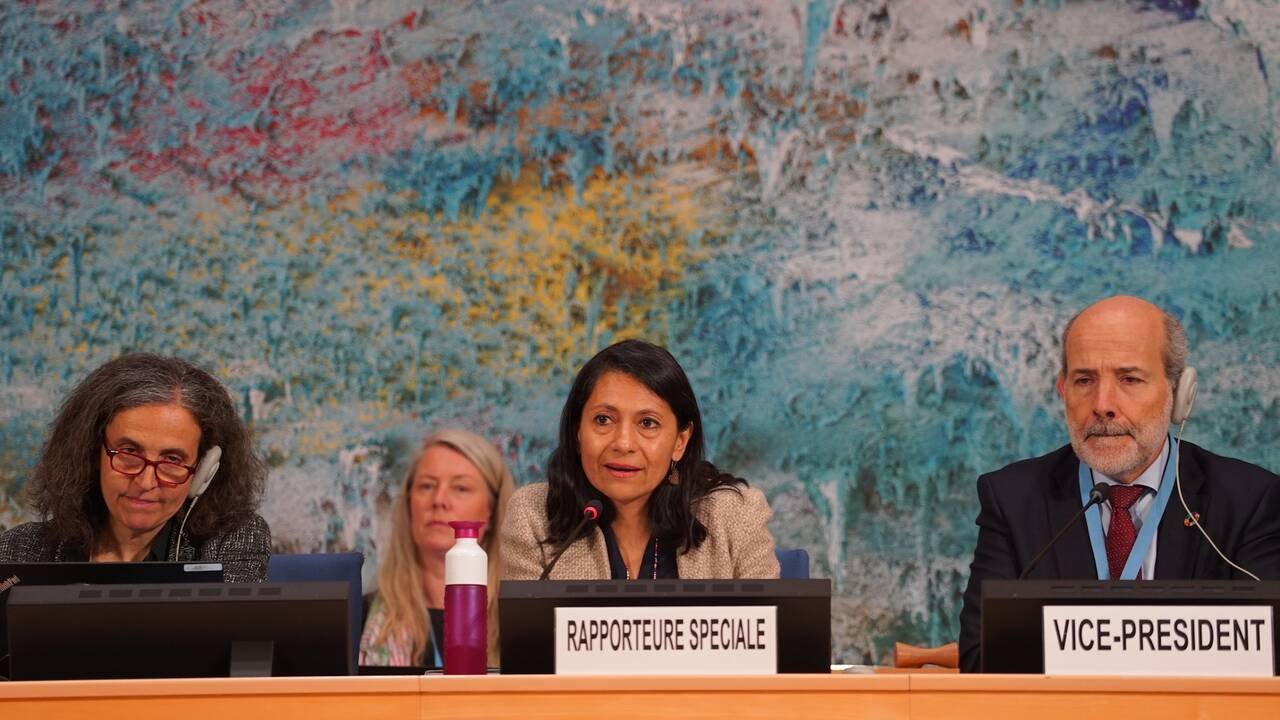
Puentes Riaño, a Colombian-born lawyer teaching at the Universidad Iberoamericana in Mexico City, was in Geneva last week to present her latest report on air pollution to the Human Rights Council. The document opens with a simple message: “Breathing clean air is vital for all”.
Yet, a day after she spoke to delegates in Geneva, military strikes by United States and Israel on oil storage sites in Iran’s capital, Tehran had residents gasping for air after the sky with smoke and acid rain showered down onto the city.
Shortly before her nomination in 2024 as the first woman and first representative from a developing country to hold a mandate that had been renamed from human rights and the environment following the General Assembly decision, Puentes Riaño won an historic case for communities in La Oroya, a Peruvian mining town impacted by toxic contamination from a smelter.
The decision was the first to implement the human right to a healthy environment, ordering the government to compensate residents and hold mining firms responsible for the harm caused. As Puentes Riaño explains, the case was all the more consequential as it involved an urban setting. “That matters because the vast majority of the world’s population lives in cities,” she says. “Human rights, health and the environment are not only about forests and Indigenous peoples. They concern all of us.”
In recent years, international treaties, including the Montreal biodiversity agreement and the high seas agreement which entered into force in January, have helped bolster the right to a healthy environment. However, since the return to office of US president Donald Trump and other populist leaders reversing environmental and social protections, many companies have also retracted from their environmental, social and governance commitments.
Geneva Solutions: How much legal recognition does the right to healthy environments receive globally?
Astrid Puentes Riaño: The right is now recognised by 166 states, the vast majority of governments worldwide. (China, Russia and Iran are among those that abstained when the right was adopted. -ed.) The International Court of Justice also provided a very clear recognition of it recently, in an advisory opinion on climate change published in July 2025. The ICJ said it is unthinkable how states may fulfill human rights, including the right to life and health, without enforcing and guaranteeing the right to a healthy environment. We can actually conclude today that the right to a healthy environment is part of customary international law,, because in order to guarantee the enjoyment of all other human rights, they have to protect it as well.
In your latest report on clean air, you underscored the threat that fossil fuels posed to the right.
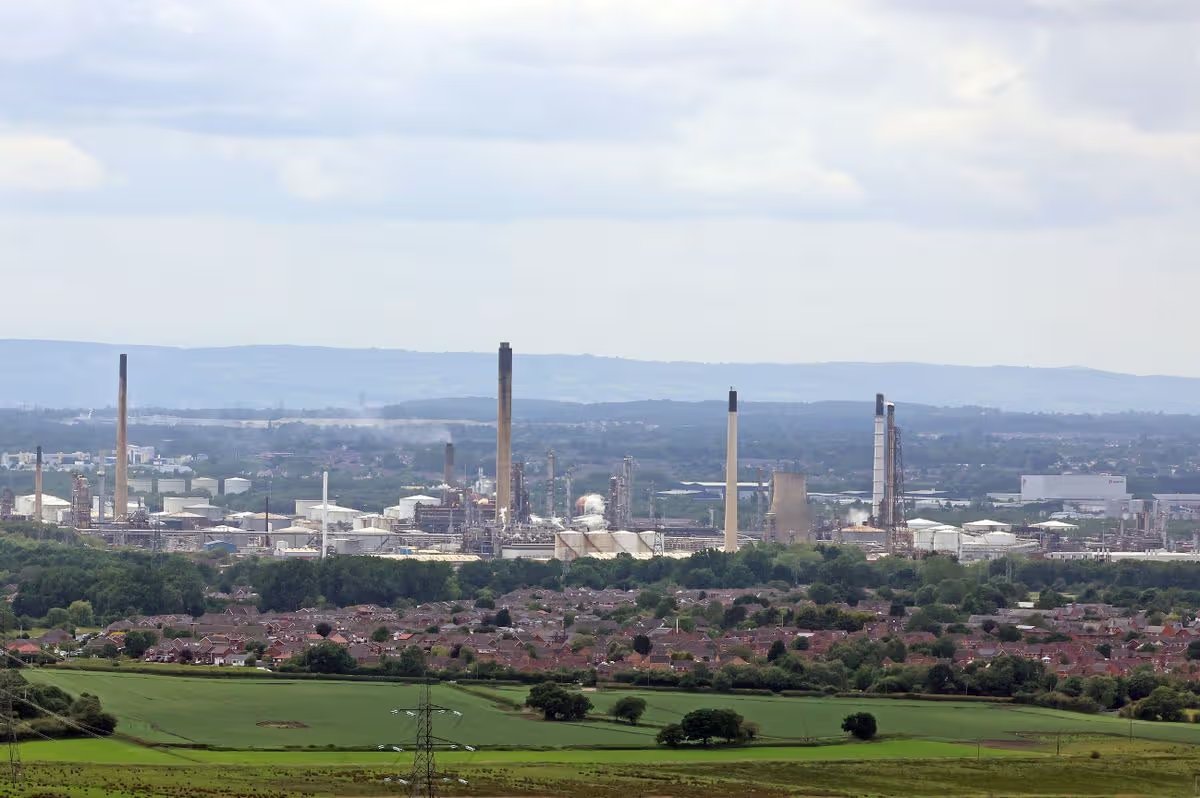
One of the major threats and drivers of air pollution is fossil fuel extraction, the use of fossil fuels and fossil fuel energy and transportation. This includes flaring, when natural gas is burned off during the extraction of oil, that takes place not only in the Middle East, but also in Europe, Africa and Latin America. The fact that it is banned in certain countries means that the industry can operate without it. Flaring needs to be banned. States need to better monitor the sector, and emissions and toxics linked to fossil fuel facilities, including particulate matter, ozone, bauxite and methane generated from flaring. I recommended that states use the best available science and technology, for a just energy transition, which I realise may take some time.
A day after you reported to the council on air pollution, toxic rain fell in Tehran following US and Israeli attacks on oil storage sites. Are threats to clean air becoming a weapon of war?
We are definitely seeing a rise, in conflicts, of the use of natural resources and the environment as a weapon of war. Hopefully awareness of the right to a healthy environment will increase, as well as the importance of protecting the environment in conflict and war, and how civilians are affected. What is happening in Iran is very worrisome. Scientists also found a sharp increase in carbon emissions since the start of the war in Gaza, linked to the conflict and the genocide. In spite of all the efforts in the Middle East, Europe and the rest of the world to mitigate carbon emissions, just a week of war in Iran has hugely increased emissions.
What type of pollution has been generated by recent wars?
In Iran, the bombing of oil storage sites has ignited huge fires and acid rain. We sent letters to Israel and other states providing it with support, condemning its spraying of white phosphorus (over homes in southern Lebanon earlier this month). Other carbon emissions have come from tankers being hit and aerial bombings, releasing massive amounts of CO2, increasing the toxicity of the air.
The destruction of ecosystems and water sources is yet another impact on the right to a healthy environment. In Palestine and Gaza, the destruction of olive trees by Israel is a threat to the right to food, in addition to the right to a healthy environment.
We need to decrease greenhouse gas emissions by 50 per cent by 2030, and to zero by the end of the century, but we are nowhere close to those targets, aimed at limiting global warming to 1.5°C, according to international obligations. States are not required to include emissions linked to the military in their emissions inventories. The compounded rise in war and conflict in the world today is impacting the environment, clean air, and the climate.
How has the private sector approached the right to a healthy environment?
While the process to recognise the right to a healthy environment was led by a large coalition of civil society, a group of 50 small and large businesses calling themselves the B Corps supported the right, saying it was good for business. But the fossil fuel and energy sectors, as well as other sectors, have been saying that one has to choose between the protection of human rights and the right to development. That’s a false dichotomy, as proven by science. We need businesses to operate responsibly and to act on their duty to protect human rights.
I have also been speaking with cities, including with the mayor of London. They agree that one of the biggest challenges they have to protect clean air and advance positive actions, is misinformation, and a narrative that such actions – which include protecting the health of children, who are among the most vulnerable to air pollution – are detrimental to the economy and businesses will go bankrupt.
Last week you also spoke at the FIFDH film festival in Geneva following the screening of Yurlu about an Australian Indigenous community contaminated by an abandoned asbestos mine. Is there a risk that in the new mining boom for critical minerals, many other communities may be seriously affected by mining activities?
Absolutely. Whenever there is an extractive industry, there is a risk of impacts on human rights including the right to a healthy environment. This is exactly why states need to have strong regulations, good planning and carry out strong environmental, social and human rights impact assessments. Mining will always have a big impact. States have to ensure that wherever a mine is located, it’s not impacting Indigenous peoples or other communities, and if it does, that impacts are mitigated and remediated. The case in Australia shows how important it is for mines to have a responsible closure and exit plan. It’s not enough after finishing activities to put a lock on the door and leave.
Are you concerned about the funding cuts on multilateral organisations, including the Office of the High Commissioner for Human Rights and what that may mean for defending the right to a healthy environment?
The right to a healthy environment as well as other human rights, requires a strong rule of law, regulations and monitoring, and for that, we need institutionality, both national, regional and international. The UN, the WHO and other UN institutions provide a very important role by advising states and monitoring situations. The funding cuts are impacting that. As one of the office’s independent experts, we work on a pro bono basis. We’re not paid, but need some funding to do country visits and to prepare the reports, which is being cut. With fewer resources, we will be able to contribute less. If we decrease the already limited funding it will compromise our ability to be impactful.