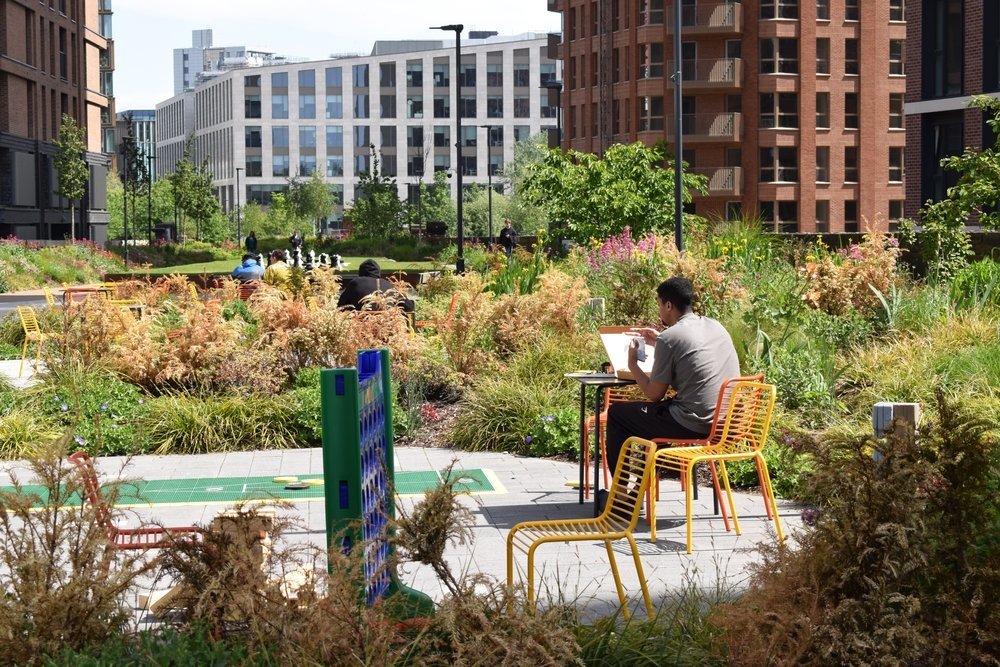
Nature has been declining at a pace that should alarm all of us. The UK is now one of the most nature‑depleted countries on earth, with around one in six species at risk of extinction and urban wildlife populations falling by an estimated 30% in a generation. In cities and towns, where 83% of the UK population now lives, the picture is even starker: over 40% of urban green spaces have been lost since 2001, squeezed out by competing demands for land and infrastructure.
We know the state nature is in. And we know what works. The science is there. The expertise is there. The intent is growing too. So why don’t we see more nature in our built environment?
Part of the answer lies with governments and policies, and part lies with us; humanity’s next big choice about how we want to live in harmony with our planet. But just as crucial is the tangle of red tape, design codes, liability fears and often well‑meaning but competing priorities that quietly block nature from happening, even when everyone involved claims to want more of it.
The invisible blockers we rarely talk about
Take ponds. We know they boost biodiversity, help with water management and create places where people can decompress and observe wildlife. Yet they’re frequently ruled out near homes and schools because of perceived drowning risks and liability, even when thoughtful design can eliminate those hazards. Similarly, trees in busy places are often discouraged due to fears of falling limbs, slippery leaves, or proximity to roads and railways.
Planting choices can become surprisingly fraught. Bee‑friendly or berry‑producing species are sometimes avoided near playgrounds in case of stings, allergies or accidental ingestion. Bright, continuous street lighting is maintained at high levels for visibility and crime reduction, with little consideration for the impact on bats, insects and other nocturnal species. Dense planting is kept away from building edges to prevent antisocial behaviour. And at road junctions, sightline requirements in the Highways Code can restrict even modest attempts to introduce greenery.
Green roofs and living walls illustrate the same tension. They’re treated with caution because of perceived fire risks post‑Grenfell, despite the availability of safe and well‑tested systems. Many green roofs also require reinforced structures, increasing material use and embodied carbon, making them harder to justify in traditional cost‑benefit terms. Tree planting may be limited where roots could affect drains, utilities, or fibre‑optic cables.
Some councils have grown wary of nature‑based features because of past experiences with vandalism or unclear maintenance responsibilities. In high‑density housing, wildlife‑friendly spaces are sometimes reduced to minimise conflict with domestic pets. And in urban landscaping, non‑native ornamentals – prized for low maintenance and year‑round aesthetics – still dominate over ecologically valuable alternatives.
Then there is the uncertainty factor. It is easier to model the strength of concrete than the behaviour of a beaver dam. That uncertainty means nature‑based features are often the first items removed when budgets tighten or when maintenance requirements become unclear. Landowners may be keen to create and restore habitats, but are often wary of locking them into biodiversity net gain, given the 30-year stewardship commitments that can limit future flexibility.
We price the risks of nature – not the cost of losing it
All of this leaves us in a position where we are very good at quantifying the risks nature might pose but far less skilled at valuing the cost of losing it: hotter cities, more surface flooding, poorer air quality, reduced pollination and diminished wellbeing from children to older people.
Some of these blockers are hard to challenge. But none will be solved by nature specialists alone. We need planners, designers, engineers, asset managers, health and safety teams, procurement professionals and policy‑makers – across the public and private sectors – to examine their own assumptions and decision making through a nature lens.
We need to ask, what blockers can I challenge or remove? What can I do differently? What would it look like if nature wasn’t the exception, but the starting point?
That’s the ambition behind the BAM x Eden partnership: helping the built environment shift from working around nature to working with it and thinking about how we can protect and support nature right from the start of any major developments. Because the question today is no longer whether nature belongs in our urban future, but whether we will reshape our systems fast enough to let it in.