While there’s a fair chance that one in every five words of everyday Hindi is borrowed from Persian, Indian historians, translators, philosophers, and religious scholars wrote freely in the language for centuries.
For over two centuries, from the time of Akbar, India led the world in Persian literature, both in quality and quantity. By 1700, India was likely the world’s leading centre for the patronage of Persian literature and scholarship, “with an estimated seven times more people literate in Persian than in Iran,” notes historian Richard M Eaton in India in the Persianate Age: 1000–1765 (2019).
Eaton reminds us that today, in an Anglophone South Asia, it is easy to forget this earlier Persophone world. “For centuries, Persian had been the pre-eminent language of diplomatic discourse in India,” he writes.
A language flowing through the ages
India and Iran have been close neighbours, bound by deep cultural ties since antiquity. “In some ways, the Iranians are our closest cousins. Ethnically and linguistically, we’ve long been very connected to Iran historically,” historian Abhishek Kaicker told The Indian Express.
Under the Achaemenid Empire ruler Darius I (522–486 BCE), large parts of Northwestern India, including present-day Herat and Kandahar in Afghanistan, formed key territories. When Chandragupta Maurya founded the first Indian empire, Achaemenian statecraft served as a model; Persian manners permeated courtly and public life alike.
In an interview with The Indian Express, Eaton says, “Persian served administrative purposes as far back as the Achaemenid dynasty of Cyrus the Great. They developed sophisticated systems for administration, taxation, revenue collection, and justice. Despite dynastic changes, this class of administrators and scribes persisted, carrying their language and practices from the Achaemenid dynasty through the Parthian and into the Sasanian dynasty.”
India was never isolated. Linked to the Indian Ocean and to the Iranian plateau through strategic mountain passes, the Indo-Gangetic plain and the peninsula to its south have long been crossroads of transregional exchange.
Story continues below this ad
Within these flows, Persian texts and speakers moved across West, Central, and South Asia from the 11th century through expanding, dense networks. It is for this reason that historian and author Nile Green, in The Persianate World (2019), describes Persian as a transregional contact language.
“Along the Silk Road, Persian was the language of merchants, travellers, and pilgrims. It reached as far east as China, where it was the official foreign language during the Yuan Dynasty,” Eaton says in his interview
He adds that travellers like Marco Polo in the 13th century used Persian, as did merchants and pilgrims, and this practice extended into India.
“Persian was the link language of the pre-colonial era, the English of the era,” observes Akhlaque Ahmad ‘ahan,’Professor & Chairperson, Centre of Persian and Central Asian Studies, JNU, in an interview with The Indian Express.
Story continues below this ad
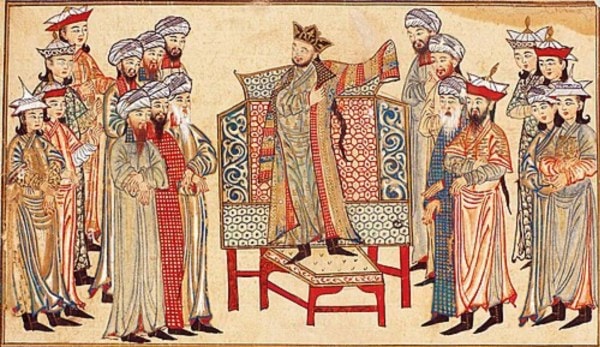 Mahmud of Ghazni (Wikipedia)
From the mid-11th century, the Ghaznavid dynasty ruled much of Punjab from Lahore, bringing with them Persianate institutions and practices. The Persian they used was New Persian. As Green explains in his work, “Transformed through its encounter with Arabic, this emergent written vernacular is… as distinct from the Middle (Pahlavi) and Old (Avestan) Persian of the Sasanian and Achaemenian eras.”
Eaton also remarks that Persian poetry was established in India “long before Amir Khosrow”. “When the Ghazni Turks arrived in the 11th century, they brought Persian poets with them, and Mahmud of Ghazni even created the office of Poet Laureate.”
Kaicker adds: “The really interesting development in Persian is that the language, because of poets like Firdausi—who presented his Shahnama at Mahmud of Ghazni’s court—achieved a solidification as both a literary and cultural language. A modern Persian speaker today can pick up the Shahnama and essentially start reading it. You can read a thousand-year-old text and still understand it.”
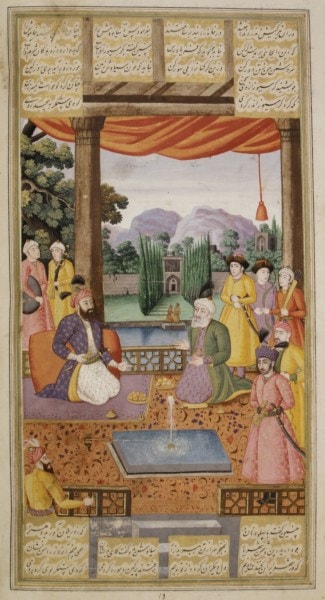 Abu’l Qasim Firdausi (Wikimedia Commons)
In the late 12th century, the Ghurid dynasty displaced both the Ghaznavids and North India’s martial clans (later called Rajputs), paving the way for the Delhi Sultanate. As regions such as Delhi, Kannauj, Gwalior, Ujjain, Bihar, and Banaras came under Muslim rule, a new hub of Persian learning emerged. From there, Green observes, “within a century, a sequence of Persographic urban nodes irradiated as far as Gujarat, Bengal, and the Deccan.”
Story continues below this ad
By the 14th century, Persian had become the principal language of governance across South Asia, used by vast revenue and judicial bureaucracies under the Delhi Sultanate, and later the Mughal Empire.
Eaton says, “Under the Delhi Sultans, Persian dominated the upper levels of bureaucracy, while vernaculars prevailed at the lower levels,” adding, “This bilingual administration allowed Persian vocabulary to seep into Hindi, Urdu, Marathi, and other languages —a legacy that still echoes in Bollywood and everyday speech today.”
From administration to music and religion
The history of Persian loanwords in Hindi is, in this sense, unparalleled.
A large share of these loanwords relates to administration: kagaz, rasid, vakil, diwani, salahkar, chaprai. Administrative units—shahar, tahsil, mohalla, pargana, zila—are all Persian. Even the postal lexicon: khat, lifafa, pata, khabar, and akhbar have Persian roots.
Story continues below this ad
Beyond administration, Persian shaped the vocabularies of music and games: tabla, sitar, rubab, shahnai, nagara, sarod; and shatrank, tash, patang, caugan (polo), kushti, and pahalvani. So too in architecture: diwaar, haveli, makaan, manzil, baramda, burj, kila, mahal.
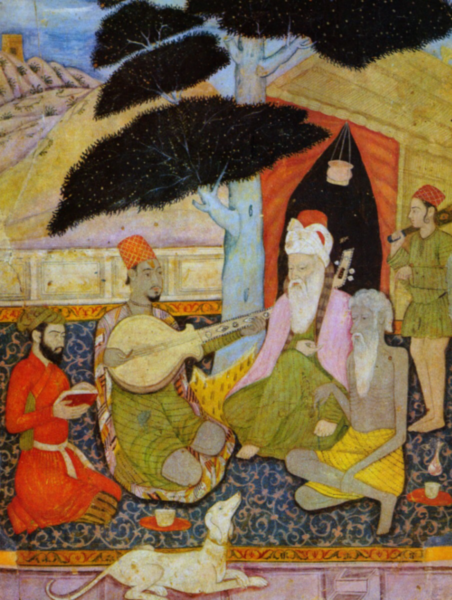 A musician plays a form of rubab in Golkonda, 1660 (Wikipedia)
Persian vocabulary also entered Indian religious thought. In the Sikh tradition, key terms include hukm (‘grace of God’), langar (‘communal meal’), and khalsa (‘community of sworn initiates’).
Green adds in an email interview with The Indian Express, “Incidentally, I always tell my students one of the biggest living legacies of Persian in India today is in restaurants. All of the following words are Persian: biryani, pilau, naan, gosht, panir, aloo, kebab, korma.”
Yet, he cautions in his work, “After Persian emerged as a lingua franca between senior officials and their employees, between the central chanceries and the districts, Persian did not stamp out other written languages but coexisted and ultimately interacted with them.”
Story continues below this ad
Ahmad says, “‘Hindi’ is Persian, ‘Punjabi’ is Persian, ‘Punjab’ is Persian. Words like Zameen, Asmaan, Parda, Dar, Darwaza, Deewar… Persian is, in a way, woven into our linguistic and cultural DNA.”
Beyond Akbar’s court and into the bazaars
From the early 16th century onward, the rise of the Safavid, Mughal, and Shaybanid dynasties created new opportunities for Persian-speaking secretaries, scholars, and Sufis. The decisive shift came in 1582, when Akbar made Persian the official language of the empire. In administration and education alike, Persian became dominant: state records, reports, and chronicles were all written in it.
Raja Todar Mal, Akbar’s revenue minister, ordered that all records be kept in Persian, replacing earlier Hindi usage. Linguist and literary critic Hardev Bahri notes in Persian Influence on Hindi (1960), “He thus forced all clerks and officials, including his co-religionists, to learn the court language of their rulers.”
Hindus, who had not previously practised Persian literacy widely, took to reading and writing it.
Story continues below this ad
This demand was sustained by reformed madrasas and village maktabs (elementary schools), which spread basic literacy in Persian. Scribal groups emerged among the Kayasthas of Agra and Oudh, and the Khatris of Punjab and Delhi, trained in a Persianised culture.
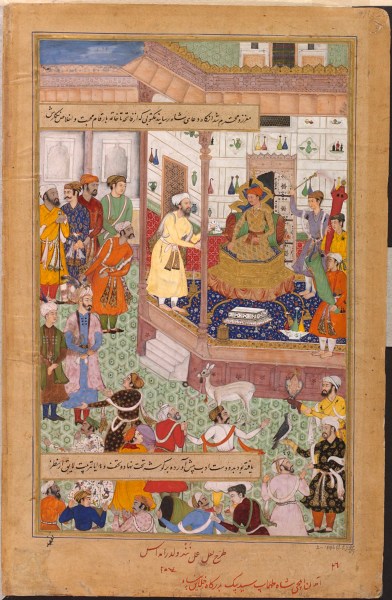 Iranian Ambassador Sayyid Beg in Akbar’s court, 1562 (Wikimedia Commons)
Green writes, “This increased state-driven demand for skills in Persian literacy, and particularly for mastery of epistolary forms, was the impetus for more and more Hindus to learn Persian in search of work in the imperial civil service.”
Over time, such groups absorbed Persianate norms—adopting pen names and participating in Sufi practices like qawwali at Sufi shrines in centres like Allahabad or Lucknow. Beyond the court, soldiers and officials carried Persian into bazaars, where merchants adopted its vocabulary for everyday exchange.
Green also notes, “The other important social frontier that Persian literacy increasingly crossed in the sixteenth and seventeenth centuries… was that of gender,” as elite women learned Persian.
Story continues below this ad
Bilingual wordbooks (nisabs) proliferated. In his work, Eaton explains, “After Akbar had made Persian the sole language for all levels of the Mughal bureaucracy, such wordbooks proliferated, their numbers exploding in the 18th century… Many of them were intended for children… particularly scribal castes, with a view to socialising them into the Mughal world from a tender age.”
Geographically, Persian’s reach was vast. In 18th-century Bihar, both Hindu and Muslim zamindars founded madrasas where Hindu literati taught Persian. Among Bengali aristocrats of the seventeenth and eighteenth centuries, proficiency in Persian was so prized that it was treated as a shastra.
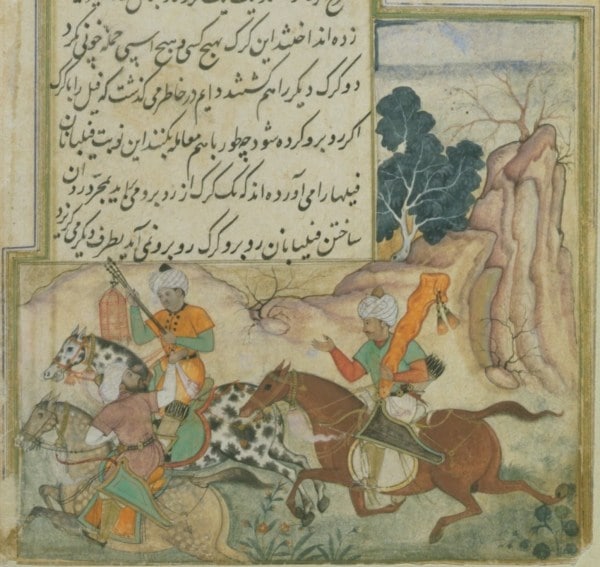 Page from the Persian translation of Babur’s memoirs (Wikipedia)
Yet, the exchange was not one-way: Sanskrit scholars compiled Persian manuals and absorbed Persian elements into their own works. “Then, language wasn’t tied to identity. Mullah Badayuni, a conservative Muslim, translated the Mahabharata, Ramayana, and Rig Veda into Persian, and Dara Shukoh translated 50 volumes of the Upanishads,” says Ahmad.
Akbar also sponsored major translations of Sanskrit texts into Persian. The most ambitious of such projects, as per Eaton, “were the court-commissioned Persian translations of the great Sanskrit epics, the Mahabharata and the Ramayana, which Akbar sponsored from the 1580s.”
Persian, then, was far more than a bureaucratic medium.
The birth of Urdu
According to Bahri, the most significant Persian influence on Hindi lay in the rise of the Urdu language and literature.
He notes Urdu is a Turkish term originally used for an encampment, later a military station. Within these camps—encompassing armies, courts, harems, and barracks—“in course of time… the residents in the forts evolved a mixed type of speech which was Hindi in genius but which had an unavoidable admixture of Arabic and Persian words.”
At first, Urdu was looked down upon by courtiers and the elite.
“So much of Urdu vocabulary and structure derives from Farsi. Farsi is woven into Urdu, which is itself intertwined with Hindi—it’s a language that blends Hindi, or Hindavi, with Farsi,” Kaicker says.
Urdu literature, too, was deeply Persianate, not just in form and conception, but in feeling, tone, and imagery.
“It is a historical truth that Urdu did not flourish in the north. It passed its early stages, not in Delhi or Lucknow, but in the Deccan, where Persian was not given a chance to flourish either as a spoken language or a court language,” Kaicker adds.
Eaton notes, “It is telling that, shortly after his coronation in 1674, Shivaji commissioned the compilation of a Persian–Sanskrit glossary, the Rajavyavaharakośa, intended to help government administrators find Sanskrit equivalents for Persian lexical…”
The very effort to purge Persian vocabulary underscores how deeply the western Deccan had already been absorbed into the Persianate world.
East India Company’s official language
Under British rule, the frontiers of Persian only expanded. In 1765, Shah Alam II granted the Diwani of Bengal, Bihar, and Orissa to the Company on the condition that Persian remain the court language.
The Company, unable to overhaul existing systems, retained Persian across revenue, judicial, and police administration. “For over 200 years, the East India Company conducted diplomacy and bureaucracy in Persian, seeing themselves as heirs to the Mughals,” says Eaton.
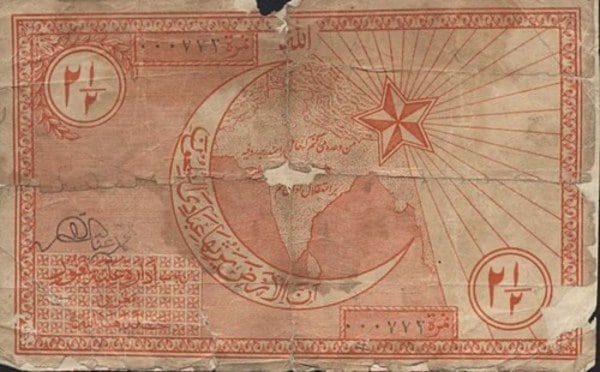 Image of the Punjabi Khaksar Movement’s poster for the freedom of British India, written in Persian (Wikipedia)
Initially, Persianate intermediaries (especially Armenians) handled communication for the Company. Over time, growing demand led to a surge in grammars, dictionaries, and epistolary manuals designed to teach Persian to Europeans. As Green writes, “It was, then, only Britain’s East India Company that made large investments in Persian, which remained the Company’s official language of law and bureaucracy until the administrative reforms of 1832–37.”
Institutions such as the Calcutta Madrasa (1781) and Fort William College (1800) trained British officials, while Persian instruction spread as far as England. Hundreds of British students were now taught Persian at the East India Colleges founded at Haileybury in 1806 and Addiscombe in 1809. Printing further extended its reach: presses in Calcutta and London produced administrative texts, grammars, and classics. By the nineteenth century, India was producing more Persian dictionaries than Iran.
The turning point came in 1832–37, when the Company replaced Persian with Urdu (and later other vernaculars) in administration. The civil and criminal codes were translated, retaining extensive Arabic-Persian vocabulary. Educational institutions followed suit: at Delhi College (founded 1823), Persian was replaced by Urdu textbooks by 1840. Even colonial munshis and literati shifted to vernaculars, though Persian lingered in some princely states into the late nineteenth century.
Green notes, “By the turn of the twentieth century, these vernaculars…became inseparable from the new ideology of nationalism, with its ‘modular’ formulation of ‘one people, one language.’” The rise of new imperial and vernacular languages eventually undermined Persian.
Yet, Kaicker laments the loss. “In independent India, we essentially decided to turn our back on Persian. By refusing to learn Farsi, we lost the ability to engage directly with our history; it’s like living in amnesia.”