- The United Kingdom’s cocoa imports drove more than 2,000 hectares of deforestation in 2025 alone, mainly in Côte d’Ivoire (78%) and Ghana (18%), according to an analysis by climate NGO Global Witness.
- Total post-2021 losses linked to chocolate products exceeded 8,244 hectares. For all commodities — including palm oil, soy, beef, coffee and rubber — the deforestation exposure was 52,000 hectares.
- Britain continues to be exposed to deforestation despite enacting the 2021 Environment Act, designed to purge illegal forest destruction from supply chains. The reason is that the U.K. has not put in place key rules.
- Promised regulations remain stalled, with no timeline from the government to implement them. This leaves companies without due diligence rules and consumers remain exposed to goods linked to deforestation.
As Easter eggs and chocolate bunnies fill British families’ baskets this holiday season, a new report reveals that West Africa continues to be deforested to meet the United Kingdom’s growing demand for cocoa.
In 2025 alone, cocoa imported into the U.K. contributed to more than 2,000 hectares (about 4,940 acres) of deforestation, according to an exclusive analysis by climate NGO Global Witness shared with Mongabay.
The findings come more than four years after the U.K. passed its Environment Act, which promised to strip illegal deforestation from the nation’s supply chains. But additional regulations for implementing the law have not been put in place, and the government declines to say when they might be enacted.
While the government has failed to set rules, consumers remain at risk of buying chocolate and other goods that contribute to the climate crisis, even as they reach for foods stamped as sustainable, experts say.
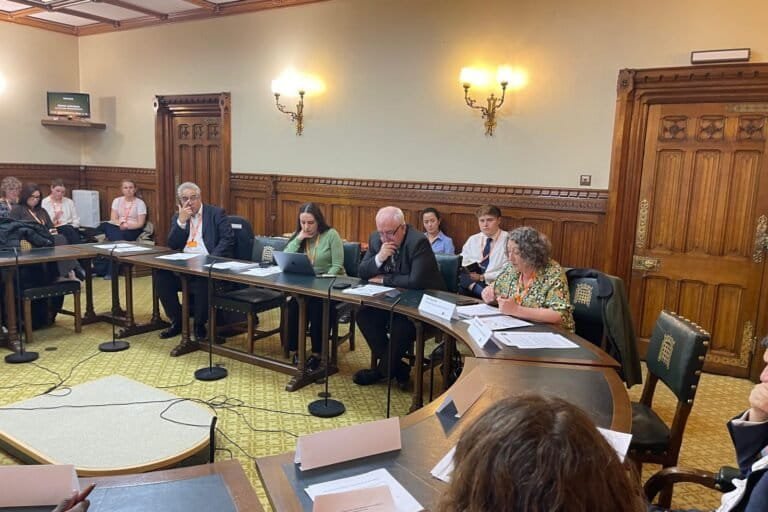
Last week, a coalition of chocolate manufacturers, British supermarkets and NGOs hosted an All-Party Parliamentary Group event on global deforestation at the House of Commons in London. The group gathered to urge the government to finally regulate commodities at risk for links to deforestation and provide more clarity to the industry.
The U.K. Cocoa Coalition is formed of major firms, such as Ferrero Rocher and Hershey; retailers Sainsbury’s, Waitrose and Marks & Spencer; and several nonprofit organizations, including Earthsight, the World Wildlife Fund, Mighty Earth and others.

“We want to be able to buy chocolate in the U.K. without worrying that it has been grown on illegally deforested land,” said Cassie Dummett, coordinator of the NGO Forest Coalition, which advocates for the end of global deforestation. “It’s a basic requirement that the commodities we buy should not be causing environmental damage or harming human rights in the countries in which they are grown.”
Since the Environment Act passed in November 2021, the U.K.’s deforestation exposure from direct cocoa imports exceeded 8,200 hectares (around 20,370 acres), according to Global Witness’s estimates. The area is equivalent to 11,500 football pitches of forests lost for cacao plantations.
To do its analysis, Global Witness cross-referenced the Food and Agriculture Organization’s agricultural production data and commodity-driven deforestation figures with U.K. direct imports, using customs trade data.
The analysis found that the vast majority of the estimated deforestation associated with cocoa imports into the U.K. was linked mainly to Côte d’Ivoire (78%) and Ghana (18%), two of the world’s top producers.

Both countries have historically seen alarming rates of deforestation. According to a 2023 study in the journal Nature Food, Ghana has lost more than 65% of its forest cover since 1950, while Côte d’Ivoire has lost more than 90%, largely due to cacao cultivation, as well as mining, logging and other agricultural activities.

Meanwhile, Britain is the world’s third-largest importer of chocolate products, buying about $3.6 billion worth of chocolate and other food preparations containing cocoa in 2024, according to U.N. Comtrade data. The country ranks behind the United States and Germany and is closely followed by France.
Although the U.K. environmental initiative is centered on cocoa, other agricultural commodities imported to the U.K., such as palm oil, soy, beef, coffee and rubber, are known to contribute significantly to deforestation in producing countries. The Global Witness analysis found that the U.K.’s total exposure to deforestation from all forest‑risk imports from November 2021 through December 2025 exceeded 52,000 hectares (about 129,000 acres).

“There is a strong investment case for building sustainable supply chains. We know what works: an approach that is founded on three things: governance, unlocking finance to invest in forests and building sustainable supply chains that deliver for nature and for people,” adviser Ruth Davis, the U.K. Special Representative for Nature, said during the U.K. Cocoa Coalition event.
These long‑awaited rules are part of the U.K.’s Forest Risk Commodities (FRC) due diligence regime, established under Schedule 17 of the 2021 Environment Act. This section of the act cannot be enforced until secondary legislation is introduced. Schedule 17 outlines three core obligations: a ban on the use of illegally produced commodities from forests that are at risk, mandatory due diligence for larger companies in key sectors and annual public reporting for each covered commodity.
In December 2023, the previous Conservative government published the proposed scope of the regulations but did not set a timeline for implementation. The elections in the following year created further delays. In its election manifesto, the current Labour government reaffirmed its commitment to the Environment Act’s goals, but since it came to power in July 2024, it has not disclosed when it will bring the FRC regulations before Parliament.

Mongabay asked the Department for Environment, Food & Rural Affairs (Defra) about the timeline for implementing the new regulations and the government’s plans to align the U.K.’s requirements with those of the EU Deforestation Regulation (EUDR). But the department declined to detail regulations and when they would be put in place.
“We are reviewing our approach to tackling deforestation linked to trade and will set out our approach to this, including future Voluntary Partnership Agreements, at the earliest opportunity,” a Defra spokesperson said in a statement.
Other members of Parliament have asked the same questions during debates or in writing before and failed to get any clarity about the next steps.
In November 2025, Minister for Nature Mary Creagh answered a written question sent by Labour MP Barry Gardiner, saying the government recognizes the “urgency of taking action to ensure that UK consumption of forest risk commodities is not driving deforestation.” She added that the government is considering the best regulatory approach but did not disclose a timeline either. “We will set out this approach in due course,” Creagh said.
Most recently, in March, Creagh answered the same question, adding that the government is balancing a “range of factors, including the broader policy landscape and relevant international frameworks.” The statement suggests that the U.K. is watching the European Union’s deforestation‑free regulation developments closely before deciding on its own implementation approach.
Campaigners warn that without swift implementation, the U.K. will lag behind the EUDR. EU lawmakers have already approved two postponements to the regulation’s start date and created certain exemptions, but as it stands, it is expected that the EUDR will enter fully into application from Dec. 31 for large and medium operators and traders, and from June 30, 2027, for small and micro operators.
Some companies have already invested in EUDR compliance and now feel frustrated by U.K. delays. They seek regulatory clarity from the government and want close alignment with the European rules to streamline operations.
“We call on the government to bring forward the much-needed forest risk commodities legislation that will be a vital first step in building a more resilient and sustainable cocoa supply chain,” said Richard Laming, head of public affairs at Ferrero U.K. & Ireland, which is part of the U.K. Cocoa Coalition.

Ghana and Côte d’Ivoire passed legislation in 2022 on the African Regional Standard for Sustainable Cocoa, to align with the EUDR. The U.K. is lagging behind the EU and producer countries and should align its requirements with those of the EUDR, the Forest Coalition argues.
“If the U.K. deforestation regulation is implemented, it will protect the Ghanaian forest reserve and this will go a long way in fighting climate change, which is producing harsh weather for our cocoa farms,” said Leticia Yankey, founder of Cocoa Mmaa, a female-only cocoa cooperative in Ghana.
Banner image: Chocolate Easter bunny. Image by Markus Kammermann via Pixabay.
Citation: Kalischek, N., Lang, N., Renier, C., Daudt, R. C., Addoah, T., Thompson, W., … Wegner, J. D. (2023). Cocoa plantations are associated with deforestation in Cote d’Ivoire and Ghana. Nature Food, 4(5), 384-393. doi:10.1038/s43016-023-00751-8
FEEDBACK: Use this form to send a message to the author of this story. If you want to post a public comment, you can do that at the bottom of the page.