








Bollywood Brouhaha: Ranaut Wades Into Shah-Mishra Spat Over ‘Dog’ Comment
Political Dimensions Emerge as Kangana Ranaut Backs Piyush Mishra Against Naseeruddin Shah
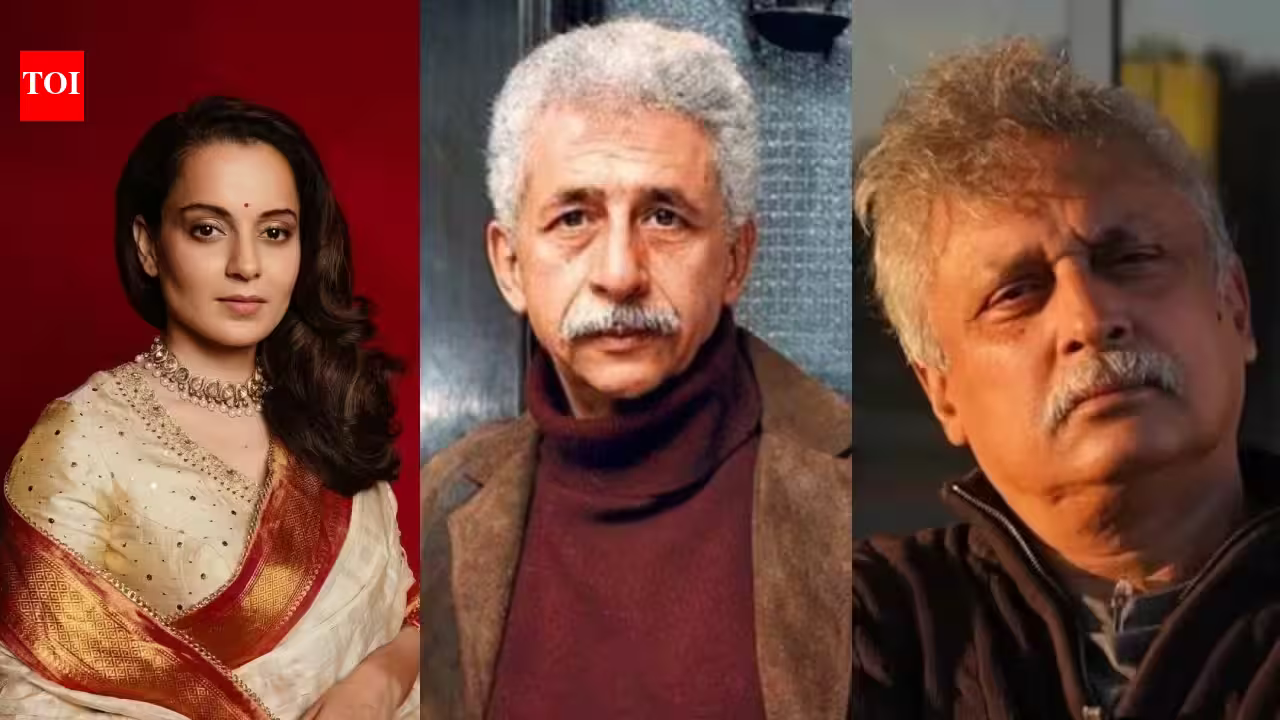
A heated exchange of words has escalated within the Indian film fraternity, drawing in prominent figures and adding a political dimension to an ongoing debate about celebrity activism. Veteran actor Naseeruddin Shah finds himself at the center of a new controversy, following sharp criticism from actor-singer Piyush Mishra, and now, a forceful intervention by BJP MP and actress Kangana Ranaut.
The genesis of this public spat dates back to remarks made by Naseeruddin Shah regarding the silence of Bollywood celebrities during student protests. Shah had provocatively compared the film industry to “a dog with a bone in its mouth that cannot bark,” implying a lack of moral courage among his peers to speak out on critical social and political issues.
This analogy, delivered with Shah’s characteristic frankness, recently resurfaced and drew a strong rebuttal from Piyush Mishra. During an appearance at the Jaipal Singh Munda Stadium in Ranchi, Mishra directly challenged Shah’s earlier comments. He questioned Shah’s own silence concerning the Jharkhand students’ protest, effectively turning the veteran actor’s criticism back on him. “Naseer Sahab, you had said during the CJP protest that some people from the film industry weren’t speaking up for the students protesting at Jantar Mantar. You said those who have bones in their mouths, they don’t speak. With all due respect, I would like to ask you, where are the other dogs who can’t speak?” Mishra stated, highlighting a perceived hypocrisy.
Mishra didn’t stop there. He also raised concerns about the motivations of some individuals involved in recent protests in Delhi and Mumbai concerning the NEET paper leak controversy. He alleged that certain participants appeared more concerned with personal comforts like “pizza and burgers” than with genuinely supporting the students’ fight for justice.
While clarifying that he continues to hold immense respect for Naseeruddin Shah as an actor, Mishra firmly declared that he no longer felt intimidated by the veteran star’s stature. This assertion signals a generational shift in how younger artists may perceive and engage with established voices within the industry.
The debate took an even sharper turn with the entry of Kangana Ranaut. Known for her outspoken views and often controversial commentary, Ranaut swiftly sided with Piyush Mishra, launching a scathing attack on Naseeruddin Shah. Embracing Mishra’s ‘dog’ analogy, Ranaut made it her own, but with a significant twist.
In a direct response, Kangana wrote, “Sach toh yeh hai har koi kisi na kisi ka kutta hai, lekin mujhe iss baat ka garv hai ki main jis ghar (desh) ki roti khati hoon uski rakhwali karti hoon/ uske liye ladti hoon, Naseer Saab khaate toh iss desh ka hain lekin laḍte padosi desh keliye hain.” This translates to, “The truth is everyone is someone’s dog, but I am proud that I guard the home (country) whose bread I eat/ I fight for it. Naseer Saab eats in this country but fights for a neighbouring country.”
Further intensifying her criticism, Ranaut rebranded Shah as a “lomdi” (fox) and contrasted it with the loyalty she associated with a dog. “I’d rather be a dog than a lomdi (fox) like Naseeruddin,” she added, implying cunning and disloyalty in Shah’s actions, particularly with her reference to him “fighting for a neighbouring country.” This remark introduces a distinct political undercurrent, suggesting Shah’s allegiances lie elsewhere, a common accusation leveled against dissenters in contemporary Indian political discourse.
This latest exchange not only highlights the deeply polarized environment within Bollywood but also underscores the increasing willingness of celebrities to engage in direct, often confrontational, political commentary. The ‘dog’ metaphor, initially used by Shah to critique silence, has now been repurposed by his critics to question his own integrity and patriotism, demonstrating the volatile nature of public discourse when art, politics, and national identity intersect.