








[
International Youth Day 2026: Bridging Aspirations and AI’s Transformative Power
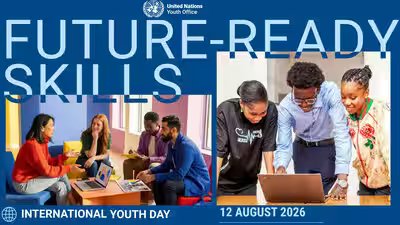
August 12, 2026 – As the world observes International Youth Day today under the poignant theme “Different Contexts, Common Aspirations,” a critical discussion is unfolding around the skills young people need to thrive in an increasingly AI-driven global economy.
The United Nations emphasizes the universal aspirations of young individuals for quality education, dignified work, meaningful participation, ample opportunities, and a sustainable future. However, these aspirations face unique challenges in Least Developed Countries, Landlocked Developing Countries, and Small Island Developing States, where poverty, climate change, geographical isolation, and unequal digital access create formidable barriers to educational and employment prospects.
UN Secretary-General António Guterres acknowledged that young people are already at the forefront as “organizers and innovators.” He underscored the urgent need for access to essential skills, including critical thinking, problem-solving, and digital literacy, to adequately prepare them for the complex future ahead.
With artificial intelligence rapidly redefining workplace dynamics and industry-wide skill requirements, today’s students are expected to possess a blend of technical proficiency, nuanced judgment, creativity, effective communication, and responsible technology utilization. Seven key skills have emerged as particularly vital for navigating successful careers in an AI-enabled economic landscape:
Essential Skills for an AI-Driven Future:
- 1. Data Literacy and Analytical Thinking: Students must develop the ability to interpret complex datasets, identify inherent biases, and make evidence-based decisions. While AI excels at rapid information processing, human judgment remains indispensable for contextual analysis and converting insights into actionable strategies.
- 2. Prompt Engineering and AI Collaboration: As generative AI becomes integral to daily work, students need to master the art of crafting clear, detailed, and contextual instructions for AI systems. Equally important is the skill to critically assess AI-generated responses and leverage these tools effectively as collaborative partners.
- 3. Critical Thinking and Fact Verification: The proliferation of AI-generated content, potentially containing errors or sophisticated deepfakes, necessitates heightened critical thinking. Students must be adept at verifying claims, cross-referencing reliable sources, and meticulously scrutinizing AI-derived answers before their adoption.
- 4. Adaptability and Lifelong Learning: Rapid technological advancements mean job requirements are in constant flux. The capacity to quickly acquire new tools, update knowledge bases, and adapt to evolving responsibilities will be paramount as industries integrate novel AI systems.
- 5. Emotional Intelligence and Communication: Core human skills such as empathy, active listening, self-awareness, and cross-cultural communication retain their importance in professional environments. These competencies are crucial for fostering effective collaboration, successful negotiation, and positive interactions with colleagues and clients.
- 6. Creative Problem-Solving: While AI can efficiently identify patterns in existing data, human creativity remains unparalleled when confronting novel or unfamiliar challenges. Students can cultivate this skill by challenging assumptions and synthesizing ideas from diverse fields.
- 7. Ethics, Bias, and AI Governance: A fundamental understanding of responsible AI use is non-negotiable. Awareness of algorithmic bias, fairness principles, and accountability frameworks will equip future professionals to identify and mitigate risks associated with AI applications in critical sectors like recruitment, finance, and education.
AI Skills Receive Global Investment Boost
In a significant move to bolster AI education and workforce readiness, S&P Global and the S&P Global Foundation have launched the three-year, $10 million StepForward initiative. This program aims to expand AI-focused learning opportunities for young people, partnering with organizations such as Generation, MIT RAISE, and various regional entities. Strategic collaborations with institutions like IIT Hyderabad, the National University of Singapore, and the Stanford Institute for Human-Centered AI further amplify its reach.
Adding to these efforts, the UN Youth Office is actively participating as a global collaborator. Their campaign specifically targets equipping young people with future-ready skills, preparing them to successfully navigate the dynamically shifting global labor markets.