








Supported by global ports and logistics operator, DP World, and local partners, more than 250 cultivation units have been established along the coast, providing new income opportunities for fishing families while contributing to healthier marine ecosystems.
The initiative, led by DP World’s Marine Services business, Shipping Solutions AMEA, is being implemented in partnership with the Indian Network on Ethics and Climate Change (INECC) and ClimaCrew. It supports coastal communities facing increasingly unpredictable fishing conditions by introducing seaweed cultivation as an additional source of income that requires no land or freshwater and can be harvested several times a season.
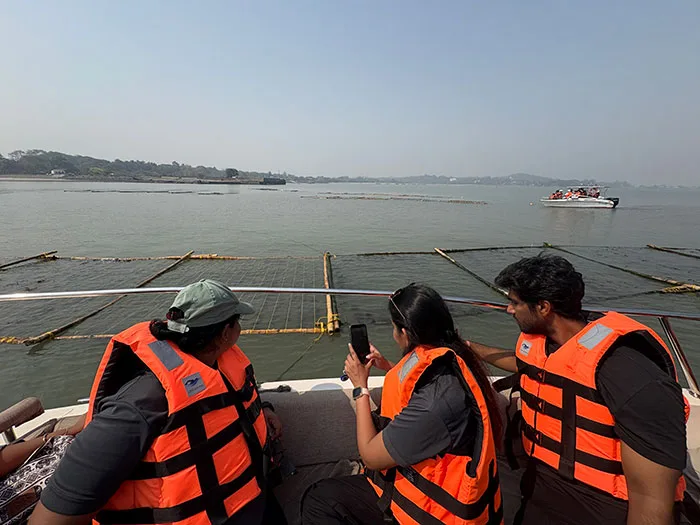
The cultivation units create artificial seaweed beds that function as marine biofilters and provide habitats for marine species such as prawns, crabs, and small fish. Water quality and marine biodiversity are also being monitored as part of the initiative to better understand the ecosystem benefits.
The farms currently produce 20–25 tonnes of wet seaweed biomass per cycle, with the potential to scale production to 50–75 tonnes by the end of the season, as the program expands and more community members take part.
 Touring a seaweed farm. (Image credit: DP World)
The program is engaging fisher families and women-led self-help groups who are involved in seaweed cultivation. For many, seaweed farming offers an opportunity to diversify livelihoods while maintaining close ties to the marine environment on which their communities depend.
CM Muraleedharan, Regional Director – India, Shipping Solutions AMEA – Marine Services, DP World, said: “Seaweed farming offers coastal communities a resilient livelihood in the face of climate change. When communities are supported with sustainable solutions, they can build economic security while contributing to the long-term health of their marine environment. This reflects our strategic commitment to sustainability, where community resilience and ecosystem health are fundamental to how we deliver lasting impact.”
Myron Mendes, Executive Director of the Indian Network on Ethics and Climate Change (INECC), said: “For coastal communities, climate change is not an abstract conversation. It is something they experience every day through declining fish catch, unpredictable seasons, and growing uncertainty in livelihoods. Seaweed farming offers an important pathway that strengthens incomes while also supporting the health of our oceans. When communities themselves lead these solutions, we begin to see what real climate resilience looks like.”
Devleena Bhattacharjee, Chief Operating Officer of ClimaCrew, said: “Seaweed is one of the few bio-resources that can be truly sustainable end-to-end, grown without land or freshwater, converted into high-value products, completely compostable, and degradable. It’s people, planet, and profit in one system. Fisherfolk incomes have shrunk under climate and human pressures, seaweed farming is one of the fastest local livelihood upgrade, preventing climate migration to nearby cities.
Seaweed cultivation is increasingly recognized globally as part of the emerging blue economy, offering a low-impact marine livelihood that supports both climate adaptation and ecosystem regeneration. Seaweed farms help improve water quality, absorb excess nutrients, and create micro habitats that support marine biodiversity while providing coastal households with an additional and more stable income source.