




N. Chandrasekaran’s Decade at Tata Sons Nears End Amid Shifting Power and Costly Bets
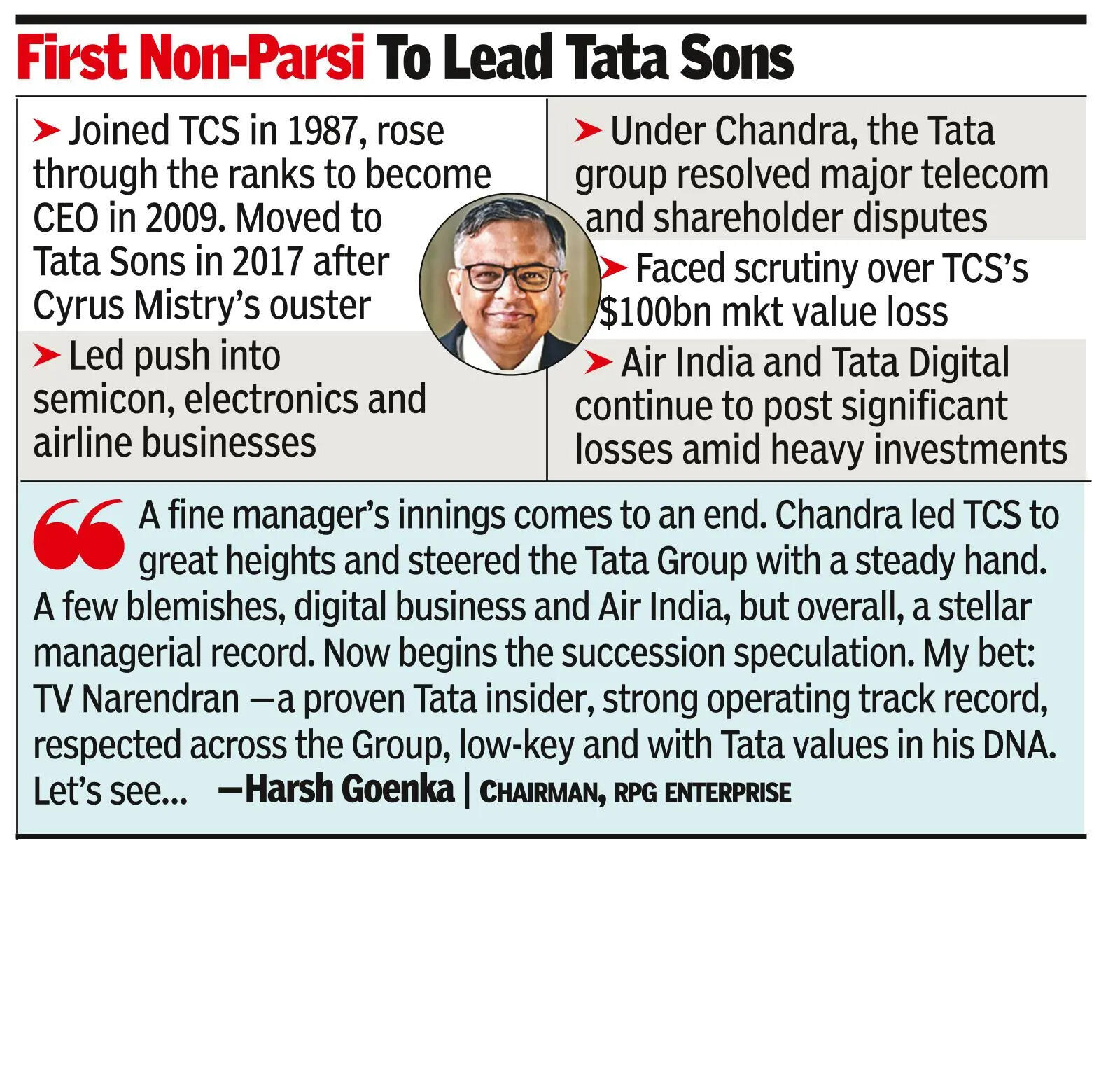
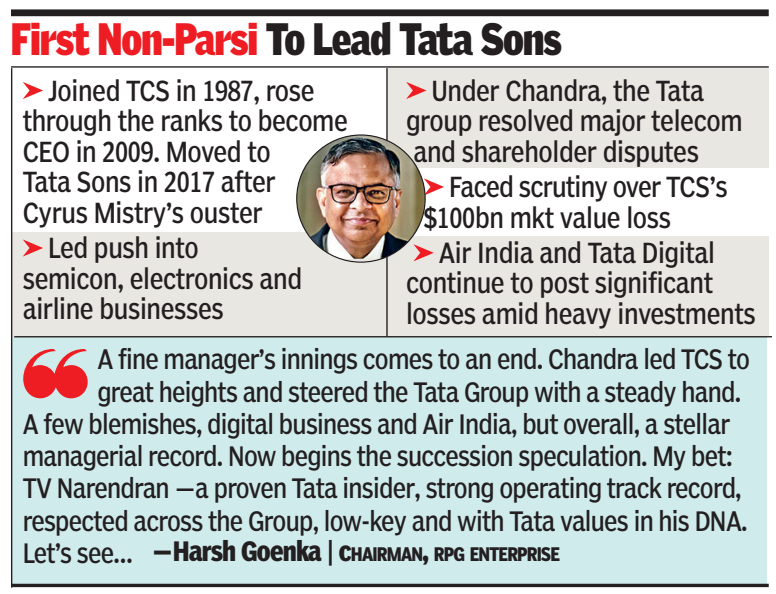
MUMBAI: A pivotal era at the helm of Tata Sons is drawing to a close as N. Chandrasekaran, the first non-Parsi to chair the venerable conglomerate, faces an uncertain future less than a week before the company’s August 18th Annual General Meeting (AGM). Reports indicate that Chandrasekaran’s extension as chairman hangs in the balance, a scenario exacerbated by the absence of a powerful patron and significant financial pressures from his ambitious ventures, Air India and Tata Digital. Furthermore, Tata Consultancy Services (TCS), a jewel in the Tata crown and Chandrasekaran’s former domain, has seen its market value plummet by nearly $100 billion amidst the seismic shifts brought by ChatGPT and the broader AI revolution.
Chandrasekaran’s journey to the pinnacle of Tata Sons was meticulously shaped by influential mentors. His career began in 1987 when he was hired by Faquir Chand Kohli, the legendary founder of TCS. Kohli’s successor, S. Ramadorai, further propelled Chandrasekaran’s ascent, first as his executive assistant, then as Chief Operating Officer, and ultimately, in 2009, as CEO of TCS.
Rise of Chandrasekaran
Born in 1963 in the small village of Mohanur, Chandrasekaran diverged from his father’s legal profession, choosing instead to pursue science. After completing his applied sciences degree from Coimbatore Institute of Technology, he earned his Master of Computer Applications from Regional Engineering College (REC), Tiruchirappalli. His talent quickly shone at TCS, where he gained prominence as the global head of sales, instrumental in scaling the company’s international development centers.
Chandrasekaran’s appointment as chairman of Tata Sons was not a foregone conclusion. Following the public statement by Ratan Tata in 2012 that his half-brother, Noel Tata, lacked the necessary experience for a larger role, Cyrus Mistry, whose family held the largest shareholding in Tata Sons, was named chairman. The subsequent bitter fallout and Mistry’s ouster paved the way for Chandrasekaran’s transition from TCS to the leadership of the Tata conglomerate.
During his initial term at Tata Sons, Chandrasekaran’s decisions were largely underpinned by the authority of Ratan Tata, whose influence extended from crucial labor negotiations at Tata Motors to Chandrasekaran’s own reappointment. Their relationship evolved into a close friendship, with Ratan Tata’s passion for aviation notably driving the acquisition of Air India.
Despite the current challenges faced by TCS, Air India, and Tata Digital, Chandrasekaran’s tenure has been marked by significant successes across the group. Since fiscal year 2017, Tata group revenue has surged 2.4 times to Rs 16.2 lakh crore, while profit has seen a sixfold increase to Rs 1.7 lakh crore. Leverage has dramatically decreased from 16x to 0.9x, and market capitalization has more than tripled to Rs 27 lakh crore. At Tata Sons specifically, profit after tax skyrocketed 39 times to Rs 32,000 crore.
Under Chandrasekaran’s leadership, the group has also ventured into new strategic territories, establishing new businesses in electronics and embarking on India’s first and only semiconductor fabrication plant. Tata Steel significantly expanded its capacity, adding more in a decade than it had since its founding in 1907. The auto components business climbed from 18th to second place, retail operations expanded from 1,800 to over 7,500 stores, and Tata AIA surged from 17th to second rank among life insurers.
However, the power dynamics at Tata Sons shifted significantly following the passing of Ratan Tata in October 2024. Noel Tata’s subsequent appointment, coupled with Mehli Mistry’s removal from Tata Trusts in October 2025, consolidated Noel Tata’s influence. This period has seen intensified scrutiny of N Chandrasekaran, particularly concerning the nearly $100 billion loss in TCS’s market value, the mounting losses at Air India and Tata Neu, and his strategic approach of accepting short-term pain for long-term growth. Tensions have also arisen over Tata Sons’ RBI upper-layer NBFC status, which could necessitate a listing and potentially expose the company to acquisition risks.
As Chandrasekaran’s decade at Tata Sons approaches its conclusion, it is defined by remarkable growth, bold and often costly investments, and an ever-evolving landscape of power within one of India’s most iconic conglomerates.