









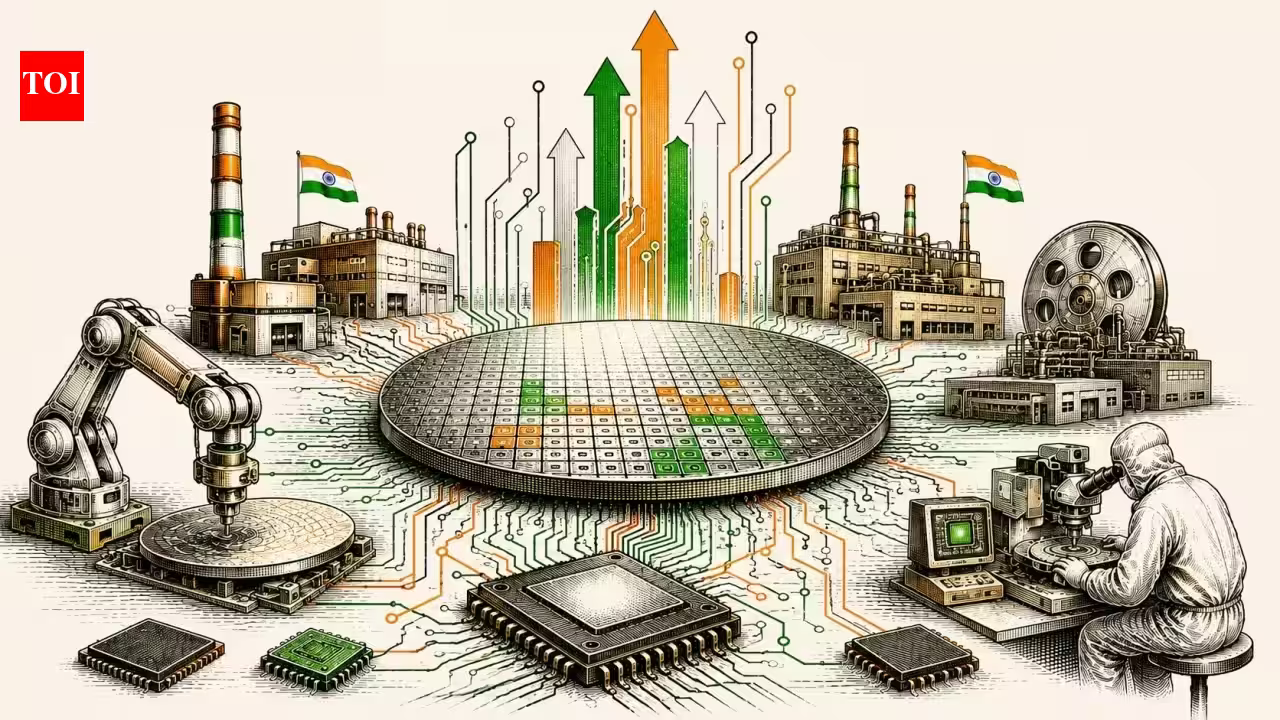
India has embarked on an ambitious journey to establish itself as a prominent player in the global semiconductor industry, launching the second phase of its comprehensive semiconductor program with an substantial investment exceeding Rs 1.27 lakh crore. This strategic move aligns with a global “semiconductor supercycle,” driven significantly by the burgeoning demand for Artificial Intelligence. As KPMG’s 2026 Global Semiconductor Outlook report indicates, the industry’s focus has shifted from cyclical concerns to rapid expansion, fueled by the insatiable appetite for AI-driven technologies. McKinsey further underscores the sector’s profitability, projecting a potential revenue of $1.6 trillion by 2030, a growth trajectory already evident in the record-breaking performances of US and South Korean stock markets.
The ubiquity of semiconductors across various sectors—from electronics and electric vehicles to telecommunications, AI, data centers, defense, and manufacturing—underscores the critical need for a self-reliant semiconductor ecosystem. In an increasingly volatile global economic and geopolitical landscape, relying on external supply chains for such fundamental components presents a significant vulnerability, both economically and strategically, as noted by Saurabh Agarwal, Partner at EY India. The pertinent question, therefore, arises: Can India, with its ambitious plan, effectively compete against established powerhouses like the US, Taiwan, and South Korea?
India’s semiconductor strategy is multifaceted, aiming to cultivate an integrated semiconductor and AI ecosystem encompassing chip design, fabrication, advanced packaging, research, talent development, and computational infrastructure. This initiative is being rolled out in two distinct phases: Semicon 1.0, with an initial outlay of Rs 76,000 crore, and the recently approved Semicon 2.0, backed by a Cabinet sanction of Rs 1,27,500 crore. To date, 12 semiconductor projects, attracting investment commitments surpassing Rs 1.64 lakh crore, have received approval, with three facilities already in commercial production. Alongside this, the nation is actively bolstering its semiconductor design capabilities through specialized skilling programs, robust startup support, and forging global partnerships.
Semicon 1.0 offered substantial fiscal support, covering up to 50% of the costs for silicon fabrication plants, compound semiconductor units, semiconductor assembly and testing facilities, and chip design endeavors. Building upon this foundation, India Semiconductor Mission 2.0 prioritizes domestic production of semiconductor equipment and materials, coupled with the development of an end-to-end Indian semiconductor intellectual property stack. Industry projections estimate the Indian semiconductor market, valued at approximately $38 billion in 2023, to expand to around $45-50 billion by 2024-25, and potentially reach an impressive $100-110 billion by 2030. The government’s vision is to enable India to design and manufacture chips fulfilling 70-75% of its domestic demand by 2029. Semicon 2.0 further aims to accelerate advanced chip manufacturing, with a clear roadmap to achieve 3-nanometer and 2-nanometer technology nodes. This phase is structured around six key pillars: chip design, semiconductor equipment and materials, fabrication facilities, advanced packaging (ATMP/OSAT), research and development, and talent development. Through these efforts, India seeks to position itself as a global semiconductor hub, strengthening the entire semiconductor value chain, attracting more chipmakers, fostering indigenous intellectual property, and advancing critical semiconductor technologies.
Experts view Semicon 2.0 as a potential transformative force for India. Saurabh Agarwal of EY India highlights that while the initial phase focused on establishing manufacturing capabilities, the second phase adopts a much broader approach, integrating design, fabrication, packaging, materials, equipment, research and development, and talent simultaneously. He emphasizes that if executed effectively, this initiative can significantly elevate domestic value addition in electronics, attract substantial investments, generate high-skill engineering and manufacturing jobs, solidify India’s position in global supply chains, and advance homegrown intellectual property. Agarwal also envisions that in the next decade, semiconductors could replicate the profound impact that software had over the past three decades, becoming a fresh engine for economic growth and national self-reliance.
Beyond economic benefits, the mission is expected to create a multitude of high-skilled jobs within the semiconductor industry and generate indirect employment across supply chains and supporting sectors. Krishan Arora of Grant Thornton Bharat points out that for electronics manufacturing, this initiative can propel India beyond mere assembly, fostering greater domestic value addition through the development of local component and semiconductor capabilities. From a strategic perspective, Semicon India 2.0 aims to reduce reliance on imported chips, bolster supply-chain resilience, and cultivate domestic expertise in semiconductor design, manufacturing, and advanced packaging, thereby enhancing technological self-reliance. However, Shivani Parashar cautions that ultimate success hinges not merely on the number of projects attracted, but on the extent to which India can develop technology, intellectual property, jobs, and overall value within the country. Saurabh Agarwal further stresses that the subsequent phase will be more challenging, requiring deeper engagement rather than broader superficial expansion. He emphasizes that while fabrication facilities often garner attention, the true measure of success lies in building out the ancillary ecosystem, including equipment, specialty materials, gases and chemicals, robust research infrastructure, and a skilled workforce.
When considering India’s competitive standing against established players like China, South Korea, and Taiwan, experts believe India is uniquely poised to carve out a differentiated semiconductor ecosystem. Krishan Arora of Grant Thornton Bharat asserts that India’s strongest competitive edge lies not in directly mirroring the advanced chip fabrication capabilities of these nations, but in cultivating a distinct semiconductor ecosystem. India benefits from a large pool of talented chip design engineers, robust engineering capabilities, increasing governmental support, a burgeoning domestic demand, and growing interest from global companies seeking to diversify their supply chains beyond traditional manufacturing hubs. Arora further highlights that India’s primary advantage in the semiconductor industry is its vast pool of skilled engineers and strong R&D talent, with many leading global chip companies already operating design and research centers in India. This deep expertise in chip design and innovation positions India uniquely to construct a competitive semiconductor ecosystem for the future.
Nevertheless, Shivani Parashar observes that India’s existing semiconductor ecosystem remains predominantly service-oriented rather than product-led. The challenge extends beyond possessing the engineering prowess to design chips; it also involves identifying large global markets and developing products tailored to them. The critical missing piece, she notes, is the commercialization of India’s engineering talent into globally successful semiconductor businesses. Saurabh Agarwal advises India to strategically focus on segments of the value chain where it can genuinely achieve world-class excellence. He points to India’s existing strengths: one of the deepest semiconductor design talent pools globally, a rapidly expanding domestic electronics market, strong policy backing, solid engineering capabilities, and a geopolitical stance that inspires trust in global supply chains. This potent combination, he believes, can transform India into a significant player in design, advanced packaging, compound semiconductors, specialty materials, equipment, and eventually, even mature node fabrication. The objective, he concludes, is not to surpass existing leaders in their own domains, but to become an indispensable partner within the global ecosystem.
The semiconductor sector is characterized by lengthy development cycles, substantial capital requirements, and sustained investment in research and development. Therefore, achieving India’s ambitious semiconductor goals necessitates a long-term strategy that effectively addresses current challenges while systematically building domestic capabilities. Experts emphasize the critical role of capital outlay. Shivani Parashar of Counterpoint Research stresses that from a policy perspective, consistency, speed, and access to patient capital will be paramount. Given the long development cycles and significant investment required for semiconductor projects, predictable incentives, expedited clearances, and reliable infrastructure are essential. She also advocates for a stronger venture capital ecosystem in India, one capable of supporting 7-10 year development cycles, multiple tape-outs, and deep-tech commercialization, without which many startups may struggle to progress beyond initial silicon. Furthermore, Parashar suggests that incentives should increasingly reward concrete outcomes such as IP creation, product commercialization, production volumes, and revenue generation, rather than solely design activity. The ultimate goal, she asserts, should be to transition from a design destination to a creator and owner of globally competitive semiconductor products and intellectual property. Saurabh Agarwal recommends that policy should evolve beyond providing project-specific incentives to actively fostering a comprehensive ecosystem, supporting R&D, forging global technological partnerships, and stimulating demand for domestically designed and manufactured products. As the EY expert aptly summarizes, while a few years ago, semiconductors in India were primarily a topic of discussion, the landscape has changed significantly, with tangible projects now underway. However, this represents merely the initial step on a long and arduous journey. With its semiconductor mission, India has taken decisive steps towards establishing itself as a credible participant in the global semiconductor ecosystem. Yet, successful execution remains paramount, and policies will require continuous evolution for India to leave a lasting mark in this critical industry over the long term.