









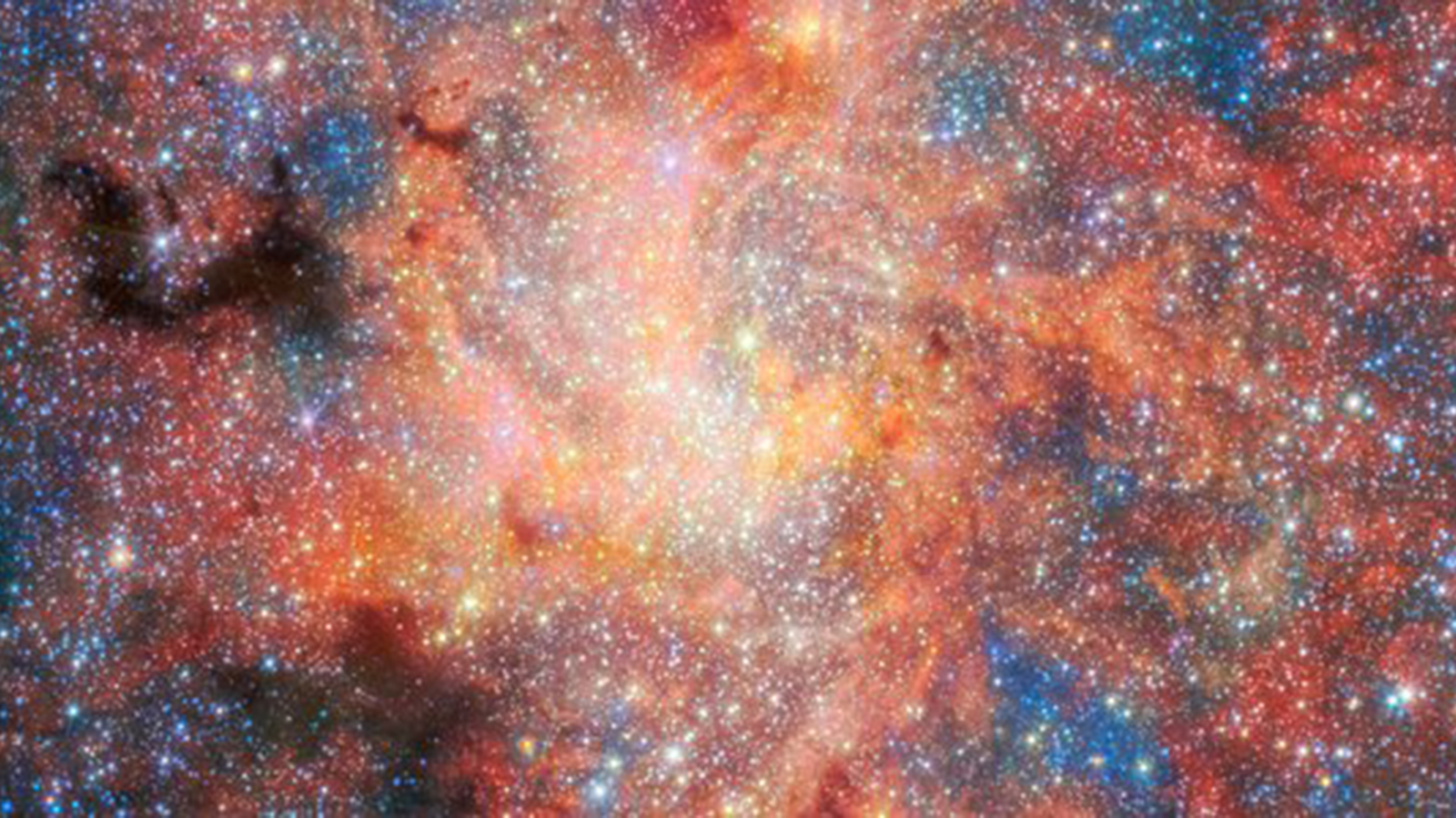
This unprecedented view of IRS 3, positioned near the image’s center, offers profound insights into stellar evolution. The star is seen actively expelling a substantial amount of its own material, forming a vast envelope of gas and cosmic dust around itself. Intriguingly, within this stellar envelope, astronomers have detected unmistakable signs of water. While water has been identified in proximity to other stars across the universe, this particular detection marks the first instance of its presence so intimately linked with the Milky Way’s central supermassive black hole, known as Sagittarius A*. This remarkable finding is situated approximately 26,000 light-years from Earth.
The observations, published on August 11 in the esteemed journal *Astronomy & Astrophysics*, significantly challenge established astrophysical assumptions. They demonstrate that even within the extreme conditions prevalent in a galaxy’s central region, aging stars like IRS 3 can still effectively contribute to the seeding of their surroundings with dust. This contradicts the previously held belief that such galactic centers were far too extreme for this fundamental process of cosmic enrichment to occur. Dr. Macarena Garcia Marin, a co-author of the study and a researcher at the European Space Agency, articulated the profound implications of this discovery in a statement. She highlighted that the detection of water is particularly thrilling because it unequivocally proves that complex molecular material can endure, and indeed thrive, within an environment dominated by intense and pervasive radiation. This has significant ramifications for our understanding of astrobiology and the potential for life in extreme cosmic locales, impacting our knowledge of the broader environment of space.
The detailed and visually stunning image was meticulously constructed by integrating data collected from two crucial instruments aboard the James Webb Space Telescope (JWST): its Near-Infrared Camera and its Mid-infrared Instrument. Dr. Garcia Marin, who also serves as the principal investigator for the Mid-Infrared Characterization of Nearby Iconic galaxy Centers (MICONIC) program, explained that this marks the first time a continuous mid-infrared spectrum has been acquired for this specific star. This breakthrough allowed researchers to discern features emanating from silicate dust, thereby unveiling the star’s precise chemical composition. An additional image vividly illustrates IRS 3’s spatial relationship to Sagittarius A*, revealing its proximity at a mere 0.55 light-years away.
IRS 3 is far from an ordinary star. It belongs to a distinct classification of aging stars experiencing the asymptotic giant branch phase. During this advanced stage of stellar evolution, these stars are characterized by their immense size, relatively cool surface temperatures, and exceptionally high luminosity. A defining characteristic of this phase is the forceful expulsion of layers of their own material through powerful stellar winds. This ejected material plays a crucial role in enriching the universe with various elements, including cosmic dust. However, given IRS 3’s extreme proximity to Sagittarius A*, there was considerable uncertainty regarding its capacity to generate these stellar winds and effectively produce dust. The recent study, employing the advanced capabilities of the JWST, has provided an exceptionally clear and conclusive picture.
To accurately delineate the complex structure of the star’s expansive envelope, the research team ingeniously combined JWST’s spectral data with sophisticated models that simulated the propagation of starlight through various hypothetical dust configurations around the star. The model that best matched the observed data depicted a layered, shell-like structure of dust extending approximately 10,000 astronomical units outwards from IRS 3. Within this structure, temperatures exhibit a wide range, from an intense 1,200 kelvins (equivalent to 1,700 degrees Fahrenheit or 927 degrees Celsius) close to the star’s surface, gradually cooling to a frigid 100 kelvins (approximately minus 280 degrees Fahrenheit or minus 173 degrees Celsius) at the very edge of the envelope.
Further in-depth analysis of the mid-infrared data yielded compelling evidence of oxygen-rich dust enveloping IRS 3. This particular finding directly refutes an earlier classification of IRS 3 as carbon-rich, which was based on the morphology of its dust envelope. Instead, the current analysis definitively identified two powerful infrared signatures characteristic of silicate dust, a compound composed of silicon and oxygen, thereby confirming an oxygen-rich chemical composition. Even more remarkably, and contrary to expectations given the harsh environment, within this dusty envelope, distinct traces of water were discovered. By combining the precise spectral data with comprehensive stellar models, the scientific team estimates that IRS 3 possesses a mass approximately six times that of our sun and is roughly 72 million years old. Its luminosity is truly astounding, radiating energy at a rate approximately 60,000 times greater than that of the sun. These findings not only reshape our understanding of stellar evolution in extreme environments but also underscore the surprising resilience and ubiquitous presence of water in the vastness of space.