








Sibling Synergy: Badminton’s Brotherly Bonds Take Center Stage at World Championships
New Delhi, India – As the BWF World Championships unfold, a fascinating trend emerges on the courts: the prevalence and unique dynamics of sibling partnerships. From identical twins whose uncanny similarities bewilder officials to brothers who find joy and mental fortitude in playing together, these familial duos offer a captivating glimpse into the personal and professional lives intertwined with elite-level badminton.
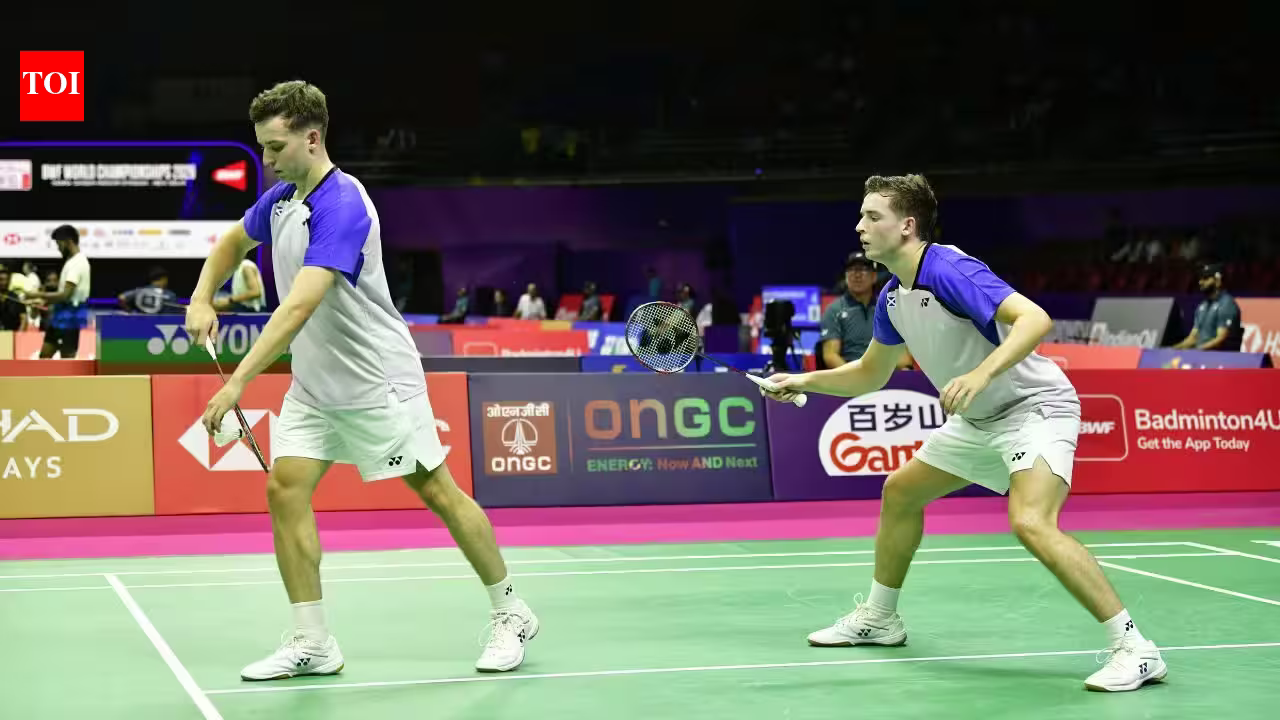
Perhaps the most striking example is that of Scottish identical twins Christopher and Matthew Grimley. At 177cm and 176cm respectively, with matching haircuts and kits, their indistinguishable appearance has even led to umpires mistakenly cautioning the wrong brother between points. Their thick Scottish accents further compound the confusion for onlookers.
Affectionately dubbed the Grimley Twins, the 26-year-olds embraced this moniker early in their careers. Their journey began in Scotland, dabbling in both football and badminton before committing to the latter. After honing their skills at local clubs, they joined the junior national team at age ten and transitioned to the senior squad after leaving school.
Their shared identity has, at times, been a source of mischievous amusement. Christopher recounts a humorous incident from a junior singles match: "One time, I had a nosebleed when I was playing a singles match… my mom said, as a joke, to go on court and see if they noticed." While his opponent immediately recognized the swap, similar antics were more successful in school, where they routinely swapped seats to the bewilderment of their teachers. Christopher jovially clarifies their boundaries, adding, "but we don’t share girlfriends!"
While they once engaged in a fierce singles rivalry at the junior level, the Grimley brothers now focus exclusively on doubles. Their strong start at the Delhi World Championships, a hard-fought 21-17, 19-21, 21-10 victory over Canada’s Kevin Lee and Ty Alexander Lindeman on Monday, underscores their synergy on court.
Off the court, their brotherly bond is evident in their tendency to finish each other’s sentences, frequent interruptions, and surprisingly, disagreements over shared memories. However, this close familial connection offers significant advantages, providing not just a sounding board for ideas but also a crucial source of motivation.
"We’ve played with each other for so long… we’ve always been doubles partners, so I feel like we know where the other is on the court. You know what the other is thinking most of the time," Christopher explains. Matthew echoes this sentiment, highlighting the emotional support they provide: "Especially when maybe we’re not feeling so good. Because we’re together, we can bring each other up easily. I know if Chris is feeling down, I know how to bring him up and vice versa." This symbiotic relationship proved fruitful when they secured a silver medal at the 2018 European Junior Championships.
Beyond the Grimleys, other sibling pairings at the World Championships attest to the unique benefits of playing with family. For French World No. 5 Christo Popov, who partners with his brother Toma Jr. Popov, doubles offers a vital element of enjoyment often absent in the intense world of men’s singles. "It’s just a lot of fun," he remarked earlier in the year. "For me, and I think for my brother as well, doubles is a way during tournaments to enjoy ourselves on court." He emphasizes how doubles provides a mental respite: "At this level, it can easily become not only about being happy on court, but also about a lot of work. Sometimes it can be tough mentally to stay at a very high level all the time. Doubles helps with that."
Even if their run at the Delhi World Championships was cut short in the Round of 64, the Popov brothers have no immediate plans to abandon their doubles partnership, underscoring the enduring value of personal connection in competitive sport.
The phenomenon of sibling doubles teams is also particularly pronounced in nations with smaller badminton communities, as highlighted by Czech brothers Ondrej and Jiri Kral. With fewer than ten professional players in the Czech Republic, athletes often find themselves collaborating with siblings from the amateur ranks onwards. Introduced to the sport by their father and older brother, Ondrej and Jiri, like many, started in singles before transitioning to doubles at the junior level.
With only a year separating them (Ondrej is 27, Jiri turns 26 in December), the Krals acknowledge both the advantages and disadvantages of their close working relationship. Jiri highlights the profound openness it fosters: "You can be open with your brother. We are also good friends. Because on tour you spend so much time together, especially as we are a small country and a small group travelling… So it’s nice that we click and it’s working."
However, Ondrej candidly points out the potential for friction: "I think the thin line is maybe sometimes saying too much, because as brothers, we are more open than we are not. So you can sometimes cross the line and maybe say a bit too much, and then we get angry at each other," he chuckles.
These brotherly partnerships, whether driven by identity, shared passion, mental well-being, or national circumstance, add a compelling human dimension to the fierce competition of the World Championships, demonstrating the power of family bonds on and off the court.