








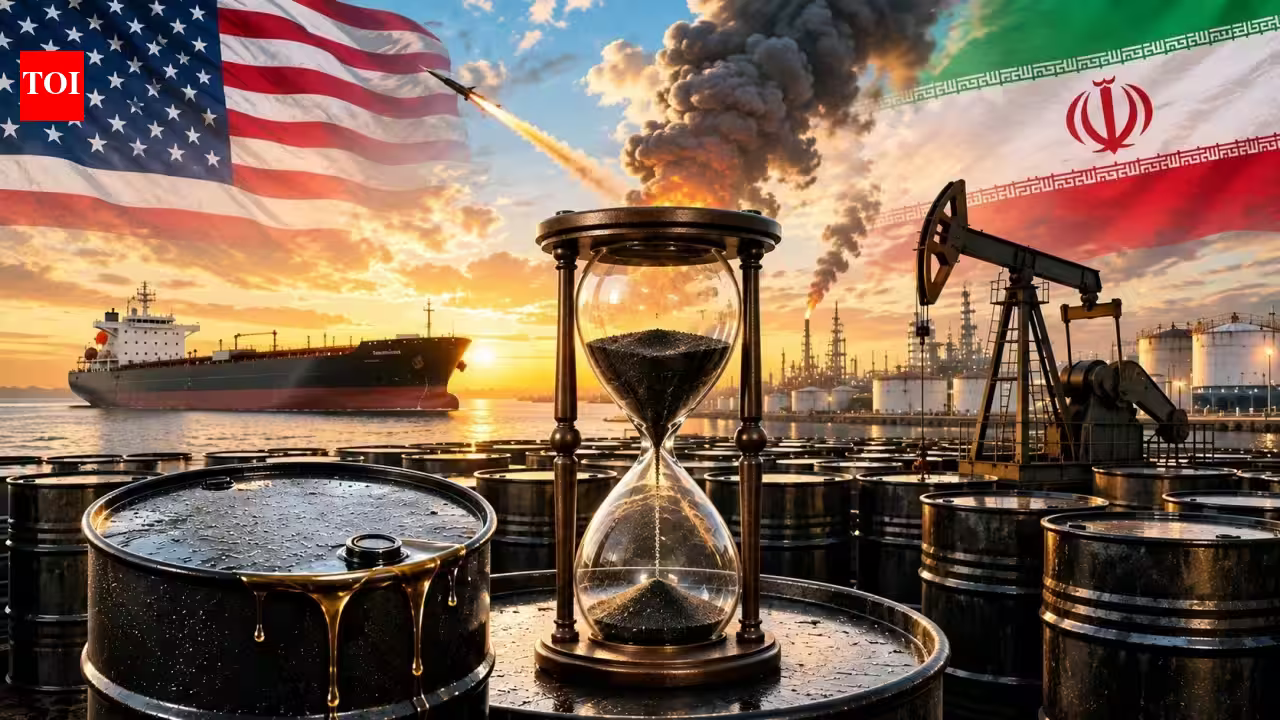
Global Oil Market Braces for Prolonged US-Iran Conflict: How Long Can Reserves Hold Out?
New Delhi, India – The ongoing conflict between the US and Iran, a potential catalyst for one of history’s most significant oil supply disruptions, has surprisingly seen crude prices exhibit only a limited spike thus far. However, as the Middle East conflict shows no signs of abating, concerns are mounting over how long the global economy, and particularly nations like India, can withstand a potentially escalating oil shock.
According to the US Energy Information Administration (EIA), a return to pre-conflict oil production and trade patterns is not anticipated until early 2027. Furthermore, the EIA’s August outlook warns that oil prices are likely to "remain elevated until global oil flows return to normal and oil inventories are replenished," citing a large drawdown in global inventories due to continued disruptions in the Strait of Hormuz. The International Energy Agency (IEA) echoes this somber forecast, projecting a substantial 4.3 million barrels per day, or approximately 4%, drop in global oil supply this year.
The immediate question facing policymakers and consumers alike is: how will the world, and specifically India, navigate a protracted oil crisis?
The Precarious Stability: What’s Kept Prices in Check (So Far)?
Several factors have contributed to the relative stability of oil prices in the initial months of the conflict, preventing a full-blown crisis:
- Emergency Stock Releases: In a coordinated effort to stabilize the market, the IEA announced the largest ever emergency release of 400 million barrels of oil from member countries’ reserves in March, with further releases promised if the situation deteriorates. The United States has also been actively drawing down its Strategic Petroleum Reserves, which are now at their lowest level since January 1983.
- China’s Demand Moderation: China’s decision to reduce its oil imports and utilize its strategic reserves has played a crucial role in mitigating the widening demand-supply gap. While the supply loss from the Gulf is estimated at around 11 million barrels per day, the actual gap compared to demand is closer to 5 million barrels per day, largely thanks to China’s actions.
- Existing Global Inventories: By some estimates, current global crude oil inventories theoretically possess the capacity to cover several months of demand. However, experts caution that not all of this inventory is readily available for release.
The Slippery Road Ahead: How Long Can the World Absorb the Hit?
Despite the initial resilience, the long-term outlook remains uncertain. Reuters analysis highlights that global oil stocks are under pressure, and the unpredictable duration of the conflict makes it difficult to assess the sufficiency of current reserves.
Saudi Aramco estimates that the world has already lost approximately 2.6 billion barrels of oil since the conflict began, representing the largest cumulative disruption since the 1979 Iranian revolution and impacting roughly 25 days of pre-war global consumption. While IEA member governments and commercial stocks could theoretically cover the 5 million barrels per day supply gap for around 300 days, the practical "readily releasable" portion reduces this coverage to approximately 180 days.
Praveen Rai, Director at Grant Thornton Bharat, explains that IEA member countries are obligated to maintain oil stocks equivalent to at least 90 days of net oil imports. The US holds around 350 million barrels in confirmed inventories after a recent 100 million barrel drawdown, while China boasts an estimated 1-1.4 billion barrels, and India approximately 100 million barrels.
However, the "operable" or minimum usable inventory varies significantly. Pankaj Srivastava, Senior Vice President, Commodity Markets – Oil at Rystad Energy, emphasizes that much of the existing oil stock is operational inventory crucial for refinery function and supply chain maintenance. Furthermore, he notes the uneven geographical distribution of inventories and the reluctance of countries to compromise their domestic energy security by exporting large volumes from their own reserves. Logistical constraints, crude-quality requirements, and refinery configurations further limit the effective usability of these stocks.
The good news is that potential increases in production from the UAE, US, Guyana, Brazil, and possibly Venezuela could ease supply constraints. Srivastava states that such an increase would "reduce the rate of inventory drawdown and extend the period over which the market can absorb the current supply disruption."
A significant challenge lies in the fact that a large portion of the world’s spare production capacity resides in the Gulf region. While non-OPEC producers can gradually increase output, any substantial response typically takes months. Naveen Das, Senior Crude Oil Analyst at Kpler, argues that the primary bottleneck isn’t storage volume, but rather logistics – specifically, getting crude out of the Gulf and managing rerouting and queuing.
Moreover, the scope for further emergency stock releases is narrowing as many countries have already depleted their reserves.
China: A Major Player with Strategic Ambiguity
China stands out as a critical player in this evolving scenario. Despite not disclosing its reserves, estimates suggest it could cover its pre-war Hormuz imports for almost a year, positioning it favorably alongside Japan. Pankaj Srivastava notes that China’s reduction in crude imports by 30-35% since the conflict began has played a significant role in preventing the global crude market from becoming excessively tight.
Should the Gulf crisis persist, Srivastava believes China will likely continue its stabilizing role through lower imports, refinery adjustments, and the utilization of its domestic crude inventories. However, experts like Kpler’s Naveen Das caution that China’s historical pattern is to buy aggressively when prices are low, not to release reserves for global benefit. While a six-month release of 1-2 million barrels could ease China’s own import needs and indirectly free up barrels for others, it would not be a deliberate act of global market support.
As China is not part of the IEA’s coordinated stock-release mechanism and views its inventories as a strategic national asset, its primary focus will likely remain on stabilizing domestic demand. Praveen Rai concludes that while China’s reserves offer an "important stabilizing influence," they should be seen as a "partial buffer rather than a solution capable of fully offsetting a major and sustained supply shock."
Implications for India: Diversification and Vulnerability
India, a major oil importer, has largely been protected by its comprehensive diversification strategy. Naveen Das of Kpler highlights that Russian crude now consistently accounts for 60-75% of India’s seaborne imports, alongside supplies from Brazil, the US, and West Africa. This diversification makes India less exposed to a prolonged war compared to Gulf-heavy importers, ensuring manageable volumetric supply security.
However, India’s vulnerability lies not just in supply, but in price. A continued narrowing of global crude oil supplies would limit India’s purchasing options, inevitably driving up prices. The increased competition from China, which has already drawn down some of its strategic reserves, could further exacerbate this. Higher crude oil prices would directly impact India’s import bill, a concern that emerged at the outset of the US-Iran conflict.
Alternative barrels often come with higher freight costs, premiums, or less favorable pricing. Das explains that "the real costs are higher freight from longer voyages, refinery adjustments to run non-Gulf crude, and price: India still pays global benchmark prices, so a persistent global deficit means continued high and volatile costs even as its physical supply holds up."
Adding to India’s complexities is the potential for new US sanctions, which could empower the Trump administration to impose tariffs of up to 100% on significant importers of Russian oil. While India’s reliance on Russian crude might face pressure, Pankaj Srivastava believes that "energy security is likely to take precedence over trade considerations, especially during periods of supply disruption." He concludes that India will likely continue to optimize its crude basket based on availability, economics, refinery compatibility, and geopolitical constraints, rather than abandoning Russian barrels solely due to tariff pressure.
The global oil market is at a critical juncture. While emergency measures and demand moderation have provided a temporary cushion, the prolonged nature of the US-Iran conflict, dwindling readily available reserves, and logistical challenges paint a picture of a slippery road ahead. The world, and particularly energy-dependent nations like India, must prepare for the possibility of sustained high prices and market volatility as the conflict continues to unfold.