






Google’s Pixel 11 Pro Fold Navigates a Shifting Foldable Landscape with Iterative Upgrades
MOUNTAIN VIEW, CA – The foldable smartphone market is undergoing a rapid evolution, with manufacturers aggressively pursuing thinner designs, invisible creases, and innovative form factors. However, Google appears to be marching to the beat of its own drum, as its newly released Pixel 11 Pro Fold largely maintains the design and specifications of its predecessor, albeit with a few notable, if incremental, enhancements.
While rivals like Samsung have dramatically slimmed down their offerings – the Galaxy Z Fold 7 last year and an even thinner, lighter Z Fold 8 this year, featuring a "passport-sized" design – and Apple is rumored to be entering the fray next month with a highly anticipated foldable iPhone promising similar advancements alongside its iOS ecosystem, Google’s Pixel 11 Pro Fold presents a more conservative update.
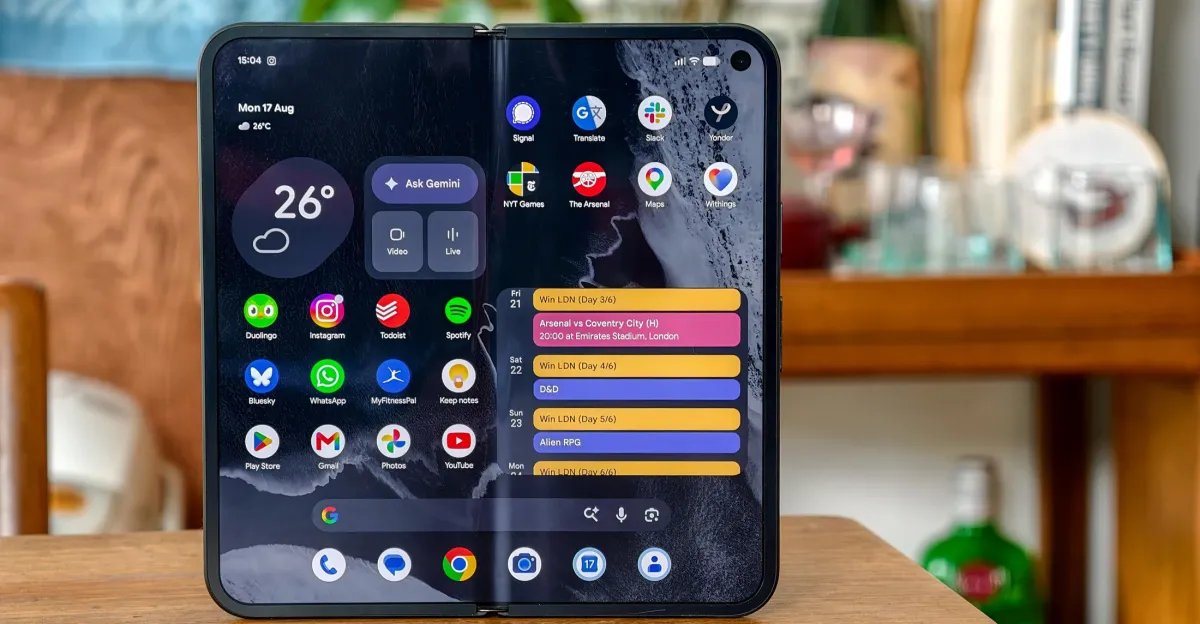
Retailing at $1,899, a $100 increase from last year’s model, the 11 Pro Fold offers an iterative hardware refresh. Key improvements include an upgrade to the Tensor G6 chipset, brighter OLED displays peaking at 3,600 nits, a larger 48-megapixel main camera sensor, and enhanced 25W Qi2 magnetic wireless charging (up from 15W). Design-wise, it’s marginally thinner (0.7mm when closed) and lighter (19g less) than the Pixel 10 Pro Fold, a difference noticeable during extended use.
Despite these upgrades, the Pixel 11 Pro Fold struggles to keep pace with the market’s rapid advancements in design. Its bulkier form factor and a clearly visible display crease feel a generation behind competitors like Samsung, Oppo, and Honor, who have made significant strides in minimizing their devices’ profiles and making creases almost imperceptible.
One area where Google continues to lead is durability. The 11 Pro Fold maintains an impressive IP68 rating for dust and water resistance, a feature still absent from Samsung’s latest foldables. Furthermore, Google touts its new glass fiber composite back as three times more durable and "nearly impossible to crack," offering a significant peace of mind for an expensive device. The inclusion of Qi2 magnetic wireless charging, though contributing to its thickness, is another unique advantage for Pixel foldables.
However, the pursuit of a slimmer design has led to a slight reduction in battery capacity, from 5,015mAh in the previous model to 4,806mAh. While still delivering all-day battery life, it falls short of being a two-day device.
The 11 Pro Fold’s almost square inner display is well-suited for multitasking, enhanced by Android 17’s new "Bubbles" feature. This allows multiple apps to float as minimized windows in a dedicated corner dock, providing quick access without disrupting the primary workflow. Yet, this screen aspect ratio may feel less modern compared to the emerging "passport-sized" designs that are gaining traction for their comfort in single-handed use and media consumption.
In the camera department, the 11 Pro Fold inherits the 48-megapixel main sensor from the standard Pixel 11, paired with a 5x telephoto lens and similar ultrawide and selfie cameras. This setup, while broadly comparable to the Pixel 11, is a theoretical step down from the Pro models. Nonetheless, the main and telephoto lenses perform commendably, especially in low light, thanks to Google’s robust image processing. The inclusion of a triple camera, particularly a capable telephoto, stands out as a significant advantage, especially with Samsung’s Z Fold 8 opting for a dual-camera setup.
Google has also introduced a suite of software enhancements to its camera app. "Camera Looks," akin to Fujifilm’s Film Simulations, offer nuanced stylistic changes to images during capture, providing more creative control than simple post-processing filters. "Magic Capture" intelligently records video and extracts the best still frames, ideal for capturing spontaneous moments. The "Creator Suite" targets content creators with features like an on-screen teleprompter and streamlined project organization.
Elsewhere, AI-driven software improvements include "Rambler," a dictation tool that summarizes spoken monologues, and "Proactive Assistance," an upgraded version of Magic Cue offering contextual task prompts. However, the latter’s limited availability and inconsistent trigger rate in testing suggest it’s still in its early stages.
As the foldable market rapidly innovates, with Samsung refining its designs and Apple poised to make a grand entrance, Google’s iterative approach with the Pixel 11 Pro Fold risks being perceived as behind the curve. While it retains compelling features like its IP68 rating, magnetic charging, and a strong camera system augmented by clever software, its current design and price point raise questions about its long-term competitiveness against increasingly sophisticated rivals. The challenge for Google will be to leverage its software prowess to compensate for hardware advancements made by other manufacturers, especially as the foldable revolution intensifies.