








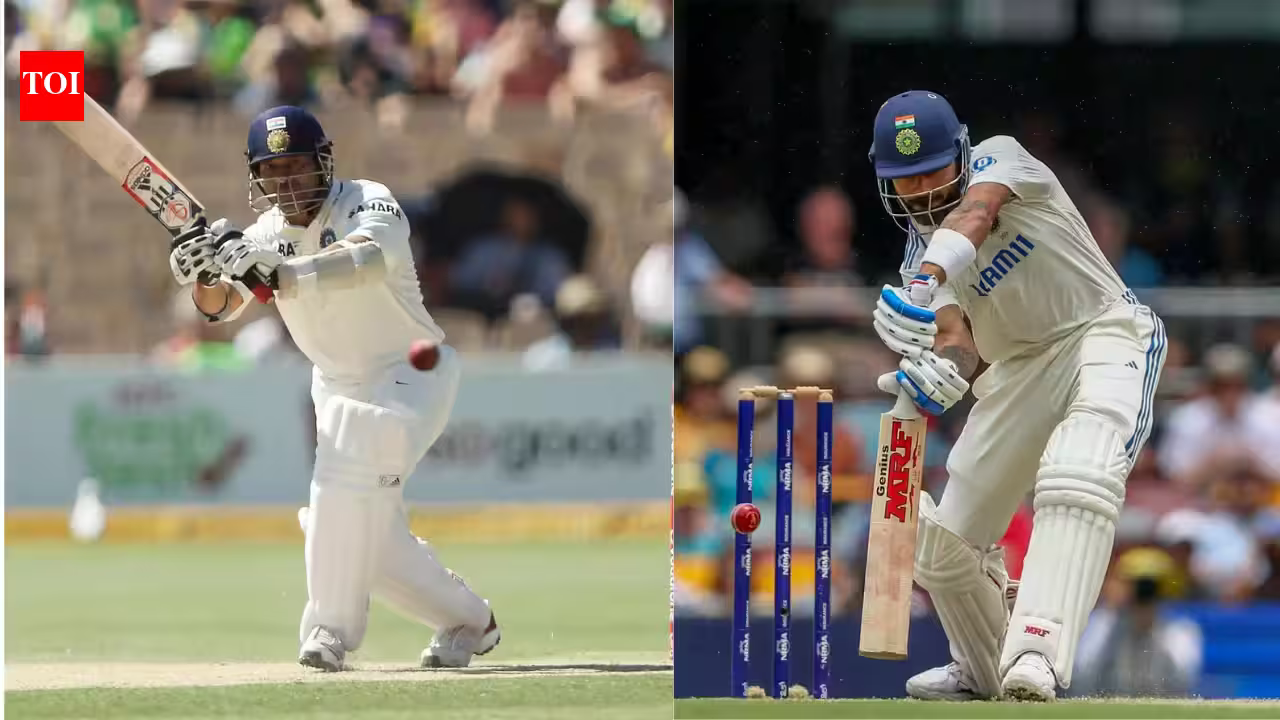
AB de Villiers Sparks Debate: Was Kohli a Superior Overseas Test Batter to Tendulkar?
Former South African superstar AB de Villiers has ignited a lively debate in the cricketing world, asserting that Virat Kohli elevated India’s overseas Test batting prowess to unprecedented heights, even surpassing the monumental legacy of Sachin Tendulkar in that specific domain. While acknowledging Tendulkar’s pioneering role in demonstrating that Indian batsmen could excel in challenging foreign conditions, de Villiers argues that Kohli took this achievement a significant step further.
Speaking on his YouTube channel following India’s commanding 165-run victory over Sri Lanka in Galle, de Villiers lauded Tendulkar’s initial breakthrough. "I think of someone like Sachin Tendulkar way back, who started that trend for India," de Villiers remarked. "But Sachin was the first guy to show that as a subcontinent batter, you can do well in bouncy and seaming conditions."
However, de Villiers then pivoted to Kohli, his former Royal Challengers Bengaluru teammate, stating, "Yet, he wasn’t as strong as someone like Virat Kohli, who was even better. Virat took that forward and raised the bar."
This bold claim has inevitably stirred discussion, given Tendulkar’s unparalleled statistical dominance in Test cricket. Tendulkar, who retired in 2013, remains the highest run-scorer in Test history with a staggering 15,921 runs from 200 matches. Kohli, whose Test career concluded in May 2025, amassed 9,230 runs in 123 Tests, placing him 19th on the all-time list.
A deeper dive into their overseas statistics further complicates de Villiers’ assertion. Of Tendulkar’s total runs, a remarkable 8,705 were scored outside India, representing approximately 55% of his career tally and making him the leading run-scorer in overseas Test cricket. Kohli, in comparison, scored 4,774 runs in 66 Tests away from home.
The disparity becomes even clearer when examining their performances in the challenging SENA countries (South Africa, England, New Zealand, and Australia). Tendulkar dominated in these conditions, accumulating 5,387 runs in 63 Tests at an impressive average of 51.30, including 17 centuries and 23 half-centuries. Kohli, while still excellent, registered 3,661 runs in 46 Tests in SENA nations at an average of 42.08, with 12 centuries and 14 fifties.
It appears de Villiers’ assessment prioritizes Kohli’s transformative impact on India’s overall team performance and mindset in away Tests, rather than purely individual statistics. Under Kohli’s captaincy, India cemented its reputation as a formidable force on foreign soil, fostering higher expectations for touring sides.
De Villiers believes this elevated standard has permeated the current generation of Indian batsmen. "Because of that, there are quite a few players now like [KL] Rahul and [Devdutt] Padikkal, who have started to up that trend and follow in the footsteps of a Virat and a Sachin," he added.
Despite this broader praise, de Villiers did highlight areas for improvement, particularly for KL Rahul. While acknowledging Rahul’s sound technique and importance to the team, de Villiers pointed out his modest overseas Test average of 34. "So you’ll expect more and that is one area where he has to work on," de Villiers advised. "He has to get bigger scores once he gets in and not just get a 100 but make it a 180 because that first-ball duck and getting out to the newish ball is always around the corner. So for him, the name of the game will be to make the big scores even bigger.”
De Villiers’ insightful comments arrive at a crucial juncture for Indian cricket. As the team looks to build on its recent victory in Galle, the focus remains on nurturing a new generation of batters capable of upholding and enhancing India’s robust record in challenging overseas conditions, a legacy undeniably shaped by both Sachin Tendulkar and Virat Kohli.