







This investigation was supported by the Pulitzer Center on Crisis Reporting and conducted as part of Rainforest Investigations Network (RIN) 2025 Fellowship.
Standing before the media entourage during the opening of the Indonesia Pavilion at the 30th session of the United Nations Climate Change Conference (COP30) in Belém, Brazil, in November, Hashim Djojohadikusumo, the Indonesian special presidential envoy for climate and energy, reiterated the country’s ambition to expand into global carbon financing.
Dressed in a light blue suit and matching shirt, Hashim highlighted Indonesia’s vast forests not only as an asset for future carbon trading but also as the backbone of biodiversity and global climate mitigation targets.
“Our vision is to make Indonesia a global hub for high-integrity carbon markets, generating measurable climate impact, creating green jobs, and supporting sustainable livelihoods,” Hashim said.
In October of last year, the Ministry of Environment had also signed a Mutual Recognition Agreement with Verra, a leading carbon standard body, that paved the way for Indonesia to sell credits on the global carbon market. The country’s carbon credit potential, the government claimed, could reach up to 13 billion tons of CO2e by 2050.
“Verra has actually listed almost 15 million tons CO2e from [Indonesian] projects of forest concessions,” Environment Minister Hanif Faisol Nurofiq said.
One of the projects registered with Verra is the Riau Ecosystem Restoration (RER), an award-winning flagship ecosystem restoration project in Sumatra. The project is run by APRIL Group, one of the largest pulp and paper producers in the world, and a subsidiary of the multibillion-dollar Singapore-based conglomerate Royal Golden Eagle.
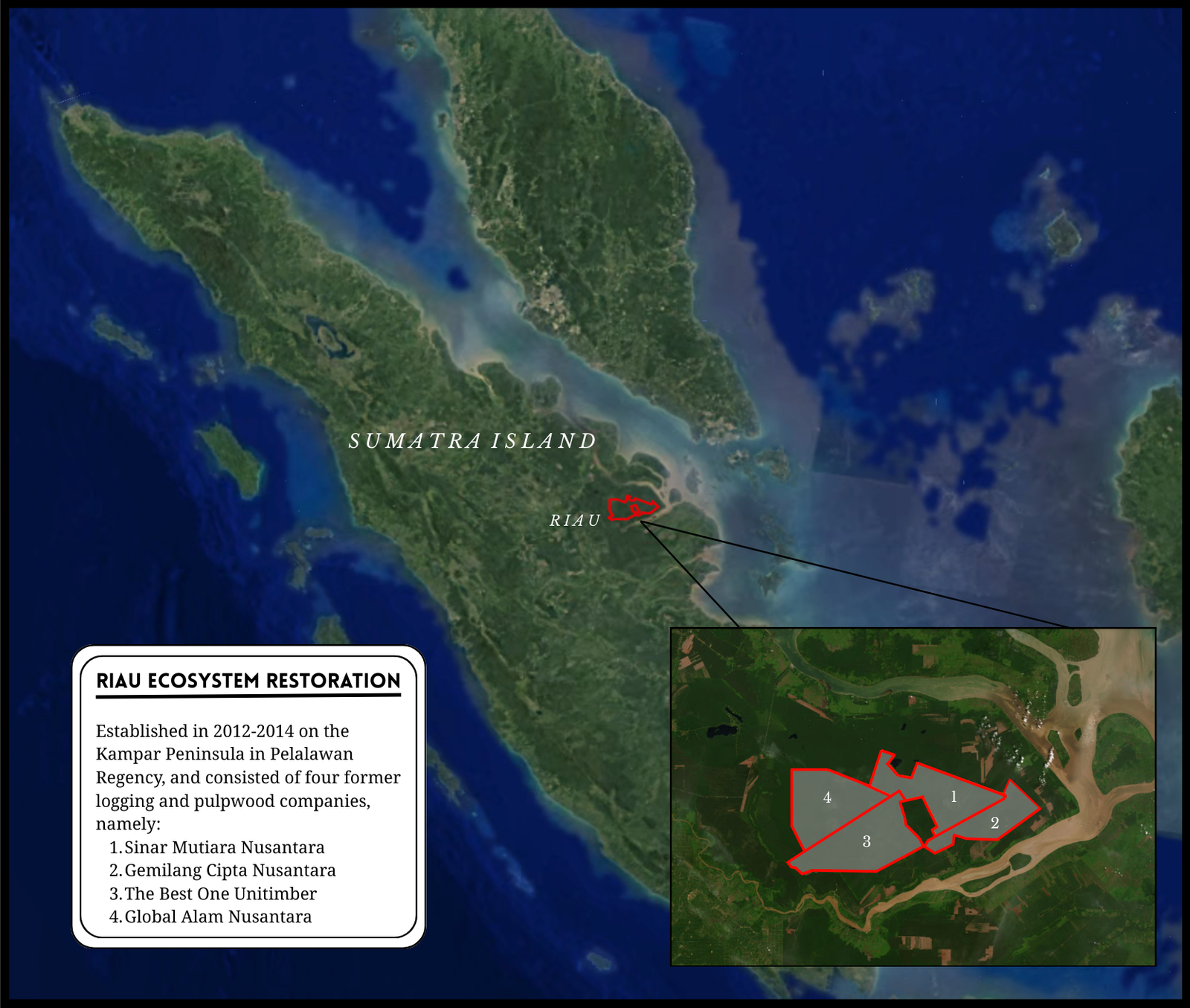
Since its launch in 2013, APRIL Group has poured $100 million into turning four inactive timber concessions in Pelalawan Regency on the Kampar Peninsula in Riau Province in central Sumatra – an area widely regarded as one of Southeast Asia’s last blocks of ancient tropical peat swamp forest – into a 130,000-hectare restoration, conservation, and carbon project.
RER said that its carbon project, which is being developed by the Singaporean environmental consulting company Himpanzee, seeks to avoid more than 373 million tons of CO2e emissions from land conversion over the 57 years of the project lifespan, which can be extended by a further 43 years.
If a ton of credit in the market is valued at $7, the project is worth $2.6 billion.
However, a months-long investigation, drawing on satellite datasets, Verra documentation, interviews, scientific research, and government and publicly available data, suggests that RER may have overstated the deforestation threat to its forests, which are already under regulatory constraints, in order to generate carbon credits.
This has been enabled by methodological loopholes and lenient monitoring, reporting, and review processes under Verra’s voluntary carbon standards.
While the project is currently seeking verification approval from Verra, these practices risk generating “hot air” – carbon credits that do not reflect genuine emissions reductions.
Overstated Threat
In every forest carbon project lies a concept called a baseline, which serves as the foundation for determining how much emissions can be reduced or prevented. The baseline is a counterfactual scenario used to quantify how much emissions would occur if the carbon project were not implemented. In short, the higher the baseline emission, the greater the potential for generating carbon credits.
In its Project Design Document (PDD), the main document for any carbon project, RER constructed a baseline assuming that without the restoration and carbon project, the entire concession area would eventually be cleared for industrial pulp plantations. The document stated that since most forest in the Kampar Peninsula is designated as Production Forest by the government, the probability of forest clearing is assumed to be 100 percent.
Based on this assumption, RER estimated that without the carbon project, approximately 78,000 hectares of existing forest within its concession would be cleared and converted into industrial plantations, most of them for pulp. Such plantations are referred to in Indonesia as Hutan Tanaman Industri (HTI), or “Industrial Plantation Forests.”
With a projected annual deforestation rate of approximately 7.5 percent, or more than 10,000 hectares of forest per year, the RER expected that the area would be completely cleared within seven to 10 years.
“The fact that this large-scale deforestation was successfully prevented is a direct result of managing the RER concession as an ecosystem restoration area,” said Bradford Sanders, head of ecosystem restoration at APRIL Group, in a written statement.
However, historical deforestation data observed through satellite and government records in the Kampar Peninsula do not show the constant pattern of deforestation assumed in that baseline.
Government data indicate that annual deforestation in the project area has fluctuated, peaking in the early 2000s – coinciding with the massive expansion of HTI plantations across Indonesia – before declining sharply after 2014, which marked a point of saturation and the establishment of conversion regulations for peatlands.
In the years leading up to and following the start of the RER project, annual deforestation in the Kampar Peninsula ranged between 2,000 to 3,000 hectares annually, before dropping drastically to only 249 hectares in 2020.

Before APRIL Group was granted an ecosystem restoration permit, the area once belonged to four inactive timber and pulpwood companies all linked to its parent company, the Singapore-based multibillion-dollar conglomerate Royal Golden Eagle. Source: Google Earth.
The Proxy Method and Baseline Inflation
The projected deforestation rates in the RER area are derived from a “proxy method,” which compares deforestation trends in other regions that possess social, political, and economic characteristics and pressures similar to the carbon project site. The historical deforestation in these proxy areas (also known as “reference areas”) is then used to estimate how the forest within the carbon project area will be cleared in the future.
RER selected six reference areas, all of which were previously pulp concessions owned by subsidiaries or suppliers of APRIL Group. Most of the proxy areas chosen by RER are inactive concessions, and at least four of them were involved in corruption cases involving officials in the 2010s.
By utilizing a cumulative average calculation and selecting only the deforestation trends from peak years, the RER carbon project generated a constant deforestation figure for decades to come.
However, when using a year-on-year method, historical deforestation in the proxy areas did not occur constantly; rather, it was episodic and sporadic. Spikes in forest-to-plantation conversion occurred during specific periods, particularly in the early 2000s, when the expansion of HTI plantations in Riau was at its most aggressive.
The cumulative approach ultimately produced an emission baseline that is significantly higher than if deforestation were calculated based on actual annual trends.
Furthermore, although project documents stated that RER concessions hold Production Forest status and can legally be converted into HTI plantations, this investigation found no evidence of any new peatland conversion plans approved by the government in the years leading up to the project’s commencement.
Forest clearing within active plantation concessions in Indonesia cannot be done arbitrarily. Such activities must receive government approval through long-term Forest Concession Working Plans (RKUs) and documents known as RKTs that must be submitted and approved on an annual basis. RKTs detail the location, production targets, and types of activities permitted within specific working blocks, including planting, harvesting, conservation, and infrastructure development.
An analysis of the 2014 RKT documents for APRIL Group suppliers PT Madukoro and PT Harapan Jaya – both used as proxy areas in the RER baseline – shows that annual operations were organized based on designated working blocks, not large-scale forest conversion.
Both companies were established in 2003 and hold concessions of 15,000 hectares and 4,800 hectares, respectively.
In 2014, Madukoro’s approved annual work plan covered approximately 1,474 hectares, or about 10 percent of its total concession area. This plan consisted of 1,000 hectares for HTI crops, 400 hectares for community crops (tanaman kehidupan), and the remainder for conservation areas.
Harapan Jaya showed a similar pattern, with an annual working block of approximately 320 hectares.
These documents demonstrate that activities within concessions are limited by annual quotas and operate within a clear regulatory framework, making the scenario of converting tens of thousands of hectares of forest per concession annually in Riau logically difficult to accept.
Juma Maulana, a researcher at Pantau Gambut, a Jakarta-based non-profit environmental organization, who analyzed the RER-related data, explained that ecologically, deep peat has high acidity and low nutrient content, making it unsuitable for conversion into monoculture plantations such as HTI or oil palm.
Economically, according to Juma, clearing deep peatland is expensive in terms of operations and maintenance, and is thus unprofitable. He stated that many companies now exclude deep peatlands from their operational areas because the risks and profits are disproportionate.
“Draining peat can create a domino effect,” Juma said. “Once dried, peat is no longer able to absorb water and eventually triggers recurring floods and fires. The risk is immense. It is economically unviable and far too dangerous.”

Peatland water within the RER concession in Riau Province, Sumatra, Indonesia. (Photo credit: Facebook/RER)
Claims of Additionality and the Evolving Regulatory Landscape
In the carbon market scheme, a project must fulfil the principle of additionality. This means that the emission reduction and prevention efforts must truly result from the project developer’s initiative, rather than being a consequence of existing government policies or legal obligations. If a forest area is already protected by law, the project developer cannot claim emission reductions or generate carbon credits from it.
In the case of RER, layers of protection policies and regulations were already in place long before the carbon project commenced.
Between 2010 and 2011, the government rejected permit application from a pulp wood company, PT Surya Alam Perkasa, to convert peat swamp forests to plantations before RER acquired the ecosystem restoration permit. This was a result of a moratorium on HTI plantations that was introduced in 2011 and later made permanent in 2019 via a presidential decree.
Then, in 2017, the government mandated the protection of peatlands with a depth of more than 3 meters as part of its national peat restoration policy. Under these regulations, forestry companies were required to revise their long-term Forest Concession Working Plans to exclude deep peat from conversion and exploitation activities, which technically reduced the effective operational area of their concessions. As compensation, the government offered replacement concessions outside peatland areas through a land-swap scheme.
In deep peat areas that had already been converted, companies were mandated to maintain the groundwater level at a range of 20–40 centimeters below the surface to mitigate the risks of subsidence, fires, and emission releases.
Long before that, the government had actually required natural forest timber and HTI companies to carry out ecosystem restoration as part of their primary activities, on the basis of a Ministry of Forestry regulation issued in August 2009.
Furthermore, in 2022, Agus Justianto, then director general of sustainable forest management at the Ministry of Forestry, stated that the former logging concessions utilized by RER were never earmarked for conversion into HTI plantations after being included in the Indicative Map for the Suspension of New Permits (PIPPIB), launched by the Ministry of Forestry in 2011.
“After becoming ex-HPH [Forest Concession Right] areas, these four restoration concessions were included in the PIPPIB and reserved for ecosystem restoration permits,” he said at the time, according to a report by Media Indonesia.
Therefore, according to Agus, RER’s carbon project narrative does not portray the full chronology of policies and should not have applied for validation by carbon standard agencies, as it is inconsistent with the ministry’s policies.

Historical deforestation on the Kampar Peninsula shows a declining trend long before RER initiated its carbon project. Source: Ministry of Forestry and Paradigma.
Agus also explained that the PIPPIB is updated periodically to reflect policy changes and forestry dynamics. By 2022, the scope of the PIPPIB had expanded to 66 million hectares of land, including nearly 15 million hectares of peatland and primary forest.
This directly contradicts the narrative of the RER restoration and carbon project itself, as ecosystem restoration was already mandatory for all logging activities, and the conversion of land into HTI plantations in the Kampar Peninsula was never on the government’s agenda. Thus, the narrative that only the RER project successfully prevented the conversion of peatlands in the Kampar Peninsula is not supported by the evidence.
Analysis of the Ministry of Forestry’s maps also indicates that RER concessions are included in the Forest and Other Land Use (FOLU) Net Sink 2030 policy and are classified as high-priority conservation areas with code RO11.
According to the government, forest conservation is a key to achieving the net sink target, where carbon sequestration from the FOLU sector is greater than or at least equal to its emissions.
Additionally, most HTI concessions in the Kampar Peninsula fall under the category of peat water management (code RO9). Consequently, even without carbon incentives, companies operating on deep peat are legally obligated to maintain hydrological conditions – including ensuring the groundwater level does not drop by more than 40 centimeters – to reduce the risk of subsidence, fires, and emissions releases.
Inigo Wyburd, a researcher from the Brussels-based Carbon Market Watch, stated that in jurisdictions with strong regulatory restrictions, additionality must be rigorously tested, particularly to determine if the mitigation activities are already legally required and whether those regulations are strictly enforced.
“If a climate mitigation effort is mandated by laws, regulations, or binding legal instruments – either explicitly or implicitly – it is unlikely to be additional and should not be credited,” he said.
To ensure climate benefits, the baseline scenario of a carbon project should be reviewed periodically through a mechanism known as baseline renewal, Wyburd added.
While the PDD mentions that RER is required to review planned deforestation areas at least every five years, the document does not clearly explain a mechanism for dynamic baseline adjustment to reflect changes in policy and regulatory structures.
“Projects should be required to account for policy and regulatory changes over time, for example through periodic baseline reviews, additionality tests, and other factors,” Wyburd concluded.
Lenient Audits
How a carbon project secures approval from Verra under the Verified Carbon Standard (VCS) program depends heavily on the execution of the validation and verification process. By design, this process is intended to ensure that project developers comply with all rules and requirements of the utilized methodology.
In the RER case, these processes are carried out by an Indian company Earthood as an accredited third-party auditor, also known as a Validation and Verification Body (VVB)
Verra then conducts an accuracy check on the documents and may request clarifications, corrections, or note methodological deviations. This entire process is documented in a Project Review Report (PRR).
An analysis of the PRR published in 2023 reveals that Verra identified several inconsistencies and methodological deviations within the RER project. However, the project was ultimately approved following revisions, recalculations, and editorial corrections, without any fundamental changes to its baseline emission claims.
Out of the 24 findings in the PRR, Verra highlighted inconsistencies in deforestation figures across various documents that “could lead to changes in the calculation of emission reductions and removals.” These findings prompted RER and Earthood to issue revisions.
Despite this, RER argued in the PRR document that “no changes in emission calculations were necessary as the updated values merely reflected the use of the correct mathematical approach in determining the deforestation rate.”
Subsequently, Verra stated that the RER project met the requirements of the VCS Program, and subsequently registered the project and approved its first verification request.
Verra also noted that during the validation process, the VVB is required to review all relevant national policies and regulations concerning the legality and obligations of project activities.
However, the available project documents do not display a regulatory analysis that responds to policy shifts in the forestry sector. Regarding the various inconsistencies and deviations, Verra maintained that issues concerning deforestation rates, the selection of proxy areas, and data consistency could be resolved through corrections.
Verra did not explain in detail how these corrections affected the overall integrity of the project’s baseline.
In response to criticisms regarding the constant emission baseline, Verra stated that carbon project developers are required to renew their baseline every five years.

Cumulative method used by RER to formulate its baseline shows constant and high deforestation rate over the course of its project lifespan, whereas observed historical deforestation pattern using independent platforms showed declining deforestation trend in Riau. (Source: Global Forest Watch and RER’s Project Design Document)
“Verra recognizes the importance of periodically updating baselines to reflect changes in policy, market dynamics, and other factors,” Verra wrote in a statement. “Therefore, during a baseline renewal, projects are required to re-evaluate deforestation dynamics in the reference or proxy areas.”
Reforming Carbon Schemes
Since its launch at COP13 in 2007, the REDD+ (Reducing Emissions from Deforestation and Forest Degradation plus) program has faced continuous criticism for allegedly failing to reflect genuine efforts in emission reduction or prevention. Experts and scientists argue that the methodologies and auditing processes employed by Verra and its auditors appear lax and are riddled with conflicts of interest.
A study published in 2024 in the journal Global Environmental Change found that forest-based carbon project methodologies often rely on overly simplistic deforestation assumptions.
Meanwhile, research by the Berkeley Carbon Trading Project also revealed that carbon project developers possess the leeway to interpret methodologies in ways that can result in “junk credits” or “over-crediting” – the issuance of more carbon credits than the actual emission reductions achieved.
These findings have resulted in mounting pressure to reform forest carbon projects to ensure they provide real climate benefits. One prominent proposal is the use of dynamic baselines based on verified emission data observed periodically, a method known as ex-post. This method stands in contrast to the ex-ante approach commonly used in REDD+ projects, whereby emission reduction tend to be forecasted and “locked in” at the project’s inception. This approach has been widely criticized for its high risk of inflating credits.
“Dynamic baselines are a promising idea, but there seems to be no serious commitment to implementing them yet,” said Thales A.P. West, assistant professor at the Department of Environmental Geography, Institute for Environmental Studies at Vrije Universiteit Amsterdam, who co-authored the study.
However, according to West, the ex-post approach is less attractive to the market: this method tends to generate fewer credits compared to the ex-ante baseline, making it less financially viable.
West also believes that for the system to improve meaningfully, the voluntary carbon market must first be freed from conflicts of interest.
In December last year, Transparency International U.S. published a report describing conflicts of interest in the voluntary carbon market as “rampant.”
“Some project developers who want to maximize their project value also sit on the boards of standardization bodies,” said Gary Kalman, executive director of Transparency International U.S. “It’s as if the students are designing their own assignments and grading their own papers.”
The potential for conflict of interest is also visible within the context of the RER project. Earthood, which was contracted by Himpanzee, was founded by Kaviraj Singh, who holds several leadership and advisory positions within the voluntary carbon market ecosystem. Singh is known to serve as the president of the International Association of Validation & Verification Bodies, a member of the Expert Advisory Group for the Voluntary Carbon Markets Integrity Initiative, and a member of the VCS Program Advisory Group.
Neither Earthood nor Himpanzee responded to repeated inquiries regarding the RER project.
“I think as long as conflicts of interest persist and the people making key decisions lack the adequate expertise to formulate real solutions, these problems will continue,” West said.
In its written statement, Verra did not explicitly address the issues of conflict of interest or data transparency, instead emphasizing the role of the VVB as the auditor.
“Verra accepts every explanation [within the documents] after the VVB has validated all data and information presented in the project documents,” it said.

A crocodile in the Serkap River, which flows through the RER concession area. (Photo credit: Facebook/RER)
Greenwashing Narrative
In a written statement in February, APRIL Group stated that the project had undergone a second verification audit in late 2025 for the period August 2020–December 2022. The second monitoring report is currently under technical review by Verra and is expected to be published soon.
“RER has in all respects implemented and complied with the VCS and has been verified and confirmed by a qualified independent VVB,” said Sanders of APRIL Group.
Despite successfully presenting a sustainable green image, a series of investigations by non-profit organizations continue to uncover how Royal Golden Eagle (RGE), the parent company of APRIL Group, remains involved in deforestation through shell companies or affiliates.
While data shows a downward trend in land conversion in Riau over the past decade, deforestation carried out by RGE-affiliated companies has shifted to other parts of Indonesia, particularly Kalimantan, at an alarming rate.
According to data from Nusantara Atlas and Trase, a global agricultural supply chain transparency initiative, annual deforestation for HTI plantations in Sumatra fell by 55 percent in 2024 compared to the previous year, from 30,345 to 13,630 hectares. At the same time, however, deforestation in Kalimantan has increased, overtaking Sumatra.
A 2021 study published by AidEnvironment found that the Nusantara Fiber Group, which is linked to RGE, cleared 26,000 hectares of primary forest in Kalimantan between 2016–2020.
A 2023 investigation by a coalition of non-profit organizations also revealed that timber from deforestation in Kalimantan still enters RGE’s pulp supply chain, despite the company’s NDPE (No Deforestation, No Peat, No Exploitation) commitment.
Refki Saputra, a forest campaigner from Greenpeace, stated that the RER project serves merely as a new part of APRIL Group’s business portfolio, which polishes up its sustainability image in the eyes of the international community by riding the carbon market wave.
“This does not reflect a genuine ambition to truly reduce emissions and prevent deforestation,” Refki said.
Made Ali, an environmental activist and independent researcher based in Riau, noted that the narrative of the RER carbon project implies that the company is saving the forest from its own threat.
He said the project is more accurately viewed as a form of “atonement” by APRIL Group for the deforestation they have carried out over the years, rather than a carbon credit project that genuinely reduces emissions.
APRIL subsidiary PT RAPP, for instance, is recorded to have cleared 128,267 hectares of peat swamp forest in Riau over the last two decades, based on analysis by Nusantara Atlas.
“This also demonstrates a classic greenwashing tactic,” Ali said. “They may protect one area, but the company continues to drive deforestation in Riau and elsewhere. Turning that protection into tradable carbon credits raises serious ethical questions.”