









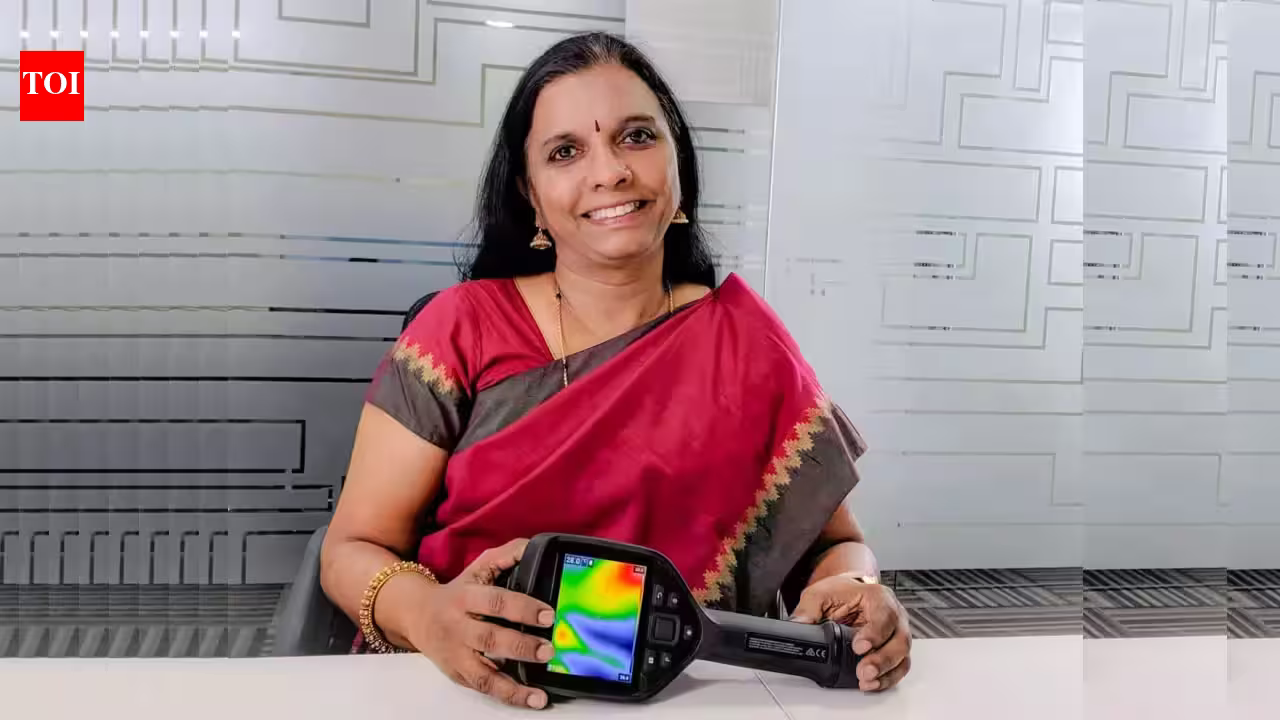
From Supercomputing to Saving Lives: How Dr. Geetha Manjunath Used AI to Transform Breast Cancer Detection
For many, innovation is the product of market research or a pursuit of the "next big thing." For Dr. Geetha Manjunath, however, the drive to innovate was born from personal tragedy. A distinguished scientist with a background in supercomputing, Dr. Manjunath turned her focus toward the medical field after losing two cousins to breast cancer within a heartbreakingly short window.
The catalyst for her mission was a realization that the current standard of care had failed her family. In one instance, a mammogram failed to detect the disease until it was far too late. Driven by the question of whether technology could make screening more accessible and accurate, she leveraged her decades of expertise to develop a groundbreaking solution.
A Foundation in Cutting-Edge Computing
Dr. Manjunath’s journey to becoming a pioneer in health-tech began in Bengaluru, where she cultivated a formidable academic and professional record. A gold medallist at the Indian Institute of Science (IISc), she spent years at the forefront of the technological revolution. During the 1990s, she was a key contributor to India’s early commercial supercomputing efforts at the Centre for Development of Advanced Computing (C-DAC).
Her career trajectory took her through high-level roles at Hewlett Packard Labs and Xerox Research, where she mastered the nuances of data analytics and machine learning. Long before AI became a modern buzzword, she was already pushing the boundaries of how complex data could be used to solve real-world problems.
The Thermalytix Breakthrough
When Dr. Manjunath began researching breast cancer diagnostics, she identified a critical gap: late diagnosis caused by a lack of accessible, comfortable, and radiation-free screening methods. She zeroed in on thermal imaging, theorizing that cancerous tissues exhibit unique metabolic and blood flow patterns that emit distinct heat signatures.
The challenge lay in the complexity of interpreting these thermal images. Drawing on her extensive background in artificial intelligence, Dr. Manjunath and her team developed software capable of identifying thermal abnormalities with high precision. This research—which started with clinical studies in Manipal—eventually laid the groundwork for NIRAMAI Health Analytix.
A New Era of Non-Invasive Screening
In 2016, Dr. Manjunath left her corporate career to co-found NIRAMAI alongside Dr. Nidhi Mathur. The company’s flagship technology, Thermalytix, utilizes AI to analyze thermal patterns, offering a non-invasive, radiation-free, and contact-less alternative to traditional mammography. Because the equipment is portable, it is capable of reaching underserved regions where traditional medical facilities are scarce.
The impact of her work has been profound. To date, the technology has been used to screen over 400,000 women across more than 250 locations in India, successfully detecting more than 2,000 cases of cancer that might have otherwise gone undiagnosed.
Turning Personal Loss into Global Progress
Dr. Manjunath’s story stands as a powerful testament to the potential of a research-oriented education. Her life’s work demonstrates that technical expertise, when paired with a deep sense of purpose, can address humanity’s most pressing challenges. She turned her grief into a tool for change, proving that sometimes the most enduring innovations do not start in a boardroom, but with a simple, persistent problem that demands an answer.
Disclaimer: This article is based on publicly available information and social media posts shared by the individuals or sources cited. The views and claims expressed are those of the respective sources and do not necessarily reflect the views of the publisher.