









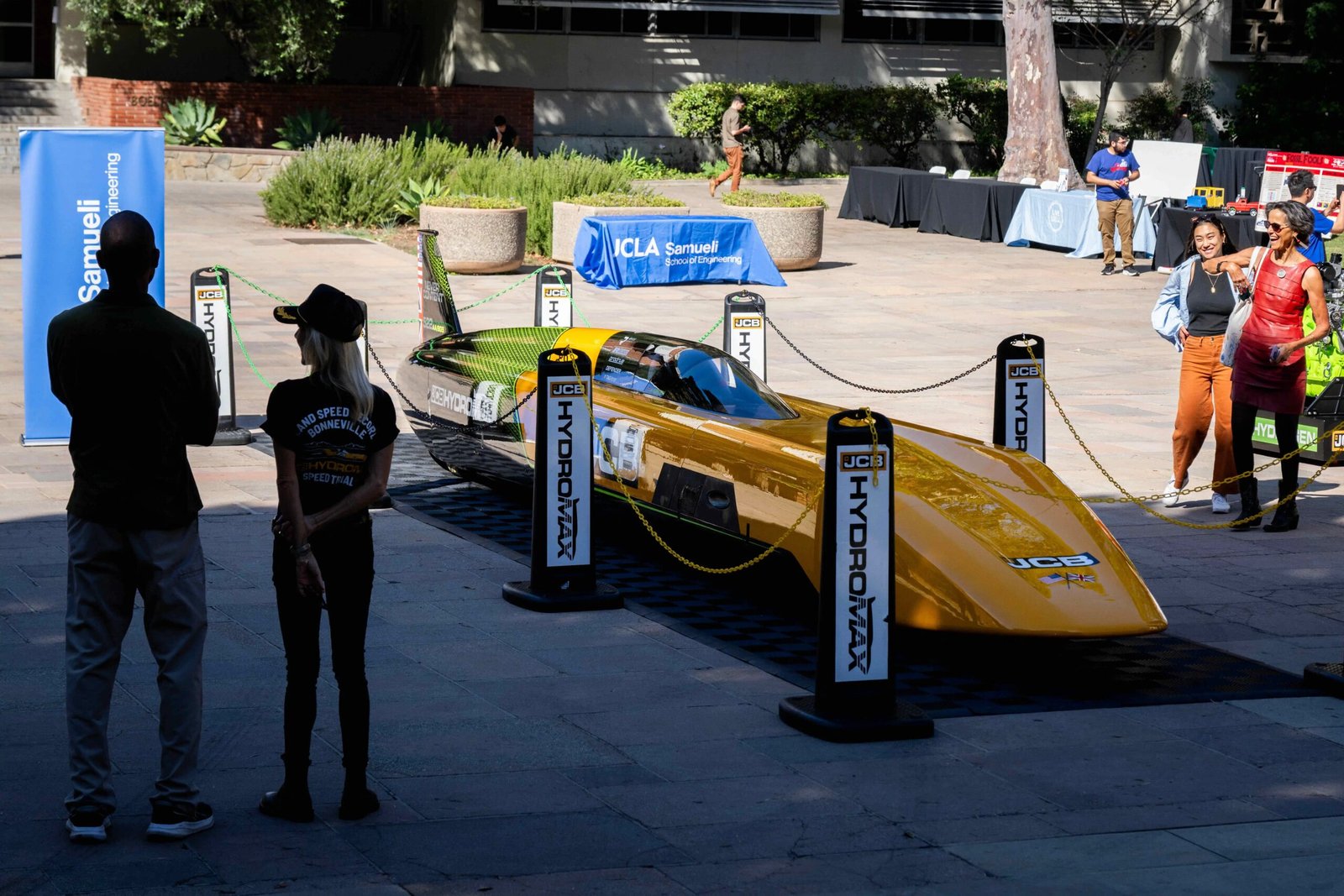
WESTWOOD — The future of sustainable transportation roared into the UCLA campus on Friday, Oct. 9, as the record-shattering JCB Hydromax race car made a special appearance for students and faculty. The sleek, 32-foot-long vehicle, which recently clocked an average speed of 406.32 mph at Utah’s Bonneville Salt Flats, served as the centerpiece for “The Hydrogen Frontier: Engineering a Clean Energy Future.”
The event, hosted by the UCLA Samueli School of Engineering and the Semel Healthy Campus Initiatives Center, aimed to highlight how hydrogen-powered technology could revolutionize industrial sectors and provide a viable path toward global decarbonization.
Developed by the British construction and agricultural giant JCB, the Hydromax represents the pinnacle of hydrogen internal combustion engineering. During its historic run on Aug. 11, the vehicle—piloted by former fighter pilot Andy Green—achieved two blistering passes of 400.623 mph and 412.135 mph. The car is powered by two of the company’s production-based hydrogen engines, which together churn out a massive 1,600 brake horsepower.
For the students of UCLA’s Bruin Racing Supermileage Team, the visit offered a rare, up-close look at the machinery they have spent their academic careers studying in theory. Members of the team spent the afternoon inspecting the Hydromax and exchanging technical insights with JCB’s engineers.
“Seeing the real-world application of high-performance hydrogen systems is incredibly motivating,” said one student attendee. “It bridges the gap between what we learn in our labs and the massive decarbonization goals the industry is chasing.”
The event went beyond speed records, however, diving deep into the infrastructure required to support a hydrogen-based economy. The program featured a panel discussion in the Mong Auditorium, where experts explored the intersection of climate technology, public health, and sustainable energy.
Participants included representatives from Mote, a climate-tech firm focused on converting biomass waste into biohydrogen while simultaneously capturing and storing carbon dioxide. The discussion also addressed the broader implications of these technologies, examining how improvements in environmental conditions—driven by cleaner energy sources—can positively impact food systems and human brain health.
The Court of Sciences provided a gallery for students to view the Hydromax alongside projects from other campus groups, including the American Institute of Chemical Engineers’ Chem-E-Car program.
JCB’s visit to Westwood marks a significant milestone in the company’s own 20-year journey toward carbon neutrality. Beyond its experimental land-speed record, the manufacturer has already begun integrating hydrogen technology into its fleet of heavy-duty agricultural tractors.
As the campus event concluded, the clear takeaway for the next generation of engineers was that the “Hydrogen Frontier” is no longer just a hypothetical concept—it is a high-speed reality, and it is gaining momentum.
Disclaimer: This content is auto-generated for informational purposes only.
Source: Read Original News