








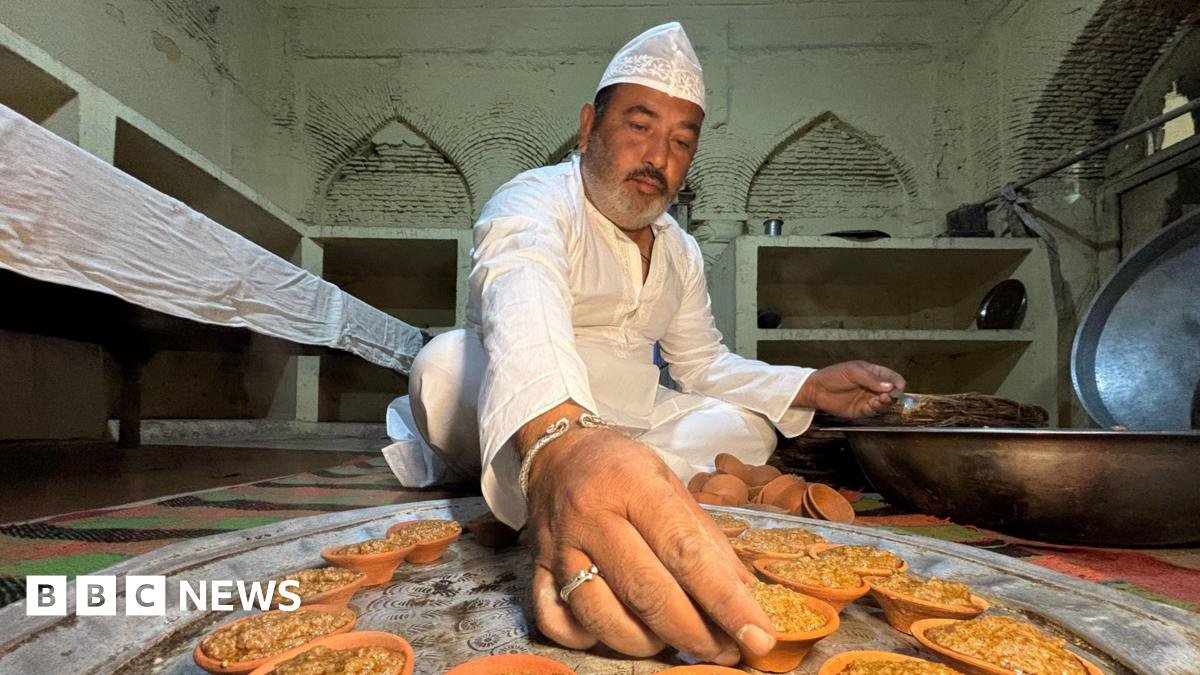
According to historians, in 1839, Muhammad Ali Shah gave 3.6m rupees – considered a vast sum in those days – to the East India Company, then a British trading enterprise, on the condition that it would be responsible for maintaining the monuments built by the Awadh nawabs, while the kitchen would continue to run on the interest earned from the fund.
After India became independent 1947, this money was transferred into a local bank.
Today, the kitchen is managed by the Hussainabad Trust – a state government-monitored body – which continues to use the interest to fund and manage the kitchen’s operations.
That legacy lives on in the meals still served here, prepared to the same standards laid down generations ago.
But step beyond the food and the building tells a different story.
The intricate patterns and iconic brick walls that once defined the kitchen have fallen into disrepair – plaster peeling from cracked walls and sections of the floor beginning to cave in.
It was this worrying decline that prompted a group of local residents to approach the Archaeological Survey of India (ASI), says Aftab Hussain, a superintending archaeologist.
The ASI began restoration work last October and hopes to complete the project by the end of March.
But the project is not just about saving a crumbling structure.
What makes this restoration stand out is its focus on returning the kitchen to exactly how it once was – from recreating its original lime-based mortar (a traditional binding material used to hold bricks together) to preserving intricate wall carvings, says archaeologist Hussain.
“We are using slaked lime as the base. It is soaked for a month and then mixed with the pulp of wood apples, black gram, natural gum found in India – called gond -jaggery and red brick dust,” Hussain says.
The workers have carefully recreated this indigenous mortar, once widely used in the Mughal era, but now largely replaced by cement in modern construction.
He adds that ‘lakhauri’ bricks – thin, burnt clay bricks typical of Awadhi architecture – are also being used to maintain the structure’s original form.