








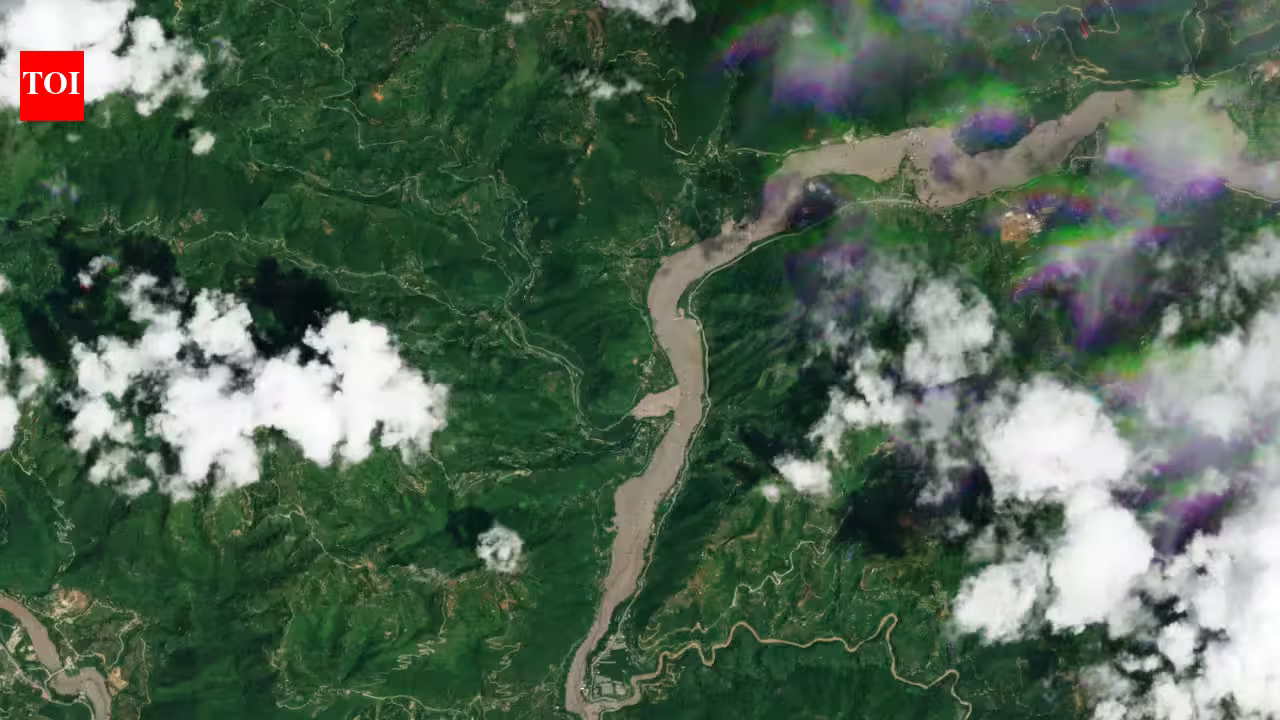
Catastrophic Glacier Collapse Sparks Deadly Flash Floods on Nepal-Tibet Border; Death Toll Exceeds 270
KATHMANDU – A massive environmental catastrophe has devastated the Nepal-Tibet border region following a gargantuan glacial collapse that triggered lethal flash floods across the Lhende Khola and Bhote Koshi river systems. As search and rescue operations enter a critical phase, the death toll has climbed past 270, with over 1,000 individuals—including a significant number of international tourists and pilgrims—still unaccounted for.
Among those reported missing are 178 Indian nationals, many of whom were traveling along the pilgrimage route toward Mount Kailash.
The Anatomy of the Disaster
The event, which occurred on August 26, 2026, was initially misidentified as a 4.4 magnitude earthquake by the US Geological Survey (USGS). However, follow-up analysis of seismic waves and high-resolution satellite imagery has since corrected the record. Experts now confirm that no tectonic activity took place; rather, a massive ice and rock mass sheared off a glacier at an altitude of approximately 5,200 meters.
The subsequent impact of this debris crashing into the valley floor created shockwaves so intense that they were recorded as a 5.2-magnitude-equivalent seismic event. Geomorphologist Daniel Shugar of the University of Calgary confirmed that the landslide displaced river water and formed a temporary, unstable debris dam. When this natural barrier failed, it unleashed a wall of mud, boulders, and water that decimated roads, bridges, hydropower infrastructure, and the vital Gyirong Port, a key commercial conduit between Tibet and Nepal.
A Region Under Siege
This disaster is the latest in a series of climate-linked catastrophes to strike the region. In July 2025, a devastating Bhote Koshi-based flood knocked out 8% of Nepal’s total electricity supply and destroyed the iconic “Friendship Bridge.”
Scientists warn that the Hindu Kush Himalayan (HKH) region is facing an existential crisis. The combination of extreme topographical gradients and the destabilization of glaciers due to rising global temperatures creates a “funnel effect,” where water and debris accelerate to destructive velocities with little to no warning for downstream communities.
Cross-Border Implications
The impact of the flood is not confined to the mountains of Rasuwa and Dhading. The affected river system feeds into the Trishuli and Narayani rivers, ultimately flowing into India as the Gandak. This hydrological link necessitated immediate flood alerts across the Indian states of Bihar and Uttar Pradesh.
For India, the disaster highlights the urgent need for robust, transboundary early-warning systems. With domestic experience managing similar risks—such as the 2023 South Lhonak Lake GLOF in Sikkim—New Delhi is under increasing pressure to coordinate more closely with regional partners on disaster mitigation.
“The tragedy serves as a grim reminder that the Himalayan ecosystem is increasingly volatile,” said a spokesperson for the National Disaster Risk Reduction and Management Authority (NDRRMA). As rescue teams struggle to navigate the debris-choked river valleys and difficult terrain, the international community is closely monitoring the recovery efforts in one of the world’s most vulnerable mountain corridors.
Quick Reference: Understanding the Hazard
- GLOF (Glacial Lake Outburst Flood): The sudden release of water from a lake formed by glacial melt, often held back by an unstable moraine dam.
- Glacial Collapse: As seen in this event, the physical breaking away of ice masses that strike river valleys, creating debris flows independently of lake outbursts.
- Why the confusion? The massive kinetic energy released when mountain-sized ice chunks strike the valley floor mimics the seismic signature of an earthquake, frequently leading to initial reporting errors in remote regions.