








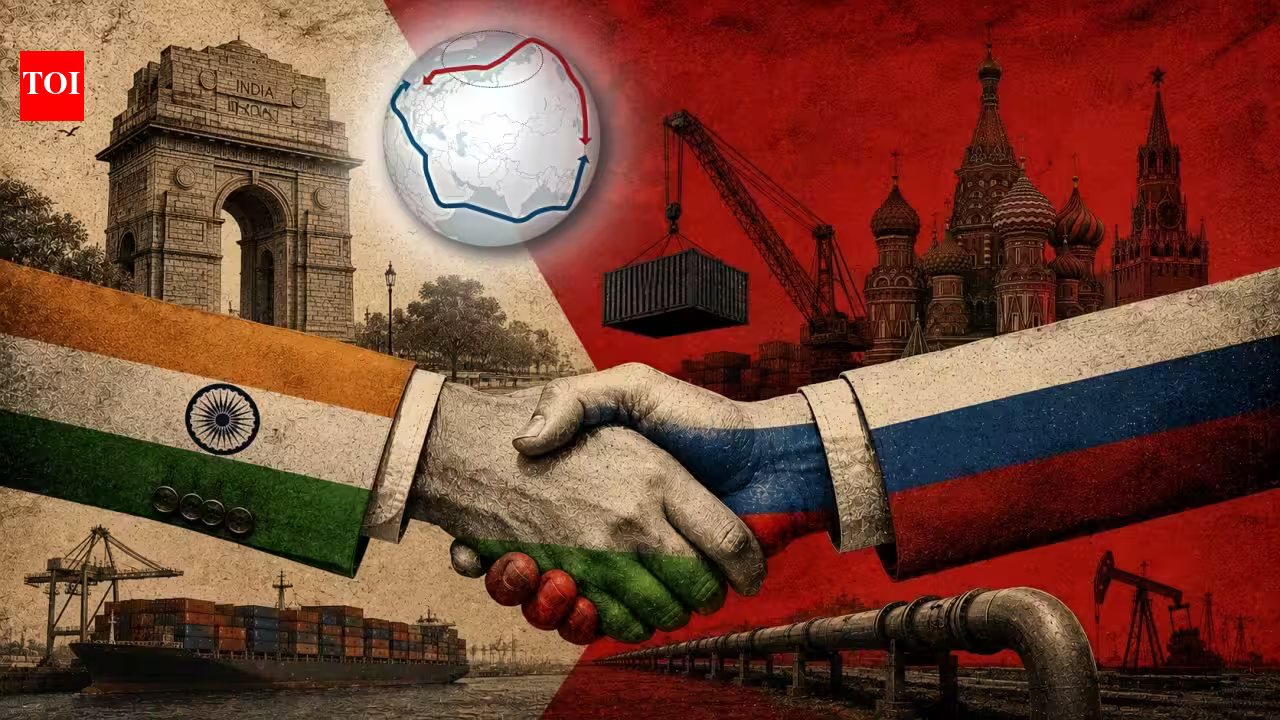
Beyond Suez: Why India and China are Pivoting Toward Russia’s Arctic Trade Route
As global trade faces unprecedented volatility—driven by geopolitical tensions, shifting tariff policies, and recurring disruptions in critical chokepoints like the Suez Canal and the Strait of Hormuz—major economies are scrambling to secure their supply chains. Amid this uncertainty, a frozen, 5,500-kilometer stretch along Russia’s northern coast is emerging as a critical alternative: the Northern Sea Route (NSR).
While China has already begun utilizing this Arctic shortcut to bypass traditional maritime hurdles, India is now preparing for a strategic entry, with plans to launch its first pilot cargo voyage through the route by 2027.
A Geopolitical Hedge
The lure of the NSR is simple: it offers a significant reduction in transit time and distance. For trade lanes connecting Asian ports to Northern Europe, the route can cut travel time by nearly 40% compared to the Suez Canal. However, as experts point out, the motivation is as much about risk mitigation as it is about efficiency.
With ongoing instability in the Middle East and the threat of sanctions looming over global shipping, the NSR provides a vital “third artery” for trade. For Russia, the route is a lifeline, allowing for the direct export of crude oil, liquefied natural gas (LNG), and rare minerals to Asian markets, effectively insulating these transactions from Western-led inspections or detentions.
China’s Lead and India’s Strategic Approach
China has moved aggressively to capitalize on the route, building on its “Polar Silk Road” ambitions. Russian state-owned nuclear firm Rosatom has already issued permits for Chinese vessels, and experts note that for China’s northern ports, the Arctic route is a game-changer, reducing the journey to the UK from 40 days to just 18.
India’s strategy, by contrast, is more nuanced. While the NSR is unlikely to replace the Suez Canal for the bulk of India-Europe trade—which requires high-frequency, year-round container services—it represents a key element in India’s broader “multi-corridor” trade architecture.
“India’s approach is shifting from strategic assessment to practical evaluation,” says Bhavik Vora, a partner at Grant Thornton Bharat. “The 2027 pilot project will allow us to assess the real-world economics of navigation support, insurance, and port infrastructure.”
The Reality Check: Can the Arctic Replace Suez?
Despite the fanfare, the Northern Sea Route faces significant structural hurdles that keep it from being a true substitute for the Suez Canal:
- Seasonality: The route is typically only navigable from July to September. Without massive, year-round ice-breaking capabilities, it cannot match the reliability of the Suez Canal.
- Operational Costs: Navigating the Arctic requires ice-strengthened vessels and expensive nuclear icebreaker escorts. When insurance premiums and navigation constraints are factored in, the “time-saving” advantage is often offset by higher overheads.
- Infrastructure Gaps: The NSR currently lacks the deep-water container ports and support infrastructure required to handle the volume of global liner traffic that currently moves through the Red Sea.
- Sanctions Risk: The limited pool of underwriters and vessels willing to operate in Russian Arctic waters adds a layer of complexity for international trade.
The Path Forward
For India, the NSR is currently best viewed as a strategic hedge. As Agneshwar Sen, Trade Policy Leader at EY India, notes, the route serves as a “complementary corridor” for energy and bulk commodities like coal, fertilizers, and minerals, rather than a replacement for general consumer goods.
As the world observes this high-latitude shift, one thing is clear: the race to secure alternative trade corridors is no longer just about cutting costs. It is about building a resilient, diversified architecture that can withstand the unpredictable tides of modern geopolitics. For now, the NSR remains a seasonal, high-stakes experiment, but as the ice thins and technology advances, it is fast becoming a permanent fixture in the strategic calculus of Asia’s largest powers.